Thursday, July 30, 2009

I can't get over how stupid this is

Apparently, Obama went for the red-blooded-American choice, a Bud Lite. Can you imagine the shitfit the far right would have had if he had chosen something even vaguely fancy, like Crowley's Blue Moon? Or a Red Stripe?

Ugh. I can feel my brain shriveling from all this. I'm stopping now.

Tuesday, July 28, 2009

ENFJ through and through


A while ago Harinder said this in comments:
...I do not agree that substituting reason with emotion is categorically irresponsible in matters of life and death. I think that kind of bold statement plays into the notion that reason is inherently superior/preferable/legit compared to emotion!
I just want to point out that this is so ENFJ:
Introverted Thinking is least apparent and most enigmatic in this type. In fact, it often appears only when summoned by Feeling. At times only in jest, but in earnest if need be, Thinking entertains as logical only those conclusions which support Feeling's values. Other scenarios can be shown invalid or at best significantly inferior. Such "Thinking in the service of Feeling" has the appearance of logic, but somehow it never quite adds up.

Introverted Thinking is frequently the focus of the spiritual quest of ENFJs. David's lengthiest psalm, 119, pays it homage. "Law," "precept," "commandment," "statute:" these essences of inner thinking are the mysteries of Deity for which this great Feeler's soul searched.
Of course, as a classic INTP, I take umbrage to this cavalier dismissal of reason:
Introverted Thinking strives to extract the essence of the Idea from various externals that express it. In the extreme, this conceptual essence wants no form or substance to verify its reality. Knowing the Truth is enough for INTPs....
In the end, it doesn't matter to me what your emotions are; you're gonna need a theory.

(Image: the 1781 edition of The Critique of Pure Reason, by Immanuel Kant. From Wikipedia)

Saturday, July 25, 2009

Yglesias bait

In the NYT, an article about the coming robot rebellion--a frequent theme in Matt Yglesias' blog. I'm sure he'll have some choice words to say about this tomorrow.

EDIT: This is Carlos bait, too:

The idea of an “intelligence explosion” in which smart machines would design even more intelligent machines was proposed by the mathematician I. J. Good in 1965. Later, in lectures and science fiction novels, the computer scientist Vernor Vinge popularized the notion of a moment when humans will create smarter-than-human machines, causing such rapid change that the “human era will be ended.” He called this shift the Singularity.


Bah. Fucking Singularity.

Must be a slow news day, because over in the Chronicle the front page headline was "Bay Area has had long love affair with the car". Has it now?

EDIT 2: And there you go.

Gatesgate reaches farce levels, so now I *have* to talk about it

I was looking forward to never saying a word about this ridiculous Henry Louis Gates business, but the absurdity of the situation has forced my hand: apparently, Obama has invited Gates and the cop to the White House to talk the whole thing out over some beers. You know, like the pat conclusion to some TGIF-lineup sitcom.


Meanwhile, healthcare reform hangs in the balance...

That's just Vinny being Vinny

A nice article about Vin Scully's call of Ramirez' grand slam the other day.

Monday, July 20, 2009

Scotch futures up


I've note approvingly that there seems to be an uptick in people's preference for Scotch lately. I had a poem about the stuff lying around, and so posted it to my silly blog. Enjoy.

(Photo by Deltasly)

Sunday, July 19, 2009

San Francisco's big mistake


In Who's Your City?, Richard Florida writes about some research that was done that looked into the question of whether there were similarities between biological organisms and cities in terms of resource consumption as a function of size:

[T]he researchers collected data from the United States, Europe, and China at a variety of times, and looked at a wide range of characteristics--things such as crime rates, disease transmission, demographics, infrastructure energy consumption, economic activity, and innovation. Sure enough, they found that

Social organizations, like biological organisms, consume energy and resources, depend on networks for the flow of information and materials, and produce artifacts and waste.... Cities manifest power-law scaling similar to the economy-of-scale relationships observed in biology: a doubling of population requires less than a doubling of certain resources. The material infrastructure that is analogous to biological transport networks--gas stations, lengths of electrical cable, miles of road surface--consistently exhibits sublinear [less than one] scaling with population.


This might all have been expected. But what the researchers had not expected to see was that the correlation between population growth and characteristics with little analogue to biology--such as innovation, patent activity, number of supercreative people, wages, and GDP--was greater than one. In other words, a doubling of population resulted in more than two times the creative and economic output. Unlike biological organisms, all of which slow down as they grow larger, cities become wealthier and more creative the bigger they get. They called this phenomenon "superlinear" scaling: "By almost any measure, the larger a city's population, the greater the innovation and wealth per person." This increased speed is itself a product of the clustering force, a key component of the productivity improvements generated by the concentration of talented people.
The theory is that the "clustering effect"--the phenomenon of talented, productive people interacting and networking with each other on a daily basis--is not just some side-benefit of lots of people living and working close together, but the principle driving force of economic growth all over the world. Hustle and bustle, in other words, generates a disproportionate amount of wealth and innovation.

If true, then this means that the general culture of San Francisco--which favors anti-growth, anti-competitive policies all in the name of "cultural preservation"--has been ruinous. I remember a while back that there were protests in the Mission against a high-rise condominium that was going to be built--on Valencia, I think--so as to preserve the "character" of the neighborhood. But this--the building of big condominiums--is precisely the kind of activity that leads to denser populations and increases the capacity of the city and--as the research shows--superlinearly increases the amount of wealth generated by the people here. That's money that not only is going to be spent here in the economy, but is also going to be taxed--and provide funding for city infrastructure, transit, and social services. It is not as if having half as many people in the neighborhood is going to result in half as much total wealth creation and innovation, with things on a per capita basis being roughly the same either way; this stifling of growth is screwing everyone over, on a per capita basis.

Here in San Francisco there is always this fear that the city will become "Manhattanized"--that it will turn into a giant unlivable, uncharming slab of concrete and steel. I've always thought this was bunk. First of all, Manhattan is awesome--and in my opinion, at least as livable as San Francisco, if not more so (if you need proof of this, go ahead and try to get from my apartment in the Mission to North Beach using public transit. Be sure to bring a book). Second, though I also take issue with San Francisco's unique tendency to illegalize things for no other reason than that they kind of suck (chain stores are routinely denied permission to set up shop in various neighborhoods--just yesterday on public TV I listened to a store owner from Hayes Valley plead with the city council to keep the chain stores relegated to Union Square and Fisherman's Wharf), there is no reason why we can't channel the extra revenue from growth into a positive subsidy for the things we want to keep around, rather than the current practice of a negatively enforced (via the prohibition of new buildings and stores) subsidy. In other words, rather than preventing the condo from being built or the Gap from setting up shop, use the extra revenue generated from being pro-growth to explicitly prop up the stuff you want to keep around (like boutique shops or revival theaters or whatever).

So anyway, it's just a real shame that there's this anti-growth culture here, because it's really bad for the city--in economic terms, the denial of growth results in a deadweight loss (especially since the growth comes not from the scaling up of preexisting activities, but the creation of entirely new firms, products, and services--even industries).

On something of a related note, I read an article in the East Bay Express recently making the case that you can't be an environmentalist if your anti-high-density growth--so if you're interested in Bay Area liberal hypocrisy, you're going to want to check that out.

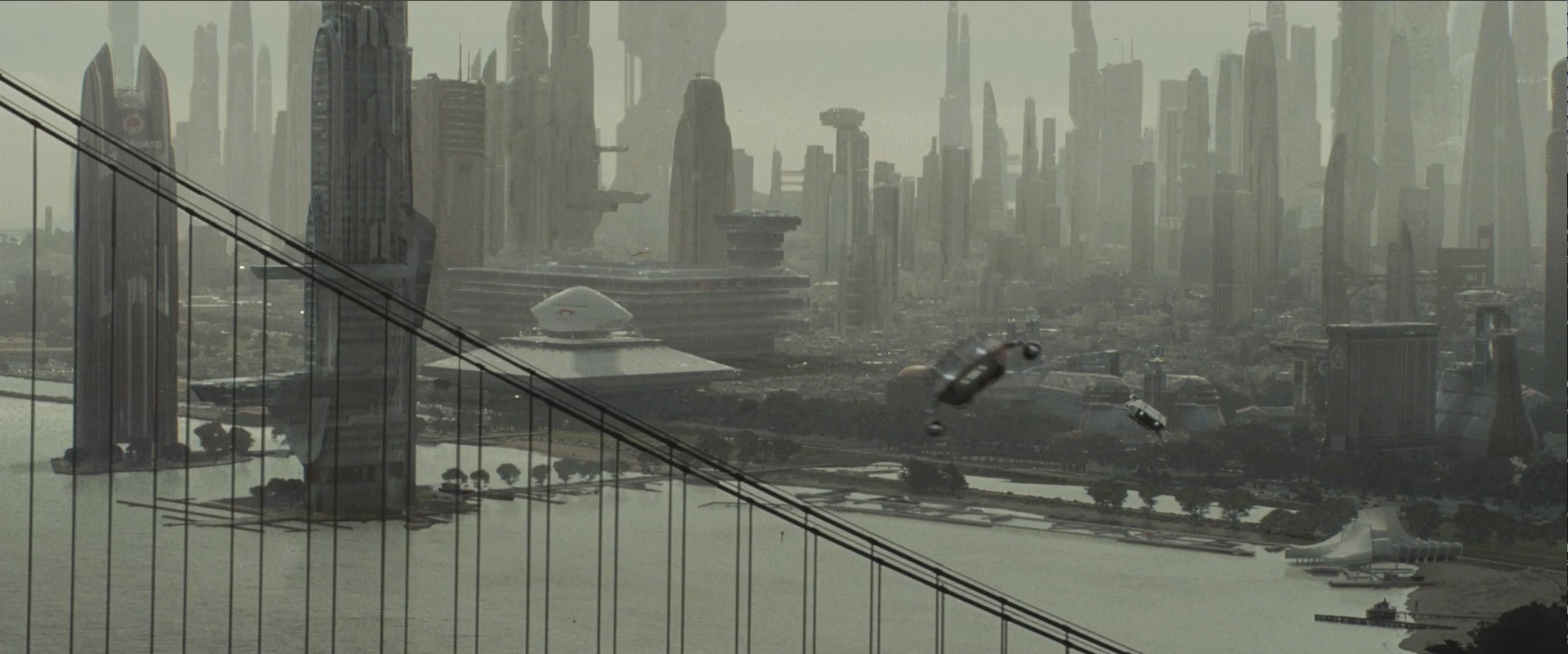
(Photo brashly stolen from the blog of one Peter Sciretta. It is a still of futuristic San Francisco from the recent Star Trek movie--clearly, in the Trek universe, the world pays izott its due heed.)

Pwning Friedman

The Juice-Box Mafia has always had it out for Thomas Friedman, and it's usually been pretty amusing. This kneecapping by Spencer Ackerman continues in that tradition.

Saturday, July 18, 2009

What Twitter needs

The internet is nothing if not a venue for complaint, so I will go ahead and do just that regarding Twitter:

There is no accounting for the frequency of tweets from people you follow. So you get a problem where frequent tweeters drown out the not-as-frequent tweeters, and you end up having to take into account tweet-frequency when you're deciding whether to follow someone. Which seems wrong.

What would be nice is if you had not one stream but two or more, where the frequency of tweets determines which stream you fall into (the high-frequency stream or a lower-frequency stream). That way you wouldn't get the drown-out problem.

Of course, I understand that Twitter is totally open so all it would take to implement this is for someone to make a website that does it. So I guess I'm saying: make it???

Quote

"Capitalism [is] the art of perfecting making someone else eat your costs." - Mike Rorty

A conservative gets real

Via Ezra Klein, a pretty good interview with Bruce Bartlett who has the too-rare distinction of being an intellectually honest and perfectly reasonable conservative. Here he is on the benefits of a VAT (value added tax):

I think the administration made a mistake approaching the funding of health-care reform how it did and I think Republicans made a mistake refusing to seriously debate the issue or its funding.

The value-added tax would be a very appropriate tax to use for this purpose. One reason is I am disturbed that we have a large percentage of the population that pay no income taxes. And I know many of those people pay payroll taxes. But income taxes fund the general government. According to a study by the Tax Policy Center, 47 percent pay no income tax, or have negative liability. And I think it's bad for democracy when people get into the position when a majority can vote benefits for themselves but not pay for it. And that should disturb liberals as much as conservatives.

The VAT would necessarily be a broad-based tax. It would be a way of getting people to pay for the benefits they themselves receive. People like Len Burman and Rahm Emmanuel's brother [Ezekiel Emmanuel, a health care adviser to Peter Orszag] have supported this for some time. Len argues that if people knew the VAT was dedicated to health-care reform, and the rate rose and fell automatically with the spending of the system, they would have an incentive to hold down taxes. They would have some positive reinforcement we do not now have with Medicare. I hope that's right. You know, every other major developed country has a VAT: The parties of the left in Europe made a deal a long time ago: If conservatives will let us have a welfare state, we'll fund it conservatively. And I think that's still a good deal.

He also makes a good point about how a VAT would give the government an additional tool to stimulate spending in a recession:

And thinking about this from another perspective, suppose we had a VAT right now and we wanted to stimulated consumption. Reducing the VAT rate temporarily would be a wonderful way to stimulate consumption. Suppose you had a 10 percent VAT and we said we weren't going to collect it for the next 10 months. People would buy like crazy. They'd buy toilet paper, they'd buy anything they could get their hands on that they knew they'd need in the future. We're depriving ourselves of a great stimulant tool by ignoring this.

I think I agree with a lot of this. Even if a VAT is regressive, realistically it's the only way you're going to get conservatives on board with funding a welfare state--and it's nice that it has other benefits too, like its ability to work as a stimulus tool, and the fact that it would properly align incentives with regard to keeping the costs of healthcare in check.

Moreover, just generally speaking, I think lots of people agree that at some point we're going to have to shift to a less demand-oriented economy (currently consumer spending accounts for 70% of GDP), so it makes sense to shift the tax burden away from income and more towards consumption.

On a separate point, I think this interview really brings into stark relief how damaging it is for the country that there is no intellectually honest opposition party that offers serious policy alternatives. I understand that conservatives don't want an expanded welfare state and that they view the obstruction of its expansion as a worthy cause, but at some point this behavior takes its toll on the ability of the government to operate: if you relentlessly increase spending while refusing to raise revenue in the long term, the federal government will eventually just stop working (see: California). That's an outcome nobody should want, regardless of ideology.

Friday, July 17, 2009

Richard Florida: Horrible Namer

I'm reading Who's Your City? by Richard Florida, which is all about how the world is increasingly forming itself into gigantic "mega-regions", such as the Boston-New York-Philadelphia corridor, or the Tokyo-Osaka region--and how these are shaping the world economy.

It's pretty interesting so far, but something that leaps out at me are the horrible names that Florida attaches to the regions he identifies--hyphenated abominations like Bos-Wash, Char-Lanta, Tor-Buff-chester, and--worst of all--Chi-Pitts. In fact, here is a list, in ascending order of horribleness, of all the mega-regions in the US:

  1. NorCal and SoCal - actual, real names. Good.
  2. Denver-Boulder - Straightforward; good.
  3. Phoenix-Tucson - Good.
  4. Cascadia - Um..sounds like a housing development, but, whatever: this will do just fine to describe the Portland-Seattle-Vancouver mega-region.
  5. So-Flo - Eesh. Borderline.
  6. Dal-Austin - Bad.
  7. Bos-Wash - Sounds like you're in such a hurry you don't have time to say complete words.
  8. Hou-Orleans - Very bad. An awful name.
  9. Char-Lanta - Wretched.
  10. Tor-Buff-chester - This set of phonemes would never naturally arise within a population of humans. Horrible.
  11. Chi-Pitts - We are left to presume that Richard Florida has a thing against the good people of Chicago and Pittsburgh. This name is absolutely horrible. Message to Richard Florida: generally speaking, people don't want the name of their mega-region to conjure up images of someone spraying chai tea into their armpits.
Let's all agree as a society to never let Richard Florida within spitting distance of any sort of official naming committee.

I love Macs; but I hate Apple


Gah. The following is so typical:

I had some files that I wanted to cut and paste--i.e., move--from one directory to another. Only, for some reason Mac OS doesn't let you use cmd-X on a file--nor can you select "cut" in the right-click menu. Sensing that maybe I was missing something, I checked the internets to figure out how to do this.

Well, it turns out that you can't do it--the only way to execute a move (cut-and-paste) on a file is via drag-and-drop. A slightly annoying design flaw, sure, but at the end of the day, not a huge deal: I still like my Mac.

Of course, none of the god-awful Apple fanboys can admit that there is actually a design flaw in the Mac OS:
robbieduncan
Feb 28, 2006, 02:50 PM
You cannot cut and paste a file. It simply does not work this way. If you want to move a file then move it. Cut and paste is not move. What happens if you forget to paste? Lost file.

Ugh. I hate this. Hate hate hate. In Windows, when you do ctrl-X on a file, it doesn't commit to the cut until you successfully paste the file. There is no possibility of a "lost file". And, really, when you think about it, drag-and-drop works the same way, only with a different UI: if the computer were to shut down while you were dragging a file, the file wouldn't be lost. Nobody in their right mind would implement any kind of file move (aka cut-and-paste) command that optimistically deletes the file before it is successfully copied to the target location. "Cut and paste is not move"??!?! YES IT IS! IT'S THE SAME GODDAMN THING, EXCEPT YOU PUSH BUTTONS INSTEAD OF MOVING A MOUSE!

(David's head explodes, then inexplicably morphs back together T-1000 style. He pauses for a moment, takes a breath, and continues.)

What we have here is a good old-fashioned case of Mac OS not having a common-sense feature for no good reason at all.

And, you know, like I said, that's okay: it happens. But I just can't stand how these people in these forums unthinkingly assume that there is some well-thought-out rationale for every little idiosyncratic behavior on the Mac OS. It makes me want to punch guys like robbieduncan in the face 100 times--forever.

Hear that, robbieduncan? I punch you in the face 100 times! Forever!

(Photo by Mitmensch0812)

Wednesday, July 15, 2009

And now for something completely different

In an effort to return to where my bloggy competitive advantage lies, I've got a Duffer post up. Learn it. Live it. Etc.

Congress created the unpersons


Paul Krugman wonders why those who were in favor of a bigger stimulus package were considered "out of the mainstream" and left on the fringes of the debate:

One of the mysteries of the way issues are covered in much of the news media is how certain views get ruled “out of the mainstream” and just don’t get covered — even when many well-informed people hold those views.

...

...[T]he voices calling for stronger stimulus are, may I say, sorta kinda respectable — several Nobelists in the bunch, plus a large fraction of the prominent economists who predicted the housing crash before it happened.

But somehow, the pro-stimulus people are unpersons. Who makes these decisions?

I think this can pretty easily be explained by the fact that Democrats didn't do a good job of framing the debate.

The thing is, the mainstream media is not only very worried about keeping a nonpartisan reputation, but also very intellectually lazy. Thus, when an issue like the simulus package comes up, they wait and see what the Republicans propose and what the Democrats propose, and use those proposals as the right and left goalposts for the debate. Anything outside the goalposts counts as "fringe".

If the Democrats had boldly demanded say $1.8 trillion in stimulus, then this would have been seen as a "legitimate" (albeit very liberal) position, and Krugman and his ilk would be welcomed into the fold as representatives of the "respectable left". But as it happened, the Democrats misjudged and decided to lowball the figure (expecting it to go up), proposing under a trillion dollars of stimulus. The debate thus ended up being framed between those who wanted just under a trillion in stimulus versus those who wanted less (or none).

And, as others have pointed out, this same thing happened with healthcare reform: the Democrats didn't seriously propose a single-payer plan. Although obviously this never would have passed, it still would have set the left goalpost further out, giving Obama's public option plan some centrist cover. As it is, the public option is now framed as the most liberal plan on the table, which the mainstream media is unlikely to embrace.

(Photo "Goalposts-2" by huvisian)