I was really excited to discover today that San Francisco is implementing a plan to build an integrated system of "smart parking meters" that will be able to track parking capacity in real time, and also adjust prices depending on parking demand. So not only will you be able to see online how many and which parking spaces are available, but higher prices in peak periods will ensure that there is always parking spaces readily available (and in slow periods, lower prices will ensure that parking capacity is being used efficiently).
The program is in the pilot phase right now, and will come online in a few neighborhoods around the city this summer (including the Mission, between 16th and 24th).
Generally speaking I'm in favor of any and all policies that do something to set a proper price on driving--whether that means a carbon tax, tolls, market-priced parking, etc. So long as we continue to subsidize driving by offering cheap gas, free roads, and free parking (including the government mandated building of parking structures and parking lots), we'll be stuck in sprawling, trafficky cities that don't work very well. Setting a price on these scarce goods--parking space, road space, etc.--will change people's behavior, encouraging more carpooling, more public transit usage, more biking, and more off-peak usage of the city's roads.
Or at least, so the theory goes. It will be interesting to see what the data from the pilot program ends up telling us.
Showing posts with label city planning. Show all posts
Showing posts with label city planning. Show all posts
Monday, June 21, 2010

Wednesday, March 10, 2010
Bike news
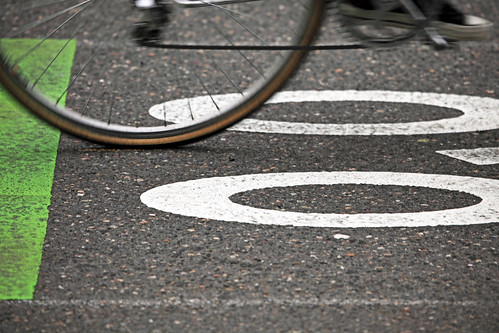
Item 1: You've probably already heard this, but Google maps now has bicycle directions that take into account hills, bike paths, avoiding busy streets, etc. It doesn't work too well yet, though--for example, to get to work, it suggested a zigzag path down Ceasar Chavez, up Harrison, cutting across 22nd to Potrero, then on up to the Division/Townsend roundabout. But that's nutty! Caesar Chavez is a horrible and dangerous street to bike on, and you end up going right through an unnecessary hill. Which brings me to my second item.
Item 2: It turns out there's plans in the works to totally redo Caesar Chavez into a bikable, walkable, green non-hellscape! Currently there's 8 lanes: one parking lane on each side, and six traffic lanes in the middle (3 in each direction). The renovation will keep the parking lanes but add bike lanes and a 14-foot median strip with trees, leaving 4 total lanes for traffic. Once done, it will make that street look about a thousand times nicer.
Of course, if I had my druthers, if they're going to make the street walkable I'd also like to see more commercial frontage, especially since it's still in walking distance from BART (though just barely). It'd be great to see it take on more of a 24th St. character. But all in due time, I guess.
(Photo by Ian Sane)
Sunday, July 19, 2009
San Francisco's big mistake
In Who's Your City?, Richard Florida writes about some research that was done that looked into the question of whether there were similarities between biological organisms and cities in terms of resource consumption as a function of size:
[T]he researchers collected data from the United States, Europe, and China at a variety of times, and looked at a wide range of characteristics--things such as crime rates, disease transmission, demographics, infrastructure energy consumption, economic activity, and innovation. Sure enough, they found thatThe theory is that the "clustering effect"--the phenomenon of talented, productive people interacting and networking with each other on a daily basis--is not just some side-benefit of lots of people living and working close together, but the principle driving force of economic growth all over the world. Hustle and bustle, in other words, generates a disproportionate amount of wealth and innovation.Social organizations, like biological organisms, consume energy and resources, depend on networks for the flow of information and materials, and produce artifacts and waste.... Cities manifest power-law scaling similar to the economy-of-scale relationships observed in biology: a doubling of population requires less than a doubling of certain resources. The material infrastructure that is analogous to biological transport networks--gas stations, lengths of electrical cable, miles of road surface--consistently exhibits sublinear [less than one] scaling with population.
This might all have been expected. But what the researchers had not expected to see was that the correlation between population growth and characteristics with little analogue to biology--such as innovation, patent activity, number of supercreative people, wages, and GDP--was greater than one. In other words, a doubling of population resulted in more than two times the creative and economic output. Unlike biological organisms, all of which slow down as they grow larger, cities become wealthier and more creative the bigger they get. They called this phenomenon "superlinear" scaling: "By almost any measure, the larger a city's population, the greater the innovation and wealth per person." This increased speed is itself a product of the clustering force, a key component of the productivity improvements generated by the concentration of talented people.
If true, then this means that the general culture of San Francisco--which favors anti-growth, anti-competitive policies all in the name of "cultural preservation"--has been ruinous. I remember a while back that there were protests in the Mission against a high-rise condominium that was going to be built--on Valencia, I think--so as to preserve the "character" of the neighborhood. But this--the building of big condominiums--is precisely the kind of activity that leads to denser populations and increases the capacity of the city and--as the research shows--superlinearly increases the amount of wealth generated by the people here. That's money that not only is going to be spent here in the economy, but is also going to be taxed--and provide funding for city infrastructure, transit, and social services. It is not as if having half as many people in the neighborhood is going to result in half as much total wealth creation and innovation, with things on a per capita basis being roughly the same either way; this stifling of growth is screwing everyone over, on a per capita basis.
Here in San Francisco there is always this fear that the city will become "Manhattanized"--that it will turn into a giant unlivable, uncharming slab of concrete and steel. I've always thought this was bunk. First of all, Manhattan is awesome--and in my opinion, at least as livable as San Francisco, if not more so (if you need proof of this, go ahead and try to get from my apartment in the Mission to North Beach using public transit. Be sure to bring a book). Second, though I also take issue with San Francisco's unique tendency to illegalize things for no other reason than that they kind of suck (chain stores are routinely denied permission to set up shop in various neighborhoods--just yesterday on public TV I listened to a store owner from Hayes Valley plead with the city council to keep the chain stores relegated to Union Square and Fisherman's Wharf), there is no reason why we can't channel the extra revenue from growth into a positive subsidy for the things we want to keep around, rather than the current practice of a negatively enforced (via the prohibition of new buildings and stores) subsidy. In other words, rather than preventing the condo from being built or the Gap from setting up shop, use the extra revenue generated from being pro-growth to explicitly prop up the stuff you want to keep around (like boutique shops or revival theaters or whatever).
So anyway, it's just a real shame that there's this anti-growth culture here, because it's really bad for the city--in economic terms, the denial of growth results in a deadweight loss (especially since the growth comes not from the scaling up of preexisting activities, but the creation of entirely new firms, products, and services--even industries).
On something of a related note, I read an article in the East Bay Express recently making the case that you can't be an environmentalist if your anti-high-density growth--so if you're interested in Bay Area liberal hypocrisy, you're going to want to check that out.
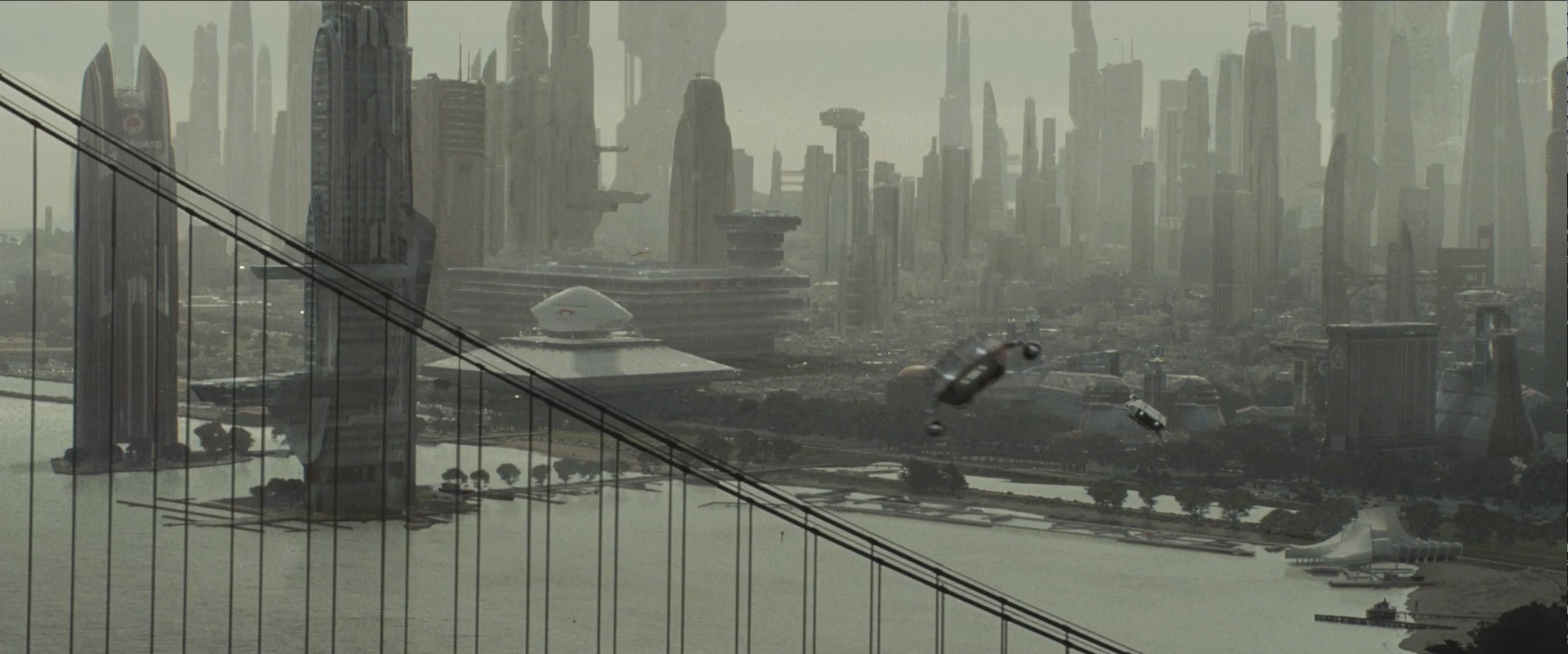
(Photo brashly stolen from the blog of one Peter Sciretta. It is a still of futuristic San Francisco from the recent Star Trek movie--clearly, in the Trek universe, the world pays izott its due heed.)
Subscribe to:
Posts (Atom)