To me, one of the best measures of wealth is the percentage of one's income that is spent on food. If you check out this map, you'll see that the wealthy spend down around 10% of their income on food, whereas those in poverty spend up to 50%.
This is also a good way to intuitively grasp the dramatic increase in total worldwide wealth since the industrial revolution. I tried finding looking for some historical data for this but my Google-fu wasn't strong enough. If I find something though I'll post it.
Showing posts with label economics. Show all posts
Showing posts with label economics. Show all posts
Monday, August 15, 2011

Sunday, August 14, 2011
Is a perfect investor possible?
 The previous post made me think of an idea I've had for a while that isn't really fully formed, which is: is it possible for there to be a "perfect" investor, or is there some formal/logical reason why such perfection would be self-defeating?
On the face of it, it would seem that the presence of a perfect investor would break the market. For normally when we make an investment, it's based on some empirical fact about what we're investing in--that the company is profitable, or that the currency will be devalued, or a trade agreement will be signed, whatever. But suppose God were an investor, and invested in X. In this case, I would also invest in X, not because of anything having to do with X, but simply because God invested in it and I know that God can do no wrong in the market. What's more, all other investors would think the same way, and also make the same investment. At this point, market behavior would become detached from empirical reality, and a prolonged (infinite?) period of irrational exuberance for X would follow.
Of course, one way out would be to simply point out that a truly perfect investor would strive to keep the fact of his perfection a secret by deliberately losing money on investments from time to time. Specifically, the investor could only continue to win so long as his success itself did not become the basis for other players' decision making. In such a scenario, whatever empirical data being collected by the perfect investment algorithm would cease to be relevant, because a new theory--that generates some other set of empirical data--would now be regulating investor decisions. (In this case, the "new empirical data" would be what investment choices the perfect investor is making. The new theory would be, "whatever the perfect investor invests in is a good investment". In the short term, switching to this new theory would not hurt the perfect investor--everyone would continue to invest in X. But eventually the pattern would have to collapse, for the same reason that pyramid schemes always collapse: at some point, you run out of new investors in X--and besides, there would undoubtedly be bizarre and disastrous global effects of so much wealth accumulating to one arbitrary investment.)
How humans use cognitive salience to guide mutually recursive decision making
 Try the following experiment:
In a classroom, give every student a slip of paper. The challenge is that they must devise a way to all meet each other at some location in France at some time during some arbitrary day in the future, say October 14 2012--only they are not allowed to communicate with each other. Each student must write down what is essentially a guess on the slip of paper, completely incommunicado.
As you can probably guess, the students are for the most part successful: most will write down "Eiffel Tower, noon" on their slip of paper.
What happens, of course, is that each student goes through a process of mutually recursive decision making: the student must guess what the others will guess, knowing that those students' guesses are dependent on his own, and so on ad infinitum. Realizing that the guess will be hopelessly arbitrary, the student supposes that, all things being equal, he would meet the others at the most canonical place and the most canonical time of day. But, knowing that the others will also gravitate to this same canonical time and place, the student can now know with some certainty that they will choose the same time and location. And so it is the very rational arbitrariness of the decision that reveals the particular salience of one time and place (in this case, Eiffel Tower at noon). This salience is then used as an empirical datapoint to rationally arrive at a now-suddenly-non-arbitrary choice, "Eiffel tower at noon".
My thinking is that this process is precisely the same one that governs markets. Stock price, for example, though naively a reflection of the "value of a company", is strictly speaking a reflection of other investors' demand for the stock. But since all investors are using the same decision function, and the function takes as its inputs the decisions of all other investors, rational decision making stalls on an infinite regress, rendering the decision arbitrary. But the arbitrariness of the decision, now placing all choices on an equal footing, reveals that some choices are more salient than others--in particular, the ones that correspond to the "naive" understanding of stock price as a reflection of the "value of a company". Because if all theories are equally arbitrary, what other theory would everyone pick? Surely, they will pick the naive theory, since that is the most salient one--because canonically, one buys the stock of a company that is doing well.
However, if there is no most-salient theory to fall back on when the initial mutually recursive decision process fails in infinite regress, then chaotic instability ensues, and bubbles and sell-offs will non-linearly continue until a sufficiently salient theory once again takes hold, and investors bind their decisions once again to independent empirical data. (Note that it is entirely possible that the chaotic movements of the stock will themselves form the basis of a new theory about the company--for example, if the stock chaotically plummets in a sell-off, this will be interpreted as an "adjustment" in response to "new information" that reveals that the company was "overvalued". But if the stock had chaotically risen in a bubble, the community might just as easily have interpreted this as "renewed investor confidence" and selected some good news about the company to use as cognitively plausible "evidence" for the company's good prospects.)
Given all this, you have to wonder how it is that computers can model the movements in financial markets. Unless your algorithm somehow is able to take into account the salience of various explanatory theories, you cannot make headway into the problem, unless you already assume some empirical theory, and use the empirical data from the theory as inputs for the computer program. But even with this, it would be the human's task to monitor the investor zeitgeist to determine when it shifts to a different most-salient theory, or when there is a theory vacuum and the market goes into chaotic instability.
This whole post was instigated, by the way, by a blog post by Zachary Karabell, where he concludes:
That is where trust becomes even more essential: we have to know that executives are behaving responsibly, in their own self-interest, and that regulators are ensuring that leverage isn’t excessive and capital is. We have to believe that ratings agencies are diligent in affirming strength, especially if we then give them credence when they announce weakness à la downgrading the United States. And we have to imagine that the media report things that have a tangible relationship to something called the truth. But we do not live in that world, and that is a headwind pushing against currents of balance, growth, and repair.
Here, I take him to be saying, in so many words, that the most-salient theories need to be reinforced credibly by institutions if we are to avoid the dreaded state of theory-less chaotic instability in the markets. However, I wonder if what he advises next makes sense:
In that world of trust deficit, we’d do well to repeat the following mantra: just because it happened last time doesn’t mean it is happening again. Being skeptical is healthy; being cynical, not so much. And the only way to judge the present is on the present, not on false application of the lessons of the past, and not on irrational fears of what the future might hold.
My problem with what he says here is that he seems to be placing the blame--or at least, expecting the fix to come entirely from--the investors who have lost "trust" in the prevailing salient theories, rather than the institutions that are charged with instilling and maintaining trust in the theories. It's hardly "irrational" of investors to withdraw from the market when suddenly there's a chance the US Government will stop paying its bills and the German government is mulling over whether it should just let Greece, Ireland, and Spain default on huge amounts of government debt--these remarkable and historical economic events threaten to bring into being a "new normal" that wipes away the old, long-agreed upon most-salient theories
that kept the markets from spiraling off into non-linear chaos.
In light of this, I would think the right "call to action" is to get Wall Street and the rest of the financial world to put extreme political pressure on the US and German governments to guarantee government debt and double-down on the prevailing global financial world order.
Thursday, August 11, 2011
The high cost of dysfunctional government

As Yglesias points out, 5 year, 7 year, and 10 year US Treasuries have such low rates that their real interest rates (that is, the interest rate after inflation is taken into account) is negative.* Which means that the US government is in a better position than someone who can borrow money for free; investors are actually paying the US government to borrow their money.
This means that, at a minimum, the US can borrow a bunch of money and just let it sit there, and that would be better than not borrowing any money. But more reasonably, it means that for any expenditure that we know must take place within the next 10 years, it makes sense to pay for it now rather than later (if possible).
The most obvious category of spending that presents itself is infrastructure. Over the next decade, we know we're going to have to build new schools and hospitals and upgrade old ones; expand airport capacity and update our air traffic control systems; repave roads and replace old pipe and sewer systems; build new highways and bridges; dig new tunnels; retrofit a lot of old buildings; expand existing rail and other mass transit; improve energy efficiency to eliminate dead-weight loss, for example by painting roofs of buildings white; etc. So there's a lot of work to be done. But there are three reasons why infrastructure spending now is a particularly good idea:
- We know with certainty that the work must be done over the next decade anyway
- Much of the work is done by state and city governments, and so federal dollars would be providing a timely boost to ailing state and city budgets
- These projects will efficiently stimulate overall demand because they will mobilize the huge amount of idle labor in the construction sector, which was hit hardest by the bursting of the real estate bubble; so there is no danger of inefficient "crowding out"**
* Say I borrow money from you at 5%. I repay you in a year--but money by then has become 5% less valuable, due to inflation. So in real (as opposed to nominal) terms, I paid 0% interest. So inflation works as a discount on borrowing money.
** In a recession, by definition, there are a bunch of idle resources in the country--perfectly good employees and machines, but no demand that puts them to work. So the way to end a recession is to increase demand so that idle resources are mobilized into productive action. One way to do that is to encourage the private sector (companies and consumers) to spend money, for example by making it cheaper to borrow money (lowering interest rates), increasing the money supply (increasing inflation, which as discussed in * has the effect of lowering real interest rates), or just giving people extra cash and hoping they spend it (tax breaks). But if that doesn't work, the federal government can just employ the idle resources directly by spending a bunch of money, say on new bridges or F-18 jets or something (stimulus). However, what happens when the government spends a bunch of money in non-recessionary times, when there are not a bunch of idle resources? Well, in the case of construction say, the government would be bidding with private entities (companies and consumers) for the scarce supply of construction labor. The government would end up bidding up the price, thus pricing out of the market a bunch of private companies and consumers--in other words, "crowding them out". Crowding out might be bad if you think the government doesn't do things as efficiently as private entities do; but this concern is moot if no crowding out is happening, which is precisely the case when the government hires labor that would have been idle anyway.
Thursday, February 18, 2010
Government stimulus impossible?
I usually try to stay away from The Corner, but this (via Yglesias) strikes me as pretty egregious:
This, in a word, is bullshit. The concept of "borrowing money out of the economy" is a non-sequitor--if anything, money is borrowed into the economy, in the sense that every dollar borrowed is a dollar spent (in other words, people don't borrow money just to stuff it under a mattress--they borrow money with something to buy in mind, like a house, car, etc.).
In fact, normally the main mechanism by which the economy is regulated is by manipulating the amount of borrowing going on. This is accomplished by the Federal Reserve, which has its finger on the interest rate--lowering the rate makes borrowing cheaper, and so more borrowing--and therefore more spending--takes place. And more spending==increased demand==stimulus (these are just semantically equivalent terms).
The problem these days is that the Federal Reserve can no longer increase demand amongst the private sector by lowering the interest rate because the interest rate is already at zero (or near zero--I think it's like 0.25% or something). And so the federal government has stepped in to shoulder the burden, borrowing--and spending--hundreds of billions of dollars on its own. I have a feeling Riedl wants to say something like, "yes, but this demand is canceled out by the fact that the money will have to be repaid later via taxes", but this is no different in principle than the fact that the car or house-buying private citizen needs to eventually repay the loan that was taken out. Obligation to pay down debt later doesn't negate the fact of money being spent now, whether you're talking about a private individual, a company, the government, or whatever.
The idea that government spending creates jobs makes sense only if you never ask where the government got the money. It didn’t fall from the sky. The only way Congress can inject spending into the economy is by first taxing or borrowing it out of the economy. No new demand is created; it’s a zero-sum transfer of existing demand.
This, in a word, is bullshit. The concept of "borrowing money out of the economy" is a non-sequitor--if anything, money is borrowed into the economy, in the sense that every dollar borrowed is a dollar spent (in other words, people don't borrow money just to stuff it under a mattress--they borrow money with something to buy in mind, like a house, car, etc.).
In fact, normally the main mechanism by which the economy is regulated is by manipulating the amount of borrowing going on. This is accomplished by the Federal Reserve, which has its finger on the interest rate--lowering the rate makes borrowing cheaper, and so more borrowing--and therefore more spending--takes place. And more spending==increased demand==stimulus (these are just semantically equivalent terms).
The problem these days is that the Federal Reserve can no longer increase demand amongst the private sector by lowering the interest rate because the interest rate is already at zero (or near zero--I think it's like 0.25% or something). And so the federal government has stepped in to shoulder the burden, borrowing--and spending--hundreds of billions of dollars on its own. I have a feeling Riedl wants to say something like, "yes, but this demand is canceled out by the fact that the money will have to be repaid later via taxes", but this is no different in principle than the fact that the car or house-buying private citizen needs to eventually repay the loan that was taken out. Obligation to pay down debt later doesn't negate the fact of money being spent now, whether you're talking about a private individual, a company, the government, or whatever.
Monday, December 14, 2009
Not batshit, but then, not really serious either
 I got momentarily excited by Conor Friedersdorf's insistence that I read one Jim Manzi's "manifesto of sorts" that lays out a "framework for understanding the challenges that America faces". I was promised that his would be a "serious voice" that moves us beyond "bromides about liberty and tyranny" that you typically hear from the right these days.
Anyway, I read the thing, and was unimpressed. Far too high-level and vague to be of any use to anyone, it strikes me more as a formulation of right-wing conventional wisdom and political narrative than any real attempt to deal with substantive issues or engage the opposition in an intellectually honest way. He passes comment on things like the bailout of Wall Street and the nationalization of GM without any sort of discussion of what the consequences would have been if those actions had not been taken; he pooh-poohs cap-and-trade as "economically extravagant" (which is something of a non sequitor, I might add) without addressing the costs of not regulating carbon output; he utterly fails to address military spending as a component of the government's precarious long-term financial position; he urges the repeal of fiscal stimulus without offering an alternative approach to alleviating America's 10% unemployment rate; he offers no way forward on health care reform.
If his goal with this essay was to engage in a productive way on any of these fronts, I'd say he failed. If you're going to dismiss cap-and-trade, for example, you have to at least address why you think it's a bad policy--whether that means a critique of the way the policy will be implemented, or empirical skepticism about the dangers of global warming, or whatever. But Manzi offers no such arguments; just blank, high-level assertions that seemed to be backed by nothing other than implicit conservative conventional wisdom.
In any case, here are a few specific things that I think Manzi either mischaracterizes or doesn't address:
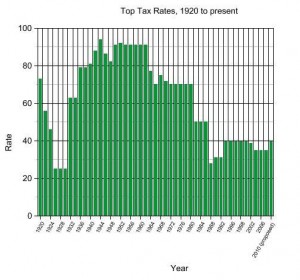
- He mainly frames America's politics as a tension between Great Society liberal welfare statism and Reagan-era economic deregulation, but I think this picture is no longer accurate today. In the first place, it's not the case that today's liberals are fighting to undo the Reagan revolution: Reagan won that war, and liberals conceded long ago. To see this, just check out what marginal tax rates were like before and after Reagan took office:
During the Great Society era top marginal rates were up around 80%; by the time Reagan took office they had already been coming down quite a bit, but part of Reagan's legacy is that that level of taxation is permanently off the table. Of course, taxation is more than just the top marginal income tax bracket--but I find this to be a useful barometer for the overall level of taxation a population is willing to bear. Keep in mind that accompanying this were decreases in the capital gains tax and, at the state levels, significant rolling back of property taxes, following the Prop. 13 "tax revolt" in California. No serious liberals today propose we fully reverse these cuts and return to Great Society levels of taxation, and even the mainstream Democratic establishment favors pro-market policies such as free trade and economic incentives such as cap-and-trade rather than direct government regulation and intervention. We live in a supply-side America.
Secondly, not only is the conflict that Manzi sets up already resolved, but he misses the crucial point that the fiscal sins that have occurred since Reagan have been largely perpetrated by the Republican party and (too many) centrist Democrats. I don't want to make this too partisan a point, so maybe I'll just say this: since Clinton took office, we've seen the California-fication of the federal government, where de facto supermajority requirements in Congress--the Senate specifically--make it impossible to implement tough decisions (like increasing taxes or cutting entitlements), and yet still allow politically popular spending initiatives to go through (like Medicare Part D and the Bush tax cut). By the time the financial crisis hit, and Bush was forced to pass a stimulus bill and a Wall Steet bailout (yes, Bush did both those things; Obama then passed a second, far larger stimulus bill), the US found itself badly overextended, and with mounting health care costs to boot.
So the narrative is not Great Society social cohesian vs. Reagan supply side economics forever dueling for our national soul; it's more like, Reagan wins, then the Republicans totally lose their bearings and abandon conservative fiscal principles while in power, and then meanwhile leverage an increasingly disfunctional Senate to obstruct any Democratic reforms from coming through. - Manzi shows here he doesn't understand the rationale for stimulus spending:
Only about 5% of the money appropriated is intended to fund things like roads and bridges. The legislation is instead dominated by outright social spending: increases in food-stamp benefits and unemployment benefits; various direct and special-purpose spending relabeled as tax credits for renewable-energy programs; increased funding for the Department of Health and Human Services; and increased school-based financial assistance, housing assistance, and other direct benefits.
The point of stimulus spending is to increase overall demand in the economy. You can do this by building roads and bridges, yes, but you can do it just as well by, say, lining the pockets of a poor person with some cash that he will be certain to spend in the near future (like, say, on food). What matters is the stimulative effect of the spending, not on whether the spending happens to be on infrastructure or more welfarish services. - More:
All told, finance, insurance, real estate, automobiles, energy, and health care account for about one-third of the U.S. economy. Reconfiguring these industries to conform to political calculations, and not market-driven decisions, is likely to transform American economic life. And the fiscal consequences of the spending involved will be enormous. The federal budget deficit for 2009 was about 11% of gross domestic product, which is far higher than any the United States has experienced since World War II. This deficit spending is the real stimulus. Something like 10% of all the economic demand in the United States is supported by government borrowing from the future, which is essential to propping up the current "recovery."
Gah. Where to begin. First: "This deficit spending is the real stimulus." That. Is. The. Point. The whole point of fiscal stimulus during a liquidity trap (i.e., when the Fed's interest rate is at 0% and cannot be lowered any further) is that the government's deficit spending props up demand until the economy gets going again. It's no big secret that stimulus spending is deficit spending. Second: nobody is reconfiguring the real-estate industry. Nobody--and it's a shame, really--is reconfiguring the finance industry. As for energy, cap-and-trade is a market solution--no different in principle than a carbon tax. Health care you can make more of a case for, obviously, but it's also true that a) the government already accounts for a high percentage of medical spending in the US, since we have, you know, socialized medicine for everyone over the age of 65, and b) the whole aim of the current health care reforms is that they will reduce the deficit over the course of a ten year time frame. Third: in economic terms, there's no difference between a recovery and a recovery with scare quotes around it--a recovery is a recovery, a job is a job. Conservatives seem to have this thing where a recovery fueled by government spending is somehow "artificial", or that jobs created by the government aren't real "jobs" (make-work, I think the term is they use). But this isn't a meaningful distinction at all (that said, I think you really can call the current recovery a "recovery", not because it is propped up by government deficit spending, but because it's a jobless recovery--asset prices are coming back up--yay Adobe stock--but unemployment remains sky-high at 10%--boo human misery). - Here Manzi makes some proposals without giving an ounce of thought as to their consequences:
we must unwind some recent errors that fail to take account of these circumstances. Most obviously, government ownership of industrial assets is almost a guarantee that the painful decisions required for international competitiveness will not be made. When it comes to the auto industry, for instance, we need to take the loss and move on. As soon as possible, the government should announce a structured program to sell off the equity it holds in GM. Similarly, the federal government should relinquish direct control of banks and insurance companies. Moreover, one virtue of the slow rollout of spending under the stimulus bill is that most of it can be stopped — and should be.
Look. If these were normal times, and GM was going under, you know what? I'd be as solemn as the next guy in saying that it should die a natural death. But these aren't normal times; these are perverse times. Here is what I think happens with folks like Manzi: in normal times, we get accustomed to the idea that markets, among other things, give you information: if the price of apples goes up, that tells you something about the supply and/or demand for apples. If a business goes under, that tells you something about the quality of its products and/or the efficiency of its processes. If an individual or company goes into debt, that tells you something about the financial decisions about that individual or company. In other words, though the market may cause pain--for example, the slow death of the American auto industry--the pain is justifiable, and in the long run it's better for everyone to suffer the pain now and move on so that the overall economy can continue to perform at a high level. And I'm more or less fine with all that. But the thing is, all that's only true in normal times, when markets are functioning. But when the financial crisis and recession hit, markets stopped functioning properly. Prices no longer reflected value; they reflected the fact that everyone was selling in a panic at the same time. Companies started failing, not because their products were of low quality or inefficiently made, but because they could not get the credit they needed to keep their business running. Saving, in normal times a virtue, suddenly became a collective vice, as the force of everyone pulling back spending caused demand to drop and the recession--and unemployment--and the condition of everyone's pocketbooks--to worsen. As Paul Krugman likes to say, we're through the looking glass--markets are no longer giving us good information about the real world.
And so you can't just cut GM off. Because, even if GM deserves to die, surely other car manufacturers with factories in the US like Toyota and Honda don't deserve to die, too. And yet that's exactly what could have happened if GM went under, because of a "supply shock"--the companies that sell parts to GM would have gone under, and the assembly lines of the other companies they sell to would have ground to a halt--which, in the midst of the worse recession since 1928, could have led to scary results indeed. And you can't just unilaterally sever the government's stake in the big financial entities like AIG--because this could trigger a panic and another financial meltdown.
Finally, you can't just revoke the stimulus. Or, if you do, you better tell a damn good story as to where the demand is going to come from that's going to lift this economy back up and bring unemployment back down. Everyone agrees that normally, with a non-zero interest rate, you would lower that rate and induce spending and investment that way. But we're at 0%, and can't cut the interest rate. So rather than inducing demand, we're straightforwardly creating it via federal deficit spending. The spending will roll out over the next couple of years, but, that's okay, because unemployment will remain high for at least that long. So you think this is a bad idea? You think the underlying economic principles are unsound? You think perhaps that stimulus won't have a significant impact, or maybe, alternatively, that the costs of a higher deficit outweight the benefits of stimulus? Fine. But tell us what your argument is. - ...
Well, this post is getting out of hand--I think you all get the picture. But let me be quick to reiterate: I don't think Manzi's essay is lacking because I disagree with its conclusions. I think it's lacking because it doesn't offer any arguments against opposing views or explain in any discernible way the rationale for its own views. Hopefully, either Manzi or someone of his ilk will get around to making a case that we can all sink our teeth into.
Sunday, July 19, 2009
San Francisco's big mistake
In Who's Your City?, Richard Florida writes about some research that was done that looked into the question of whether there were similarities between biological organisms and cities in terms of resource consumption as a function of size:
[T]he researchers collected data from the United States, Europe, and China at a variety of times, and looked at a wide range of characteristics--things such as crime rates, disease transmission, demographics, infrastructure energy consumption, economic activity, and innovation. Sure enough, they found thatThe theory is that the "clustering effect"--the phenomenon of talented, productive people interacting and networking with each other on a daily basis--is not just some side-benefit of lots of people living and working close together, but the principle driving force of economic growth all over the world. Hustle and bustle, in other words, generates a disproportionate amount of wealth and innovation.Social organizations, like biological organisms, consume energy and resources, depend on networks for the flow of information and materials, and produce artifacts and waste.... Cities manifest power-law scaling similar to the economy-of-scale relationships observed in biology: a doubling of population requires less than a doubling of certain resources. The material infrastructure that is analogous to biological transport networks--gas stations, lengths of electrical cable, miles of road surface--consistently exhibits sublinear [less than one] scaling with population.
This might all have been expected. But what the researchers had not expected to see was that the correlation between population growth and characteristics with little analogue to biology--such as innovation, patent activity, number of supercreative people, wages, and GDP--was greater than one. In other words, a doubling of population resulted in more than two times the creative and economic output. Unlike biological organisms, all of which slow down as they grow larger, cities become wealthier and more creative the bigger they get. They called this phenomenon "superlinear" scaling: "By almost any measure, the larger a city's population, the greater the innovation and wealth per person." This increased speed is itself a product of the clustering force, a key component of the productivity improvements generated by the concentration of talented people.
If true, then this means that the general culture of San Francisco--which favors anti-growth, anti-competitive policies all in the name of "cultural preservation"--has been ruinous. I remember a while back that there were protests in the Mission against a high-rise condominium that was going to be built--on Valencia, I think--so as to preserve the "character" of the neighborhood. But this--the building of big condominiums--is precisely the kind of activity that leads to denser populations and increases the capacity of the city and--as the research shows--superlinearly increases the amount of wealth generated by the people here. That's money that not only is going to be spent here in the economy, but is also going to be taxed--and provide funding for city infrastructure, transit, and social services. It is not as if having half as many people in the neighborhood is going to result in half as much total wealth creation and innovation, with things on a per capita basis being roughly the same either way; this stifling of growth is screwing everyone over, on a per capita basis.
Here in San Francisco there is always this fear that the city will become "Manhattanized"--that it will turn into a giant unlivable, uncharming slab of concrete and steel. I've always thought this was bunk. First of all, Manhattan is awesome--and in my opinion, at least as livable as San Francisco, if not more so (if you need proof of this, go ahead and try to get from my apartment in the Mission to North Beach using public transit. Be sure to bring a book). Second, though I also take issue with San Francisco's unique tendency to illegalize things for no other reason than that they kind of suck (chain stores are routinely denied permission to set up shop in various neighborhoods--just yesterday on public TV I listened to a store owner from Hayes Valley plead with the city council to keep the chain stores relegated to Union Square and Fisherman's Wharf), there is no reason why we can't channel the extra revenue from growth into a positive subsidy for the things we want to keep around, rather than the current practice of a negatively enforced (via the prohibition of new buildings and stores) subsidy. In other words, rather than preventing the condo from being built or the Gap from setting up shop, use the extra revenue generated from being pro-growth to explicitly prop up the stuff you want to keep around (like boutique shops or revival theaters or whatever).
So anyway, it's just a real shame that there's this anti-growth culture here, because it's really bad for the city--in economic terms, the denial of growth results in a deadweight loss (especially since the growth comes not from the scaling up of preexisting activities, but the creation of entirely new firms, products, and services--even industries).
On something of a related note, I read an article in the East Bay Express recently making the case that you can't be an environmentalist if your anti-high-density growth--so if you're interested in Bay Area liberal hypocrisy, you're going to want to check that out.
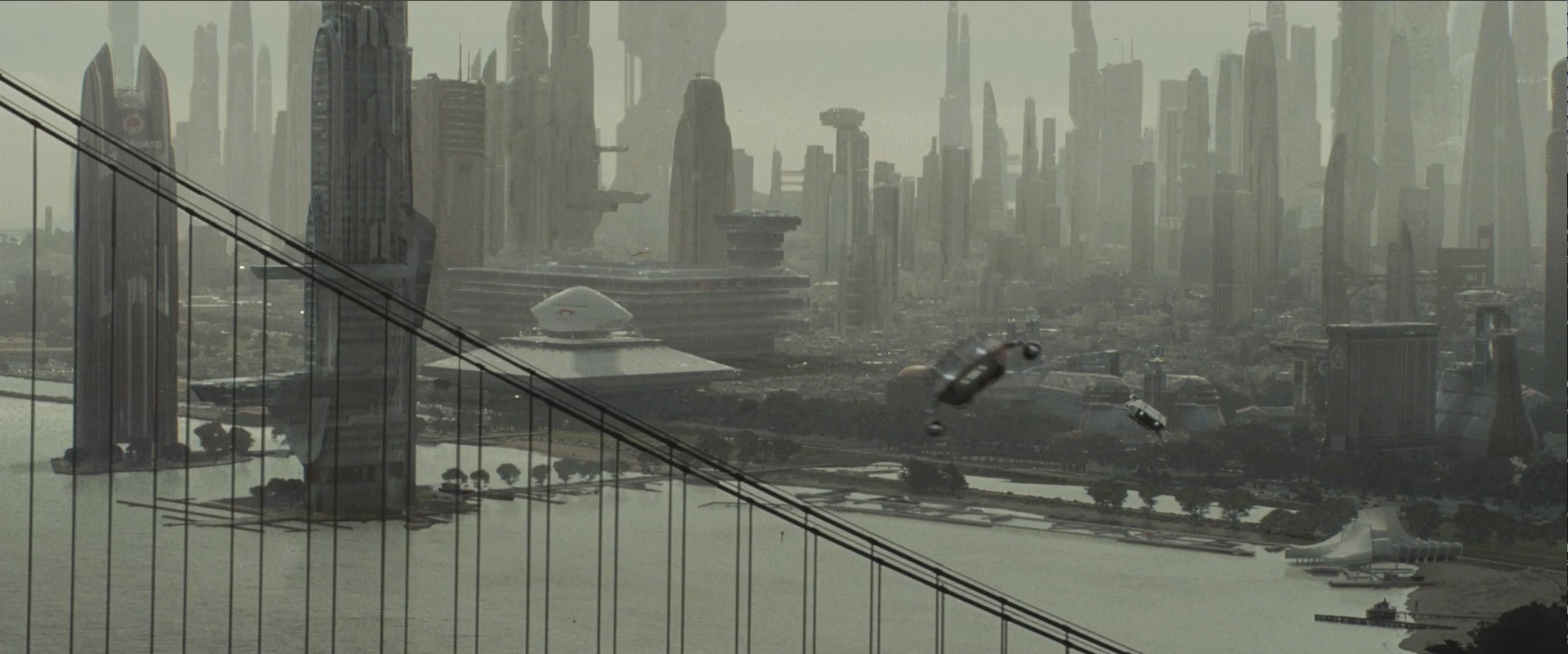
(Photo brashly stolen from the blog of one Peter Sciretta. It is a still of futuristic San Francisco from the recent Star Trek movie--clearly, in the Trek universe, the world pays izott its due heed.)
Sunday, July 5, 2009
Worldwide per capita income, 1000 BC - present
This chart, taken from the book A Farewell to Alms, has been making the rounds:
 It depicts world income, per capita, since 1000 BC. Pretty neat (although how they managed to piece together per capita income for people living 3000 years ago is beyond me). You can see at the industrial revolution that "incomes rose sharply in many countries after 1800 but declined in others".
It'd be interesting to know what percentage of people are in the "haves" part of the post-1800 chart versus the "have-nots" part. I'm guessing an overwhelming majority are in the have-nots part.
Krugman explains the "Malthusian trap":
I wonder how the have-nots line will change as China and India continue to industrialize.
 It depicts world income, per capita, since 1000 BC. Pretty neat (although how they managed to piece together per capita income for people living 3000 years ago is beyond me). You can see at the industrial revolution that "incomes rose sharply in many countries after 1800 but declined in others".
It'd be interesting to know what percentage of people are in the "haves" part of the post-1800 chart versus the "have-nots" part. I'm guessing an overwhelming majority are in the have-nots part.
Krugman explains the "Malthusian trap":
The two figures actually illustrate slightly different points. What the figure above shows is that over a roughly 3000 year period, during which there was obviously quite a lot of technological progress — iron plows, horse collars, mastering the cultivation of rice, the importation of potatoes into Europe, etc. — living standards basically went nowhere. Why? Because population growth always ate up the gains, pushing living standards back to roughly subsistence.
...
This homeostasis only broke down when very rapid technological change finally outstripped population pressure for an extended period.
I wonder how the have-nots line will change as China and India continue to industrialize.
Friday, July 3, 2009
Free parking revisited
A while ago I posted about the trouble with free parking, which led to some substantive comments worth promoting to a post. Here they are:
2 comments:
Saturday, May 30, 2009
The trouble with free parking
 We're all familiar with the basic economic principle that if you underprice something, you cause long lines for--and shortages--of that thing, and that if you want that thing to be produced and consumed as efficiently as possible, you should let the free market set its price. Yet somehow, we all seem to have our blinders on when it comes to applying this principle to parking spaces, as Matt Yglesias explains:
When I took economics, we had a little squib in there about price controls. But it was about something nobody would actually think to do these days . . . mandatory cheap bread or something. It was a historical example. At any rate, it’s overwhelming conventional wisdom in the United States that price controls are bad. If I suggested that the city implement price controls on Diet Coke, people would say that it would lead to shortages. And if I proposed dealing with the ensuring shortages by saying that anyone who wants to build a new building needs to also provide millions of dollars worth of Diet Coke to people in the neighborhood, people would look at me as if I were insane. Creating the Diet Coke shortages is not a favor to anyone—neither fans nor haters of Diet Coke benefit—and the regulatory mandate is an absurd subsidy to Diet Coke drinkers with no conceivable policy justification. It’s bizarre. But people have a strong bias toward the status quo, so they tend to assume that status quo policy just must be non-bizarre, no matter how at odds it is with everything else.
It kind of reminds me of dollar beer night at the racetrack. At first you're all excited--beer for only $1!--but when you get there, and you see the gigantic lines, and realize you'll have to wait for like half an hour just to get a stupid Budweiser, you end up wishing that it was more like $3 or $4 beer night. Well, the same applies to parking here in San Francisco: it is basically 0$ parking night every night. And so you get the long lines...
(Photo by Mark Strozier)
Friday, March 6, 2009
Is Shaq a toxic asset?
I meant to forward this along earlier--an interesting post drawing similarities between Japan's economic collapse and the Suns'.
(Related article: Bill Simmons' column on the NBA's financial woes and why the most sought-after contract in the league belongs to...some guy named Raef LaFrentz.)
(Related article: Bill Simmons' column on the NBA's financial woes and why the most sought-after contract in the league belongs to...some guy named Raef LaFrentz.)
Monday, February 16, 2009
Stagnant wages, falling home prices
A look into how household spending patterns are contributing to the slump:
One of the reasons why the real estate crash has hurt so much is because rising home prices were driving consumer spending, and consumer spending accounted for something like 70% of GDP. So when home prices fell, households saw their net worth shrink and started to save instead of spend, causing GDP to fall.
One concept that has gotten a lot of attention the last few months is the household balance sheet: the relationship between household assets and liabilities, and what that means for household behavior (consumption versus saving). Though not the precipitating factor in the current crisis, the weakening of household balance sheets (fewer assets, same liabilities, less net worth, more anxiety) has likely had a significant effect in depressing consumption, which has been the single largest factor in our recent decline in GDP.
...
On the headline level, [from 2004 to 2007] median income fell from $47,500 to $47,300 (all figures are in constant 2007 dollars), while median net worth (assets minus liabilities) grew from $102,200 to $120,300. No surprise there: we already knew wages stagnated, while real estate and stocks appreciated. However, since the survey was conducted in 2007, median net worth fell by 17.8% according to the Fed estimate, to $99,300, and that’s just to October 2008. Given that the cumulative returns of the stock market have been about -15% since October 31, and that housing prices have fallen as well (and the Fed used a housing index that has fallen less than the Case-Shiller index*), that net worth is probably between $90,000 and $95,000 - significantly less than in 2004, and back around 1998 levels ($91,300).
One of the reasons why the real estate crash has hurt so much is because rising home prices were driving consumer spending, and consumer spending accounted for something like 70% of GDP. So when home prices fell, households saw their net worth shrink and started to save instead of spend, causing GDP to fall.
Wednesday, February 11, 2009
The uncoupling of merit and economic performance in a depression
One of the most compelling arguments for capitalism, I think, is the idea that it is meritocratic: successful businesses are the ones that create products and services that people truly desire, and businesses that fail to create desirable enough products eventually go under. People who live beyond their means eventually fall into debt and go bankrupt; people who are careful with their money invest it and see their wealth multiply. If you work hard, you get something in return; if you don't work, you get nothing. And there's no such thing as a free lunch.
Of course, that's the Platonic ideal--in reality, even the most ardent capitalism-booster admits several points at which the meritocracy of capitalism breaks down. Not all wealth is earned through hard work--much of it is inherited. Many jobs are awarded based on personal connections and loyalties rather than skill. There are systemic injustices in our society: women and minorities see fewer opportunities to get ahead, and are paid less; children in poorer families receive a worse education than children in wealthier families; rich and powerful industries lobby Congress to give them unfair advantages, like subsidies or unwarranted deregulation (which most of the time is tantamount to subsidy, since the societal costs of the industry's activities end up being socialized); companies routinely violate labor laws that prevent workers from unionizing and negotiating better wages; etc. And, of course, there is the most powerful and arbitrary force of all: sheer dumb luck.
There are a lot of imperfections.
But even so, the capitalist will argue that, despite these difficulties, by and large capitalism is still meritocratic enough, still better than any other economic system yet devised, and so worth preserving and improving upon. And America--being a nation of mostly capitalists--have bought into this idea, and the idea is so ingrained and familiar that it becomes something like an axiom that markets are meritocratic. This belief in the meritocracy of capitalism is so certain, in fact, that we often use economic performance as a procedural criterion to determine the worthiness of a product, the acumen of a businessman, the work ethic of a laborer. The very fact that Google is the most successful search engine means that it is also the best search engine; the very fact that some company is successful means that the executives are doing something right; the very fact that this man started with nothing and rose to the position he's in today means that he's a resourceful, hardworking fellow. And, the converse: the fact that Yahoo has gone down in marketshare means that its search engine is inferior; the fact that this company has gone out of business means that the executives were incompetent; the fact that this man started with everything and is now penniless means that he's lazy, irresponsible. Because of the iron-clad assumption that economic performance is meritocratic, economic performance becomes a measuring stick for merit.
In normal times, and in a not-completely-dysfunctional free market economy, you can get away with this sort of thinking in a rough-and-ready sort of way: I think it would be reasonable for a person to presume, for example, that Google's search engine is superior even if that person has never used a search engine before in his or her life; it would be reasonable to presume that a fellow that has squandered a small fortune has some serious character flaws or other life problems; etc. Of course, there are always exceptions and mitigating circumstances and things like that, and so you have to judge people on the merits, and take into account all of the evidence in each case, and so on. But often in life you don't always have the time or energy to delve into each case and give your full consideration--lots of times we navigate the vast world of people, situations, and products on the fly, trying our best to size things up with a cursory glance. Thus, we perhaps avoid a restaurant that is nearly empty during peak dinner hour; we are attracted to the person at the party who is successful (and I don't mean money, per se, but professional success--maybe a successful comedian or writer, or big-time lawyer, or famous professor). In other words, we let economic success be a yardstick for actual merit--and most of the time, it works out okay.
That's normal times. But the times we find ourselves in now are anything but normal--on the contrary, we find ourselves in the midst of a depression. And the interesting thing about depressions is that they take the meritocracy of capitalism and flip it upsidedown: normally, when times get tough the right thing to do is cut back your spending and save your money; in a depression, though, cutting back your spending is precisely what is contributing to the downward economic spiral that is making you poorer (a phenomenon known as "the paradox of thrift"). Normally, when a company goes out of business for lack of demand for its products, we can safely blame the poor quality of the product for the lack of demand; in a depression, however, the lack of demand for a product has nothing to do with the quality of the product, because there is a lack of aggregate demand--general demand for everything is going down (that is to say, it's not as if the money not being spent on the product is being spent on superior competing products--it just isn't being spent at all). Normally, when someone loses their job, we can infer that--for whatever reason--they didn't have what it takes to compete with other employees for the job; in a depression, though, people who are excellent, productive employees lose their job through no fault of their own (they aren't losing their jobs to superior competing laborers--the jobs are just disappearing altogether).
The problem these days is that everyone is still wired to assume that because the nation's economic performance is so bad, we must somehow deserve it. Economic performance is still being used as a measuring stick for merit. And so you get a lot of people who think that the economic crisis was brought about because we as a nation lived beyond our means; or that all of this was the inevitable result of greed on the part of someone, somewhere. You have people who believe that the system is purging itself of waste, that this is an "adjustment" that is painful, but ultimately healthy. You have people who believe that we must all "tighten our belts"--government included--and stop the profligate spending and consumerism in favor of good old-fashioned saving. You have people who look at the disproportionate wealth of the United States and think to themselves "the party's over; here comes the great reckoning". The tendency is to frame the whole sequence of events as a morality play: in Act 1 some character flaw leads to sinful behavior, in Act 2 the bad behavior finally catches up with us, and in Act 3 we make the painful sacrifices and hard decisions and, finally, atone for our sins. There's no easy answers, no free lunch. It is a world that is basically intuitive and fair, where good behavior is rewarded and bad behavior is punished--it is a world, in other words, where economic performance is meritocratic.
But this way of thinking obscures a more helpful way of thinking of the economy, which is that it is a big, complex mechanism capable of breaking down and, hopefully, being fixed--that the reasons for its breakdown are not necessarily attributable to some great human foible, and that the fix does not necessarily require some kind of painful, character-building sacrifice. Of course, in order to think of the economy in this dispassionate way, you have to spend a great amount of effort trying to understand how it works--an effort that many pundits, reporters, and members of Congress either cannot or will not undertake. So these folks rely on their intuitive, meritocratic notion of capitalism and sense of cosmic justice and end up advocating precisely the opposite of what ought to be done--that we should cut spending rather than increase it, that we should let companies die off (remember how people cheered the demise of Lehman Brothers out of concerns about "moral hazard"? How about GM and Chrysler?) because they aren't competitive, etc.
Of course, not everyone who opposes a large stimulus package is necessarily someone who is relying on an faulty, intuitive understanding of economics. There are some very capable economists who are skeptical, on empirical grounds, that such a stimulus would work. But there are too many people in positions of authority that do not appear to have even a basic understanding of the economic crisis, and who therefore reject the idea of stimulus with the air of someone who is told that the solution to their obesity problem brought about by eating too much candy is to start eating even more candy.
Of course, that's the Platonic ideal--in reality, even the most ardent capitalism-booster admits several points at which the meritocracy of capitalism breaks down. Not all wealth is earned through hard work--much of it is inherited. Many jobs are awarded based on personal connections and loyalties rather than skill. There are systemic injustices in our society: women and minorities see fewer opportunities to get ahead, and are paid less; children in poorer families receive a worse education than children in wealthier families; rich and powerful industries lobby Congress to give them unfair advantages, like subsidies or unwarranted deregulation (which most of the time is tantamount to subsidy, since the societal costs of the industry's activities end up being socialized); companies routinely violate labor laws that prevent workers from unionizing and negotiating better wages; etc. And, of course, there is the most powerful and arbitrary force of all: sheer dumb luck.
There are a lot of imperfections.
But even so, the capitalist will argue that, despite these difficulties, by and large capitalism is still meritocratic enough, still better than any other economic system yet devised, and so worth preserving and improving upon. And America--being a nation of mostly capitalists--have bought into this idea, and the idea is so ingrained and familiar that it becomes something like an axiom that markets are meritocratic. This belief in the meritocracy of capitalism is so certain, in fact, that we often use economic performance as a procedural criterion to determine the worthiness of a product, the acumen of a businessman, the work ethic of a laborer. The very fact that Google is the most successful search engine means that it is also the best search engine; the very fact that some company is successful means that the executives are doing something right; the very fact that this man started with nothing and rose to the position he's in today means that he's a resourceful, hardworking fellow. And, the converse: the fact that Yahoo has gone down in marketshare means that its search engine is inferior; the fact that this company has gone out of business means that the executives were incompetent; the fact that this man started with everything and is now penniless means that he's lazy, irresponsible. Because of the iron-clad assumption that economic performance is meritocratic, economic performance becomes a measuring stick for merit.
In normal times, and in a not-completely-dysfunctional free market economy, you can get away with this sort of thinking in a rough-and-ready sort of way: I think it would be reasonable for a person to presume, for example, that Google's search engine is superior even if that person has never used a search engine before in his or her life; it would be reasonable to presume that a fellow that has squandered a small fortune has some serious character flaws or other life problems; etc. Of course, there are always exceptions and mitigating circumstances and things like that, and so you have to judge people on the merits, and take into account all of the evidence in each case, and so on. But often in life you don't always have the time or energy to delve into each case and give your full consideration--lots of times we navigate the vast world of people, situations, and products on the fly, trying our best to size things up with a cursory glance. Thus, we perhaps avoid a restaurant that is nearly empty during peak dinner hour; we are attracted to the person at the party who is successful (and I don't mean money, per se, but professional success--maybe a successful comedian or writer, or big-time lawyer, or famous professor). In other words, we let economic success be a yardstick for actual merit--and most of the time, it works out okay.
That's normal times. But the times we find ourselves in now are anything but normal--on the contrary, we find ourselves in the midst of a depression. And the interesting thing about depressions is that they take the meritocracy of capitalism and flip it upsidedown: normally, when times get tough the right thing to do is cut back your spending and save your money; in a depression, though, cutting back your spending is precisely what is contributing to the downward economic spiral that is making you poorer (a phenomenon known as "the paradox of thrift"). Normally, when a company goes out of business for lack of demand for its products, we can safely blame the poor quality of the product for the lack of demand; in a depression, however, the lack of demand for a product has nothing to do with the quality of the product, because there is a lack of aggregate demand--general demand for everything is going down (that is to say, it's not as if the money not being spent on the product is being spent on superior competing products--it just isn't being spent at all). Normally, when someone loses their job, we can infer that--for whatever reason--they didn't have what it takes to compete with other employees for the job; in a depression, though, people who are excellent, productive employees lose their job through no fault of their own (they aren't losing their jobs to superior competing laborers--the jobs are just disappearing altogether).
The problem these days is that everyone is still wired to assume that because the nation's economic performance is so bad, we must somehow deserve it. Economic performance is still being used as a measuring stick for merit. And so you get a lot of people who think that the economic crisis was brought about because we as a nation lived beyond our means; or that all of this was the inevitable result of greed on the part of someone, somewhere. You have people who believe that the system is purging itself of waste, that this is an "adjustment" that is painful, but ultimately healthy. You have people who believe that we must all "tighten our belts"--government included--and stop the profligate spending and consumerism in favor of good old-fashioned saving. You have people who look at the disproportionate wealth of the United States and think to themselves "the party's over; here comes the great reckoning". The tendency is to frame the whole sequence of events as a morality play: in Act 1 some character flaw leads to sinful behavior, in Act 2 the bad behavior finally catches up with us, and in Act 3 we make the painful sacrifices and hard decisions and, finally, atone for our sins. There's no easy answers, no free lunch. It is a world that is basically intuitive and fair, where good behavior is rewarded and bad behavior is punished--it is a world, in other words, where economic performance is meritocratic.
But this way of thinking obscures a more helpful way of thinking of the economy, which is that it is a big, complex mechanism capable of breaking down and, hopefully, being fixed--that the reasons for its breakdown are not necessarily attributable to some great human foible, and that the fix does not necessarily require some kind of painful, character-building sacrifice. Of course, in order to think of the economy in this dispassionate way, you have to spend a great amount of effort trying to understand how it works--an effort that many pundits, reporters, and members of Congress either cannot or will not undertake. So these folks rely on their intuitive, meritocratic notion of capitalism and sense of cosmic justice and end up advocating precisely the opposite of what ought to be done--that we should cut spending rather than increase it, that we should let companies die off (remember how people cheered the demise of Lehman Brothers out of concerns about "moral hazard"? How about GM and Chrysler?) because they aren't competitive, etc.
Of course, not everyone who opposes a large stimulus package is necessarily someone who is relying on an faulty, intuitive understanding of economics. There are some very capable economists who are skeptical, on empirical grounds, that such a stimulus would work. But there are too many people in positions of authority that do not appear to have even a basic understanding of the economic crisis, and who therefore reject the idea of stimulus with the air of someone who is told that the solution to their obesity problem brought about by eating too much candy is to start eating even more candy.
Wednesday, February 4, 2009
"The frontier of mass material comfort" comments
I thought the comments from this recent post were worth promoting to a post. I don't think I quite landed the dismount on my last response and came off sounding way more condescending than I intended, but hey I'm shooting from the hip here (metaphors mixed: 2):
-
 Blinkity said...
 Okay, this is a bit ridiculous. The upside of capitalism is that we have unbelievable material wealth and comforts? You don't say. I think that detractors of Capitalism (those who aren't concerned with the damage that it does directly) believe that these material comforts don't result in an overall increase in satisfaction or happiness. That they slowly raise our standards and expectations so that whatever we have seems barely enough. I don't mean to include extremes on either end of the spectrum in this. But there does seem to be something to the idea that our happiness level is largely a practical biological reaction to our circumstances, and one that is very good at adapting to the current situation. I like comforts as much as the rest. I just don't know that I would be that much less happy if it were taken away from me, or if more were given to me, for a sustained time.
- David Morris said...
"Okay, this is a bit ridiculous. The upside of capitalism is that we have unbelievable material wealth and comforts? You don't say."
My point wasn't to merely assert that the upside of capitalism is material worth--it was to see if we could frame it in a way that makes us appreciate just how extreme the improvement has been. I think realizing that 250 years ago you'd have to spend half your income on food--and that 5 out of 6 meals you bought were fucking oats--helps us truly understand how fortuneate we are to be alive in this place and this time, and how imperative it is that as many humans as possible be liberated from their dismal oats-only existences.
Now, is having material comfort sufficient for being really and truly happy? Well, maybe not. But when you frame the question in terms of a concept so big and monolithic--Human Happiness--the little things--like interesting food, like being able to buy any book you want, like having hot showers in the morning--fall by the wayside. But the cumulative quality-of-life impact of these things over a person's lifetime are significant! These are things that would make anyone, of any era, happier in an immediate and straightforward way.
Shouldn't we be careful not to be too quick to paint people of other cultures and other eras as happy, authentic, in-tune-with-nature faceless peasants and villagers? They are so authentic, they have no need for base materialistic things like televisions, cars, and French cuisine! That stuff doesn't really make you happy anyway, so there's no pressing need to give some dude wasting his life in rural China the opportunity to experience these materialistic trifles that I experience every day! Why, to think otherwise would be crass materialism!
You see what I'm trying to get at here? How there might be some cognitive dissonance at play in all this? Good liberals like us find it discomforting to praise ourselves, to praise capitalism...- Blinkity said...
Yeah, I know this is a classic lame liberal move, and I didn't make it unconsciously. It's just that I see two actual pieces of evidence that point to it - the first is thinking a little bit about the way the brain surely actually works (there was a TED talk about this). The second is comparing my own experience to potential additional comforts that I might have in the future. It doesn't sound that great, and it's hard to imagine I'll be happier overall, despite the fact that two hundred years from now people will probably look back to my awful state with pity. I mean, alleviating suffering is one thing, but it's important to distinguish when people are actually suffering from when we are projecting suffering on them, because *we* would be suffering in that situation.
- David Morris said...
I take your point, but also I'd encourage you to go back to DeLong's original post and reread it carefully, because I think he basically comes to the same conclusion that you are coming to.
However, I don't think it's right to think that in 200 years, people will take pity on our awful standard of living--I think in 200 years, people will look at our lives and think they were just fine, just like how we might think that some wealthy noble 200 years ago lived a quality of life that was just fine. There is a real objective standard at work here, which in the DeLong post is quoted from Keynes:
Keynes thought that by today we would have reached a realm of plenty where "We shall once more value ends above means and prefer the good to the useful. We shall honour those who can teach us how to pluck the hour and the day virtuously and well, the delightful people who are capable of taking direct enjoyment in things, the lilies of the field who toil not, neither do they spin."
In other words, having plenty frees us from lives that are devoted almost entirely to subsistence, and allows us to get down to the business of living good and happy lives. We no longer are forced to spend 50% of our labor just feeding ourselves; we can use the majority of the fruits of our labor on things that are valuable not solely as a means for survival--things that are valuable in themselves.
Of course, the great irony in all this is that human nature--which puts such a prize on status--prevents us from really appreciating how well off we are, causing DeLong to sigh:
I'm convinced that everyone I know can easily imagine how to spend up to three times their current income usefully and productively. (It is only beyond three times your current spending that people judge others' spending as absurd and wasteful.) And everybody I know finds it very difficult to imagine how people can survive on less than one-third of what they spend—never mind that all of our pre-industrial ancestors did so all the time. There is a point at which we say "enough!" to more oat porridge. But all evidence suggests Keynes was wrong: We are simply not built to ever say "enough!" to stuff in general.
So I think DeLong agrees with you that humans in general aren't "built" to appreciate their material fortunes; but that doesn't mean that we can't put in a special effort to appreciate our material fortunes, nor does it mean that our material fortunes are not something truly worth appreciating.
Sunday, February 1, 2009
The frontier of mass material comfort
I was reading economist Brad DeLong's blog, and came across an interesting post that brings home the economic progress that's been made over the last few centuries:
I think this kind of mental exercise is useful for really appreciating the upside of modernity/capitalism. The vast majority of humans for the vast majority of history have had to live in uncomfortable, monotonous, shitty conditions twenty-four hours a day seven days a week for the duration of their lives. The phenomenon of significant portions of humanity living in material comfort is relatively new, and with each passing decade many more are being lifted up out of poverty.
Of course, the trick now is to figure out how we can continue to do this without also rendering the planet inhabitable to ourselves.
Our goods are not only plentiful but cheap. I am a book addict. Yet even I am fighting hard to spend as great a share of my income on books as Adam Smith did in his day. Back on March 9, 1776 Adam Smith's Inquiry into the Nature and Causes of the Wealth of Nations went on sale for the price of 1.8 pounds sterling at a time when the median family made perhaps 30 pounds a year. That one book (admittedly a big book and an expensive one) cost six percent of the median family's annual income. In the United States today, median family income is $50,000 a year and Smith's Wealth of Nations costs $7.95 at Amazon (in the Bantam Classics edition). The 18th Century British family could buy 17 copies of the Wealth of Nations out of its annual income. The American family in 2009 can buy 6,000 copies: a multiplication factor of 350.(Chez Panisse, for those not familiar with Berkeley, is the fanciest--and likely most expensive--restaurant in Berkeley.)
Books are not an exceptional category. Today, buttermilk-fried petrale sole with pickled vegetables and parsley mayonnaise, served at Chez Panisse Café, costs the same share of a day-laborer's earnings as the raw ingredients for two big bowls of oatmeal did in the 18th Century.
...
Today we still spend about one dollar in five on food—down from the half of income that Americans spent in 1776. The share hasn't fallen more because some of us buy buttermilk-fried petrale sole with pickled vegetables and parsley mayonnaise cooked, served, and cleaned up by others rather than (or in addition to) oats in the gunnysack.
I think this kind of mental exercise is useful for really appreciating the upside of modernity/capitalism. The vast majority of humans for the vast majority of history have had to live in uncomfortable, monotonous, shitty conditions twenty-four hours a day seven days a week for the duration of their lives. The phenomenon of significant portions of humanity living in material comfort is relatively new, and with each passing decade many more are being lifted up out of poverty.
Of course, the trick now is to figure out how we can continue to do this without also rendering the planet inhabitable to ourselves.
Friday, January 9, 2009
Facebook valuation by way of Whopper
I don't think what Kottke's doing here makes much sense. The basic premise is, Burger King has a Facebook app called Whopper Sacrifice that lets you delete 10 friends in exchange for a free Whopper. This sets up a Facebook-friend-Whopper exchange rate. After determining the value of a Facebook friend in terms of Whoppers, he then determines the value of Whoppers in terms of dollars, and, presto, comes up with the dollar value of a Facebook-friend.
But there is a problem here. Once Kottke gets the dollar value for a Facebook-friend, he then multiplies that by the total number of friends in the Facebook network to arrive at a valuation of the network. But this doesn't make sense, because it's not as if Facebook friends are a commodity (like Whoppers) that are, for all intents and purposes, interchangeable with each other. Some friends are more valuable than other friends. I may happily exchange my least favorite ten friends on Facebook for a Whopper, but decline to do the same when it comes to my ten most favorite friends.
Assuming an efficient Facebook-Whopper market, what this scheme does do is set the cost of keeping a Facebook friend to 1/10 the cost of a Whopper. This is, I think, a win-win for everyone involved, because it will purge the Facebook network of non-meaningful friendships and get Burger King some nice publicity.
Of course, there also seem to be some perverse incentives, like for instance friending strangers just so you can unfriend them for Whoppers. But presumably the app is robust enough to guard against this kind of exploitation (for example, it could be that you must be friends for a person for X amount of time in order for your unfriending of them to count towards a Whopper).
But there is a problem here. Once Kottke gets the dollar value for a Facebook-friend, he then multiplies that by the total number of friends in the Facebook network to arrive at a valuation of the network. But this doesn't make sense, because it's not as if Facebook friends are a commodity (like Whoppers) that are, for all intents and purposes, interchangeable with each other. Some friends are more valuable than other friends. I may happily exchange my least favorite ten friends on Facebook for a Whopper, but decline to do the same when it comes to my ten most favorite friends.
Assuming an efficient Facebook-Whopper market, what this scheme does do is set the cost of keeping a Facebook friend to 1/10 the cost of a Whopper. This is, I think, a win-win for everyone involved, because it will purge the Facebook network of non-meaningful friendships and get Burger King some nice publicity.
Of course, there also seem to be some perverse incentives, like for instance friending strangers just so you can unfriend them for Whoppers. But presumably the app is robust enough to guard against this kind of exploitation (for example, it could be that you must be friends for a person for X amount of time in order for your unfriending of them to count towards a Whopper).
Tuesday, January 6, 2009
Economy blah blah spending blah blah
Now, I've been trying really hard the last few months to understand what's been going on in the economy, and still I find most of this article to be pretty inscrutable. I'm not even saying that it's wrong: I'm just saying that I don't understand it. For example, first it says this:
Well, wait a minute. Yes, there is a credit freeze--for private individuals, companies, and investors. But there isn't a credit freeze for the United States government--in fact, the whole reason there is a credit freeze is because lenders will only lend to the United States government (because it is perceived to be the one borrower that cannot possibly fail). The article even explicitly mentions the favorable interest rates that the government can borrow at as a result of this investor "flight to safety":
Maybe he means that huge government deficits will worsen the credit crunch because the government will end up sucking up all the dollars that would have been lent to private borrowers? But isn't the whole point of the deficit spending to increase demand to get the economy back at full capacity and get lenders confident enough to lend again? I mean, if there was no stimulus everyone agrees the recession, unemployment, and credit situation would be worse, right?
Bah. Time to go find a blog post somewhere that actually explains what the hell is going on with this stuff...
Big deficits force the government to borrow more money, saddling future generations with large financial burdens. The problem is especially acute now because credit markets, which at times in recent months have been all but frozen as the financial system has been buffeted, could be further strained by the need to finance the huge deficit.
Well, wait a minute. Yes, there is a credit freeze--for private individuals, companies, and investors. But there isn't a credit freeze for the United States government--in fact, the whole reason there is a credit freeze is because lenders will only lend to the United States government (because it is perceived to be the one borrower that cannot possibly fail). The article even explicitly mentions the favorable interest rates that the government can borrow at as a result of this investor "flight to safety":
...the good news, at least for the moment, is that the Treasury’s borrowing costs are as almost as low as they have ever been. Short-term Treasury rates are hovering just above zero, but the rates on 10-year Treasury bonds are below 2 percent.
Maybe he means that huge government deficits will worsen the credit crunch because the government will end up sucking up all the dollars that would have been lent to private borrowers? But isn't the whole point of the deficit spending to increase demand to get the economy back at full capacity and get lenders confident enough to lend again? I mean, if there was no stimulus everyone agrees the recession, unemployment, and credit situation would be worse, right?
Bah. Time to go find a blog post somewhere that actually explains what the hell is going on with this stuff...
Wednesday, December 24, 2008
Economists move in herds....they do move in herds
A clever explanation about why most economists failed to foresee the current crisis. Sounds true to me...
Subscribe to:
Posts (Atom)
You know, these free market principles make a lot more sense if you assume everyone has the same amount of money, and hence the dollars they allocate to something represent exactly their 'desire' for that object. So the person who wants it the most gets it, with the least fuss.
Fine, you can say that the people with more money have more entitlement to stuff, that is the idea of capitalism anyway. But when it comes to basic needs, yes, like parking, it's meant to be something everyone can get. So free market can totally screw it. The richest people get it, even if they don't want it that much (a bit of a stretch), and maybe even abuse it.
It's more of an obvious problem with, for example, gas. If there's a limited amount of it, and prices soar, then rich folks can use it to excess, and poor people can get seriously screwed. So price caps as a form of socialism seem necessary, even though it makes the distribution much less efficient.
I don't think what you're saying makes a whole lot of sense. You seem to have slipped into the mindset that goods and services are just magically already there in set amounts, and that what happens on the consuming end has no effect on what happens on the producing end.
But consumption drives production. If gas becomes very scarce, it is in everyone's interest for prices to reflect this (for them to "soar"), not because the rich are "entitled" to anything, but because high profit margins in the gas business will encourage people, in the aggregate, to divert more resources into producing more gas, and so there will be more gas for everyone, and prices will go back down--for everyone. Or, alternatively, if the gas supply cannot be increased any further (if we have reached "peak gas"), then the high cost of driving a gas-powered automobile will start to make non-gas-reliant modes of transportation more competitive, and people will find it profitable to start diverting resources into developing those new industries and technologies.
So I think in this case you are guilty of "shooting the messenger"--you're blaming the price for the problem, when really the price is just indicating the real problem, which is that the tradeoffs of producing this good--gas--are becoming too costly in comparison to other things we could be spending our time and energy on. By introducing price controls you're just "living in denial"--delaying progress by keeping everyone in the same spending pattern on the same products, even as the quality and access to those products steadily declines.
Of course, this free market pricing mechanism can't be applied to everything--sometimes there are extenuating circumstances. For example, with healthcare, we might decide that it's morally unacceptable to deny a poor person medical coverage in an emergency, and then find ourselves on a slippery slope, so that by the time we're giving away ER care for free, it actually is more efficient to give that person access to less costly preventive care that would prevent the costly trip to the ER in the first place. And so--boom--you're on your way to some form of socialized medicine. That's just fine.
But there are no such slippery-slope-inducing moral imperatives regarding parking spaces! Only a child of Los Angeles could believe something so patently absurd as the idea that "free parking" is a "basic need". It reminds me of the Woody Allen quote about LA: "I don't want to move to a city where the only cultural advantage is being able to make a right turn on a red light".