- Ugh. What a terrible effort by the Lakers. And Kobe whining because he wasn't getting the calls he wanted wasn't very fun to watch, either.
- Apparently, Stan Van Gundy thinks there shouldn't be NBA games on Christmas, because it prevents the players from spending time with their family. I can't abide this whining. I mean, think of it: these people are paid millions of dollars to play friggin' basketball--the least they can do is work on a holiday. And guess what: there are millions of people who do work on Christmas Day, but who don't get millions of dollars for it. And what about the troops overseas? Not only are they working during Christmas, but they're away from home; and not only are they away from home, but they are in actual life-threatening danger; and not only are they in life threatening danger, but they're doing all this for practically nothing. So, spare me, Stan, and go play some fucking basketball. Lots of people would give their right arm to be in your position--you should just be thankful for that.
- How old do you have to be for it to be meaningful in any way that the Knicks are good? I'm always hearing about how "good for basketball" it is when the Knicks are good, and how classic and legendary and important Madison Square Garden is. But the Knicks never won a ring in the 90s when I was growing up--they were just standard issue Eastern Conference Jordan fodder. And in the 80s they didn't do anything either. And if you asked me to name a great Knick (besides Ewing, who wasn't even that earth-shatteringly great--nowhere near Olajuwan, for example)--I don't think I could. So I don't get what's so special about the Knicks.
Showing posts with label sports. Show all posts
Showing posts with label sports. Show all posts
Friday, December 25, 2009
NBA notes

Wednesday, December 2, 2009
Ron Artest: "I've Killed a Man"
That, at any rate, is my best attempt at a Ron Artest Onion headline. The article would have to contain at least one instance of Artest referring to himself in the third person, and maybe include some speculation as to what kind of fine David Stern might impose ($25,000, say).
Friday, November 27, 2009
The NBA on NBC opening sequence for a new generation

If NBC ever gets rights to the NBA again, this is how the sequence has to go:
First, we get Tesh back into the recording studio to record a "preamble" to the original theme--something very dignified with a lot of horns that evokes great Presidents of history and hallowed...er, traditions. You know what I mean: the horns come in--do do dooooooooooooo--and then a big drum--bum bum bum.
So anyway, this preamble is playing and the camera is zooming forward through video cutouts of Great Moments of NBA History, as well as Great Players That Defined Their Era. So you're going to have--what is it, Jerry West hitting some half court shot?--in black in white, and then Wilt's 100 point game, and all this stuff. But the thing is: this sequence is structured like the Wall Chart of History, so that the size of the video cutouts are proportional to their importance at that time. I don't know enough about NBA history to know how the first chunk of this sequence will be, but I do know that once you get to the 80s you start seeing Magic's baby hook, that one Bird steal, and big cutouts of Kareem hitting a skyhook and one of Magic posting up Bird or something. And then of course you have a nod to the Pistons teams.
Then, of course, you get to the 90s and Jordan just dominates the screen, and you have all sorts of classic Jordan highlights going, including one of him maybe hugging the championship trophy (and there can be some smaller screen flitting by that feature Barkley, Stockton/Malone, whatever).
And then beyond this you get the Duncan/Shaq era, and so these two dominate, and you show cutouts of various Horry shots and--er, whatever great Spurs moments there might have been. And then the way is cleared for the present Lebron/Kobe era (with I suppose some kind of recognition for KG, though, really, he's just got the one ring), with the two of them mostly taking up the whole screen.
And mind you--the preamble tune has been playing this whole time (along with audio snippets from the various video cutouts), and, oh, I don't know maybe ten or twelve seconds have passed. But when we ease into the Lebron/Kobe era, the music resolves into the beginning of the original NBA on NBC sequence (in which the logo is etched into that steel thingy with lasers--doo doo doo do do do do doooo), and then--there is some kind of explosion or flash, and we hit the ground running, with the revamped version of Roundball Rock going and an appropriate montage of present day players starts flitting around the screen, plus other basketball visual bric-a-brac. You can fill this bit in yourself.
But the big question here is: what play do you use to finish the sequence off, before the announcer intones, "The NBA on NBC"? In the 90s, it was Jordan hitting the game-winner against the Cavs, but in today's NBA you'd have trouble because you'd have to choose between Lebron and Kobe. I suppose you'd have to go Kobe, since he's older and he's got the rings (and the larger catalog of great moments--I mean, Lebron has a ridiculous highlight reel, but the only meaningful things I think he's done are the Game 5 takeover against Detroit and the game winner against Orlando. But even then, he has no rings, so nothing he's done can be that important). I'm not sure what Kobe's signature moment would be--I suppose one of his buzzer beaters, but if it wasn't a clutch playoff shot I'd go with one of his more ridiculous moves, like for example that nifty pump-fake-spin-jumper he had in the 61-point game against the Knicks, or that one siiiiiiiiick, high-arch fade-away he hit over Lebron last year.
If I was rich I'd give NBC money to buy rights to the NBA. Or maybe just buy the theme song from them.
(PS: I forgot that a requirement for the last play of the sequence has to be a good Marv Albert call--so I retract those two suggestions.)
Tuesday, November 17, 2009
Sunday, November 15, 2009
Testing Artest

When the Ariza-Artest trade first went down, my general opinion was that it wasn't nearly so bad as people made it out to be--that, sure, it would've been nice to keep Ariza but Artest is certainly comparable.
But the more time goes by, the more worried I get that this was, in fact, a pretty bad move. Artest hasn't really impressed me so far: he seems kind of slow and lumbering on defense, and hasn't seemed to hit any kind of rhythm offensively. Meanwhile, Ariza is just getting better, as everyone predicted he would.
So the Rockets-Lakers matchup tonight should be an interesting test, as I'm sure both players will be playing hard to show up their former teams.
Fantasy aside: Josh Howard is injured "indefinitely"--which completely fucks me over. Thanks, fantasy basketball, for making me care about Josh Howard's ankle.
Tuesday, November 10, 2009
A mind poisoned by fantasy
I knew going into it that participating in an NBA fantasy league was going to have an impact on how I follow the sport--but I didn't realize the effects would be so instantaneous. I'm already secretly hoping that Lebron James gets swine flu and has to sit out the rest of the week...
Monday, November 9, 2009
Kobe on the block
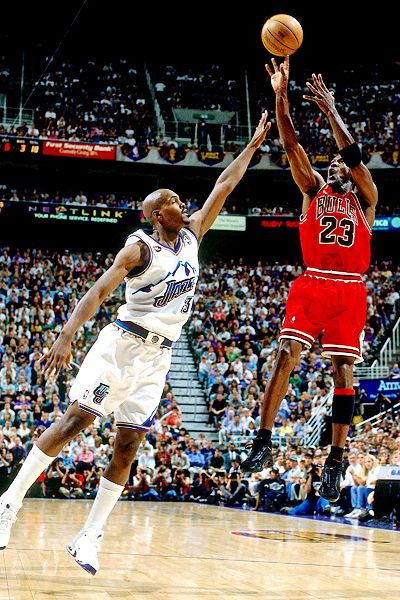
I haven't been watching the games, but I thought this was an interesting observation over at Forum Blue and Gold:
• This season, 36% of Kobe’s shot attempts have come out of the post. Last season that was 14%.
• I don’t expect the percentage to stay that high for Kobe when Gasol and Bynum return and need post touches — Phil Jackson said as much postgame the other night — but if team’s don’t adjust the Lakers should keep giving it to Kobe on the block.
In general, I've often wondered why Kobe hasn't gone to more of a late-period-Jordan post game. I feel like with his repertoire of fade-aways, spin moves, and drop steps--plus the ability to draw favorable whistles--he'd be far more efficient in the post than when he resorts to his patented impossible-to-hit-contested-20-ft-jumpers-that-he-somehow-makes-sometimes shtick. Moreover, I think once Kobe gets within 10-15 ft of the basket, his FG% goes way up--although that's just a gut impression, unsupported by data.
Wednesday, November 4, 2009
Let the Artest era begin
"You know if somebody hits me, I'm going to react. I got hit with about three elbows. It's just not fair. I don't want to fight, I don't feel like doing it. If you throw an elbow into Ron Artest's chest, do you know who you're hitting?" -Ron Artest
Sigh. Here we go...
Sigh. Here we go...
Wednesday, October 21, 2009
Go Lakers!
Well, with pitching like that, and hitting like that, you're not going to get very far. Such a weird postseason--first we seem to dominate the Cardinals and catch every break, and then the Phillies just clean our clock in every facet of the game. Sigh.
Sunday, October 18, 2009
A good thing to know
Jumping off from the previous post, it seems to me that a good a priori statistic to know would be the following:
Suppose that two teams meet in a 7 game series. If you suppose that they are evenly matched, then you'd expect Team A to win the series 50% of the time. Okay. Now, suppose Team A loses the first game. A is down 0-1. What would have to be the odds of A to win each game such that Team A would have a 50% chance of winning the series? Does Team A have to be 55-45 good? 60-40? 70-30? What would bring the odds for winning the series back to parity? This, I think, would be a good set of figures to know to have a good intuitive grasp of how improbable a series win is for a team that falls behind.
Of course, these figures are just fixed mathematical calculations that you could apply in any sport. Unfortunately I don't know how to do the math to calculate them out, but maybe some bored genius will help us out.
Suppose that two teams meet in a 7 game series. If you suppose that they are evenly matched, then you'd expect Team A to win the series 50% of the time. Okay. Now, suppose Team A loses the first game. A is down 0-1. What would have to be the odds of A to win each game such that Team A would have a 50% chance of winning the series? Does Team A have to be 55-45 good? 60-40? 70-30? What would bring the odds for winning the series back to parity? This, I think, would be a good set of figures to know to have a good intuitive grasp of how improbable a series win is for a team that falls behind.
Of course, these figures are just fixed mathematical calculations that you could apply in any sport. Unfortunately I don't know how to do the math to calculate them out, but maybe some bored genius will help us out.
The value of ad hoc statistics
 More questionable baseball statistics, this time about the Yankees:
The math certainly bodes well for them. Since Major League Baseball adopted a best-of-seven format for the ALCS in 1985, the team that won Game 2 has advanced to the World Series 17 of 23 times.
I'm always wary of this sort of statistic because it can be misleading. Of course, for any Game n in a series, you expect the eventual series winner to have won that game more often than the loser, if only because in every series the winner is guaranteed to have 4 wins spread over those 4-7 games and the loser only anywhere from zero to three wins spread over the same. And of course, by definition, you expect the series winner to win Game 7 100% of the time.
So what are the a priori probabilities here? Well, running a simulation of 10,000 7 game series in which each team has a 50-50 chance of winning, these were the results:
Team A wins 4922 out of 10000 series
Series winner wins
Game 1: 6541/10000 (65%)
Game 2: 6565/10000 (66%)
Game 3: 6579/10000 (66%)
Game 4: 6643/10000 (66%)
Game 5: 5896/8732 (68%)
Game 6: 4692/6220 (75%)
Game 7: 3084/3084 (100%)
So a priori, assuming evenly matched teams, we would expect the series winner to win Game 2 about 65% of the time. The statistic in the article said that the series winner in the ALCS has won Game 2 17 out of 23 times, or about 74% of the time. Considering that the sample size is very small--23 games--this difference of 10% doesn't seem to be terribly significant.
(Bonus section: in the above example, I'm actually being conservative, because I'm assuming that the teams are evenly matched. But of course, in real life the teams are sometimes not evenly matched, in which case we should say that one team has a (e.g.) 60-40 or 70-30 chance of winning. If we run the 10,000 series simulation with 60-40 odds, we get this:
Team A wins 7140 out of 10000 series
Series winner wins
Game 1: 6766/10000 (68%)
Game 2: 6690/10000 (67%)
Game 3: 6784/10000 (68%)
Game 4: 6724/10000 (67%)
Game 5: 5853/8436 (69%)
Game 6: 4456/5748 (78%)
Game 7: 2727/2727 (100%)
If we run it with 70-30 odds, we get this:
Team A wins 8729 out of 10000 series
Series winner wins
Game 1: 7318/10000 (73%)
Game 2: 7286/10000 (73%)
Game 3: 7274/10000 (73%)
Game 4: 7305/10000 (73%)
Game 5: 5558/7532 (74%)
Game 6: 3474/4363 (80%)
Game 7: 1785/1785 (100%)
So what we see here is that, when we account for the fact that teams are not always evenly matched--that sometimes a team will have a odds-on advantage in winning each game--it only nudges the probability that the series winner will win Game 2 upwards. Which makes my case a little bit stronger....
...although, we should note that the probability probably never swings too far away from 50-50. Remember that, in the regular season, the best team in the league rarely has better than about a 65-35 advantage when it plays 165 games against all the other teams in the league (which includes a lot of crappy and mediocre teams). When you consider that in the ALCS the best teams are playing against each other, I imagine that the odds of the team favorited to win doesn't go much beyond 60, if that.)
Anyway, to conclude: the statistic cited in the article is not particularly meaningful. Moreover, it's odd to focus in on Game 2 in isolation of the fact that the Yankees also won Game 1. It seems like, if anything, the statistic we should be getting is: what are the a priori odds that the Angels will come back from 0-2 to win the series, assuming they're evenly matched with the Yankees (a good assumption, I think)? Well, assigning the Angels to "Team A":
Team A wins 1893 out of 10000 series
Doesn't look too good for the Angels.
(Photo used sans permission from here.)
Thursday, October 15, 2009

Tuesday, October 13, 2009
I like the Dodgers, but...
...this is easily one of the worst parties I've ever seen. It's just, like, 20 dudes in a room awkwardly pouring alcohol on each other while everyone else stands around and watches.
Odds are this guy doesn't know what he's talking about

This annoys:
Repeating as World Series champions is, as the last nine winners can attest, exceedingly difficult. The last defending champion even to reach the World Series was the 2001 Yankees. The last National League team to win consecutive World Series was the 1975-76 Cincinnati Reds, known as the Big Red Machine. So the odds are stacked against the Phillies, not that they mind.He makes it seem like the fact that the Phillies won the Series last year actually makes it more unlikely that they will win it this year. But that's just the ol' gambler's fallacy at work.
I think the real insight lurking here is that baseball is, relatively, a very stochastic game, and so even a very dominant team is going to require a significant amount of luck to make it all the way twice in a row. Compare this to, say, basketball, which is not as stochastic and where you see higher winning percentages and where championship streaks are relatively common.
Monday, October 12, 2009
Life is pain

A very good post at Memories Of Kevin Malone that channels the damaged psyche of the generation of Dodger fans who were traumatized by the continuous failures of the 1990s. There are lots of good comments, too, including one from Megalomaniac that I'll quote at length:
Sure enough, in 1991, the Dodgers had a very good team and played very good baseball. It was a great summer. They had the best record at the break, 49-31. For 18 years, that record at the break has been a benchmark for me. I measured this team against it. Weird. And then heartbreak. The Braves, 7 games down at the break, caught them, and then passed them. I was devastated. I still hate the Braves because of it.
In 1992, I watched or listened to nearly every game. And that was before all games were on TV, so it was a lot of listening. 99 losses. And with each one of them, the elation from '88 and that awesome summer of '91 felt another hundred miles away.
And then it just got weird. Five rookies of the year, the rise of Piazza, knocking the Giants out in '93. Rather than winning anything, that stuff became the measure of a good season. And when the playoffs did happen, the goddamn Braves just swept the Dodgers right back to reality.
That really, really nails it. As I think I've written before, 1991 was the year I first achieved baseball consciousness (I was only 7 during the 1988 Series), and it was heartbreaking. And then, the next year, which was really my first year of being a bonafide, stats-mongering baseball fan, I had to endure 99 friggin' losses (on TV sometimes but mostly radio). It's the sort of thing that builds a lot of character. And ingrains in you a life-long hatred of the Braves. (Actually, it was a bit of a trip going up against John Smoltz of all people in the last series...gave me flashbacks to the bad old days.)
Anyway, the point is, it's really nice discovering that there's this whole Lost Generation of Dodger fans--folks who were too young to really experience the 1988 World Series, and who have grown up with the bizarre and disappointing experience of rooting for a franchise that was on the one hand one of the most storied in baseball, and on the other, completely unsuccessful. In other words: we're completely unaccustomed to success, and yet we're steeped in a tradition of success. It's a weird place to be. And it will continue to be that way until we get a Dodger championship that we can call our own.
(Photo from this site of Jose Offerman, who hit a homerun in his first career at bat--which was exciting, until we all realized that he lacked the ability to throw a ball to first base.)
UPDATE: It is worth noting that in that 1991 season, it was still the old playoff format where only two teams from each league went to the playoffs (and for some reason, the Atlanta Braves were shoehorned into the NL West). These days, the Dodgers simply would have made it in as the wildcard.
Sunday, October 11, 2009
3 and 0 do it again go cha cha dodgers
A very satisfying Dodger victory. One or two things:
UPDATE: Harinder sez,
Nope! All the Bay Area Laker fans I'm talking about are born-and-raised Bay Area-ers. The reason why they love the Lakers is because they are weak-ass bandwagon fans who just couldn't commit to an abusive, no-championship relationship with the Warriors.
Your "fuck the Lakers" is hereby noted. Also: I've sent Kobe to rape you.
- The last few weeks I've been walking around town with my Dodgers cap on, and, man--Bay Area people really hate the Dodgers. And, you know, that's fine. But then it turns out that every Bay Area person's favorite basketball team is--you guessed it--the Lakers. Everybody here loves the Lakers! I'm never sure whether to hit them over the head with this consistency or graciously accept their love for at least one LA team.
- A guest blogger for Ackerman has a really good Moneyball-style pwn of LaRussa, explaining why reliever Ryan Franklin's ERA made him look a lot better than he actually was. This is satisfying, because I got really sick of everyone saying how LaRussa was going to out-manage us in this series.
UPDATE: Harinder sez,
I think the Lakers love is because so many Bay Area residents are SoCal transplants. I just wanted to state my "Fuck the Lakers!" here for the record.
Nope! All the Bay Area Laker fans I'm talking about are born-and-raised Bay Area-ers. The reason why they love the Lakers is because they are weak-ass bandwagon fans who just couldn't commit to an abusive, no-championship relationship with the Warriors.
Your "fuck the Lakers" is hereby noted. Also: I've sent Kobe to rape you.
Friday, October 9, 2009
Your Dodgers come-from-behind-craziness
If you're any kind of Dodger fan at all, you'll want to just sit back and watch every single one of these video clips.
Sunday, October 4, 2009
An injustice
The Dodgers will--barely--finish the season with the best record in the National League. Usually this means we would get to play the worst team that makes the playoffs, which is usually the wildcard, in this case the Rockies. But there is a rule that says that two teams from the same division cannot meet in the first round of the playoffs. And so instead of the Rockies, we will be facing the St. Louis Cardinals.
And this is bad, because the Cardinals have our number. They have excellent starting pitching and Albert Pujols. They're going to be very, very tough to beat in the post season.
Another bad thing--and this is just a general complaint--about the MLB playoffs is that the first round is over so quickly. It's a five game series. And baseball is a very stochastic game, much more so than, say, basketball or football. So a quick first round exit can really make you feel like you were the victim of bad luck more than anything to do with actual baseball skill.
And this is bad, because the Cardinals have our number. They have excellent starting pitching and Albert Pujols. They're going to be very, very tough to beat in the post season.
Another bad thing--and this is just a general complaint--about the MLB playoffs is that the first round is over so quickly. It's a five game series. And baseball is a very stochastic game, much more so than, say, basketball or football. So a quick first round exit can really make you feel like you were the victim of bad luck more than anything to do with actual baseball skill.
Tuesday, September 15, 2009
Ac-a-dem-ics
The interim Tennessee president tells it like it is:
It is true that, as far as non-sports-related prestige goes, the Pac-10 is pretty up there: Stanford, Cal, UCLA, USC, Washington--these are all genuinely good schools.
They should combine football rank with US News and World Report college rank to generate a Total Awesomeness rank. I'm almost positive Cal's ridiculous #8/#21 would put it first in the nation.
EDIT: It turns out Cal would be tied with #3/#26 USC! We either have to beat them Oct. 3 or, like, take out their film department.
Here is the AP top 10, rejiggered to include academic rankings:
"Lane [Kiffin, Tennessee head coach] comes from the Pac-10, which in many respects is the epitome of great academics and great athletics, as this past weekend showed on several different levels, including to us. When we lost to UCLA, we lost to a better academic institution, too."
It is true that, as far as non-sports-related prestige goes, the Pac-10 is pretty up there: Stanford, Cal, UCLA, USC, Washington--these are all genuinely good schools.
They should combine football rank with US News and World Report college rank to generate a Total Awesomeness rank. I'm almost positive Cal's ridiculous #8/#21 would put it first in the nation.
EDIT: It turns out Cal would be tied with #3/#26 USC! We either have to beat them Oct. 3 or, like, take out their film department.
Here is the AP top 10, rejiggered to include academic rankings:
- USC (3+26=29)
- Cal (8+21=29)
- Florida (1+47=48)
- Texas (2+47=49)
- Penn State (5+47=52)
- Brigham Young (7+71=78)
- Alabama (4+96=100)
- LSU (9+128=137)
- Mississippi (5+Tier 3)
- Boise State (10+not found!)
Wednesday, August 12, 2009
The evolution of sports hatred
From TNC, a good insight:
Jim Johnson died a couple weeks ago. For those that don't know, he was the defensive coordinator for the Eagles, and for my money, the best in the league over the past five years or so. I hated Johnson. Arguably no man ruined more Sundays for me over the past decade.For me, this is exactly what happened with Michael Jordan. I hated Jordan all through the 90s for what he and his Bulls did to the Lakers in 1991*, and also just generally because he won every damn title. I rooted against the Bulls every year, and was glad when the Rockets were able to take back-to-back titles during Jordan's first retirement.
The thing I love about sports, though, is there's always this moment when hatred transitions into respect.
But of course, after that dynasty ended, and the Shaq-Kobe era began, the hatred turned into respect, and I acknowledge him as the greatest to play the game. I even own Jordan to the Max, and am seriously considering getting a pair of Jordans, if I can find any that aren't too horribly expensive.
*This was the year I became cognizant of sports--a heartbreaking year for LA fans, it would turn out, as the Lakers lost the championship and then Magic announced he had HIV. Meanwhile, the Dodgers missed the playoffs by one friggin' game. And both teams proceeded to suck balls for basically the rest of the decade. This all goes a long way towards explaining why my favorite Laker ever is Sedale Threat, and my favorite Dodger is Brett Butler. (I wasn't really into hockey, but it didn't help that that Montreal beat the Kings for the Stanley Cup in like 1991 or 1992. Which reminds me: Marian's mother was telling me that one time not too long ago she randomly ended up eating lunch with Marty McSorely. But I digress...)
Subscribe to:
Posts (Atom)