Showing posts with label politics. Show all posts

Wednesday, January 20, 2010

Why Ariana Huffington is a hack

I don't make it a habit to delve too deeply into the cable news/HuffPo daily news cycle vortex. One of the reasons why is interviews like this with Ariana Huffington. In it, she says that the defeat of health care reform is a "blessing in disguise" for Democrats because it was a politically unpopular bill, and ditching it will better position them for the 2010 races. She does not mention anything substantive about the uninsured Americans that the bill would have aided, or how the legislation would have prevented insurance companies from discriminating based on pre-existing conditions. For her, the highest priority is that Democrats stay in power, and that they don't find themselves on the wrong side of a Zogby poll. It's pure politics, devoid of any substance whatsoever.

Me: I would happily give the Republicans Congress if it meant passing health care and other vital reforms. The proper pattern should be something like this: one party gets a bee in its bonnet. It eventually attracts enough centrists to seize power. It enacts legislation which, due to the sausage-making process, is significantly watered down, thus alienating the original base. But it gets something through which is good enough. Now the party in power no longer has any pressing reason to stay in power. So it treads water, becomes increasingly corrupt and unprincipled, until it loses to the opposing party. And the process repeats.

So, really, staying in power for long stretches of time is inherently a problematic goal for a political party to have. The attitude should be: "let's get the best possible legislation through before they kick our asses out", rather than "let's be sure to circumscribe our agenda so that we can remain in power indefinitely".

Monday, December 14, 2009

Not batshit, but then, not really serious either

I got momentarily excited by Conor Friedersdorf's insistence that I read one Jim Manzi's "manifesto of sorts" that lays out a "framework for understanding the challenges that America faces". I was promised that his would be a "serious voice" that moves us beyond "bromides about liberty and tyranny" that you typically hear from the right these days.

Anyway, I read the thing, and was unimpressed. Far too high-level and vague to be of any use to anyone, it strikes me more as a formulation of right-wing conventional wisdom and political narrative than any real attempt to deal with substantive issues or engage the opposition in an intellectually honest way. He passes comment on things like the bailout of Wall Street and the nationalization of GM without any sort of discussion of what the consequences would have been if those actions had not been taken; he pooh-poohs cap-and-trade as "economically extravagant" (which is something of a non sequitor, I might add) without addressing the costs of not regulating carbon output; he utterly fails to address military spending as a component of the government's precarious long-term financial position; he urges the repeal of fiscal stimulus without offering an alternative approach to alleviating America's 10% unemployment rate; he offers no way forward on health care reform.

If his goal with this essay was to engage in a productive way on any of these fronts, I'd say he failed. If you're going to dismiss cap-and-trade, for example, you have to at least address why you think it's a bad policy--whether that means a critique of the way the policy will be implemented, or empirical skepticism about the dangers of global warming, or whatever. But Manzi offers no such arguments; just blank, high-level assertions that seemed to be backed by nothing other than implicit conservative conventional wisdom.

In any case, here are a few specific things that I think Manzi either mischaracterizes or doesn't address:
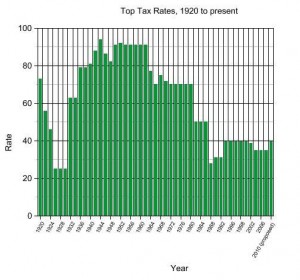
  • He mainly frames America's politics as a tension between Great Society liberal welfare statism and Reagan-era economic deregulation, but I think this picture is no longer accurate today. In the first place, it's not the case that today's liberals are fighting to undo the Reagan revolution: Reagan won that war, and liberals conceded long ago. To see this, just check out what marginal tax rates were like before and after Reagan took office:

    During the Great Society era top marginal rates were up around 80%; by the time Reagan took office they had already been coming down quite a bit, but part of Reagan's legacy is that that level of taxation is permanently off the table. Of course, taxation is more than just the top marginal income tax bracket--but I find this to be a useful barometer for the overall level of taxation a population is willing to bear. Keep in mind that accompanying this were decreases in the capital gains tax and, at the state levels, significant rolling back of property taxes, following the Prop. 13 "tax revolt" in California. No serious liberals today propose we fully reverse these cuts and return to Great Society levels of taxation, and even the mainstream Democratic establishment favors pro-market policies such as free trade and economic incentives such as cap-and-trade rather than direct government regulation and intervention. We live in a supply-side America.

    Secondly, not only is the conflict that Manzi sets up already resolved, but he misses the crucial point that the fiscal sins that have occurred since Reagan have been largely perpetrated by the Republican party and (too many) centrist Democrats. I don't want to make this too partisan a point, so maybe I'll just say this: since Clinton took office, we've seen the California-fication of the federal government, where de facto supermajority requirements in Congress--the Senate specifically--make it impossible to implement tough decisions (like increasing taxes or cutting entitlements), and yet still allow politically popular spending initiatives to go through (like Medicare Part D and the Bush tax cut). By the time the financial crisis hit, and Bush was forced to pass a stimulus bill and a Wall Steet bailout (yes, Bush did both those things; Obama then passed a second, far larger stimulus bill), the US found itself badly overextended, and with mounting health care costs to boot.

    So the narrative is not Great Society social cohesian vs. Reagan supply side economics forever dueling for our national soul; it's more like, Reagan wins, then the Republicans totally lose their bearings and abandon conservative fiscal principles while in power, and then meanwhile leverage an increasingly disfunctional Senate to obstruct any Democratic reforms from coming through.
  • Manzi shows here he doesn't understand the rationale for stimulus spending:
    Only about 5% of the money appropriated is intended to fund things like roads and bridges. The legislation is instead dominated by outright social ­spending: increases in food-stamp benefits and unemployment ­benefits; various direct and special-­purpose spending relabeled as tax credits for ­renewable-energy programs; increased funding for the Department of Health and Human Services; and increased school-based financial ­assistance, housing ­assistance, and other direct benefits.
    The point of stimulus spending is to increase overall demand in the economy. You can do this by building roads and bridges, yes, but you can do it just as well by, say, lining the pockets of a poor person with some cash that he will be certain to spend in the near future (like, say, on food). What matters is the stimulative effect of the spending, not on whether the spending happens to be on infrastructure or more welfarish services.
  • More:
    All told, finance, insurance, real estate, automobiles, energy, and health care account for about one-third of the U.S. economy. Reconfiguring these industries to conform to political calculations, and not market-driven decisions, is likely to transform American economic life. And the fiscal consequences of the spending involved will be enormous. The federal budget deficit for 2009 was about 11% of gross domestic product, which is far higher than any the United States has experienced since World War II. This deficit spending is the real stimulus. Something like 10% of all the economic demand in the United States is supported by government borrowing from the future, which is essential to propping up the current "recovery."
    Gah. Where to begin. First: "This deficit spending is the real stimulus." That. Is. The. Point. The whole point of fiscal stimulus during a liquidity trap (i.e., when the Fed's interest rate is at 0% and cannot be lowered any further) is that the government's deficit spending props up demand until the economy gets going again. It's no big secret that stimulus spending is deficit spending. Second: nobody is reconfiguring the real-estate industry. Nobody--and it's a shame, really--is reconfiguring the finance industry. As for energy, cap-and-trade is a market solution--no different in principle than a carbon tax. Health care you can make more of a case for, obviously, but it's also true that a) the government already accounts for a high percentage of medical spending in the US, since we have, you know, socialized medicine for everyone over the age of 65, and b) the whole aim of the current health care reforms is that they will reduce the deficit over the course of a ten year time frame. Third: in economic terms, there's no difference between a recovery and a recovery with scare quotes around it--a recovery is a recovery, a job is a job. Conservatives seem to have this thing where a recovery fueled by government spending is somehow "artificial", or that jobs created by the government aren't real "jobs" (make-work, I think the term is they use). But this isn't a meaningful distinction at all (that said, I think you really can call the current recovery a "recovery", not because it is propped up by government deficit spending, but because it's a jobless recovery--asset prices are coming back up--yay Adobe stock--but unemployment remains sky-high at 10%--boo human misery).
  • Here Manzi makes some proposals without giving an ounce of thought as to their consequences:
    we must unwind some recent errors that fail to take account of these circumstances. Most obviously, government ownership of industrial assets is almost a guarantee that the painful decisions required for international competitiveness will not be made. When it comes to the auto industry, for instance, we need to take the loss and move on. As soon as possible, the government should announce a structured program to sell off the equity it holds in GM. Similarly, the federal government should relinquish direct control of banks and insurance companies. Moreover, one virtue of the slow rollout of spending under the stimulus bill is that most of it can be stopped — and should be.
    Look. If these were normal times, and GM was going under, you know what? I'd be as solemn as the next guy in saying that it should die a natural death. But these aren't normal times; these are perverse times. Here is what I think happens with folks like Manzi: in normal times, we get accustomed to the idea that markets, among other things, give you information: if the price of apples goes up, that tells you something about the supply and/or demand for apples. If a business goes under, that tells you something about the quality of its products and/or the efficiency of its processes. If an individual or company goes into debt, that tells you something about the financial decisions about that individual or company. In other words, though the market may cause pain--for example, the slow death of the American auto industry--the pain is justifiable, and in the long run it's better for everyone to suffer the pain now and move on so that the overall economy can continue to perform at a high level. And I'm more or less fine with all that. But the thing is, all that's only true in normal times, when markets are functioning. But when the financial crisis and recession hit, markets stopped functioning properly. Prices no longer reflected value; they reflected the fact that everyone was selling in a panic at the same time. Companies started failing, not because their products were of low quality or inefficiently made, but because they could not get the credit they needed to keep their business running. Saving, in normal times a virtue, suddenly became a collective vice, as the force of everyone pulling back spending caused demand to drop and the recession--and unemployment--and the condition of everyone's pocketbooks--to worsen. As Paul Krugman likes to say, we're through the looking glass--markets are no longer giving us good information about the real world.

    And so you can't just cut GM off. Because, even if GM deserves to die, surely other car manufacturers with factories in the US like Toyota and Honda don't deserve to die, too. And yet that's exactly what could have happened if GM went under, because of a "supply shock"--the companies that sell parts to GM would have gone under, and the assembly lines of the other companies they sell to would have ground to a halt--which, in the midst of the worse recession since 1928, could have led to scary results indeed. And you can't just unilaterally sever the government's stake in the big financial entities like AIG--because this could trigger a panic and another financial meltdown.

    Finally, you can't just revoke the stimulus. Or, if you do, you better tell a damn good story as to where the demand is going to come from that's going to lift this economy back up and bring unemployment back down. Everyone agrees that normally, with a non-zero interest rate, you would lower that rate and induce spending and investment that way. But we're at 0%, and can't cut the interest rate. So rather than inducing demand, we're straightforwardly creating it via federal deficit spending. The spending will roll out over the next couple of years, but, that's okay, because unemployment will remain high for at least that long. So you think this is a bad idea? You think the underlying economic principles are unsound? You think perhaps that stimulus won't have a significant impact, or maybe, alternatively, that the costs of a higher deficit outweight the benefits of stimulus? Fine. But tell us what your argument is.
  • ...


Well, this post is getting out of hand--I think you all get the picture. But let me be quick to reiterate: I don't think Manzi's essay is lacking because I disagree with its conclusions. I think it's lacking because it doesn't offer any arguments against opposing views or explain in any discernible way the rationale for its own views. Hopefully, either Manzi or someone of his ilk will get around to making a case that we can all sink our teeth into.

Saturday, October 31, 2009

Why politics is boring

It's a recurring theme for him, but Ezra Klein once again does a good job of summarizing what is wrong with the American political system: the Senate. It's broken. And you can have a million pundits write a million articles and posts and do a million interviews about this or that tactic or strategy or poll or gaffe, and it's all noise, because the simple, boring, underlying reason that we're in the position we're in is because it takes sixty--sixty--goddamn votes in the Senate to pass a law.

As the refrain goes: We're all Californians now.

Tuesday, September 15, 2009

Crisis on infinite CNNs

I haven't posted much since coming back from vacation because every time I sit down to knock something out, I find myself staring off into the middle distance and going, "Urrrmmmmm..."

The thing is, politics is, for the most part, pretty dumb. As in: not intellectual. It's a lot of people posing--affecting airs of being Serious or outraged, of thinking themselves caught up in some exciting, historical struggle for Something Or Other. But most of these people--the politicians, the pundits--they're just so awfully mediocre. Such forgettable people. And sometimes I think it's a real shame that I spend so much time and energy engaging with all of it. Just what do I think I'm doing, exactly? What is this, this me giving my two cents about every dumb non-issue that comes down the chute from the NYT, Sullivan, Yglesias, and the rest of it?

The thing is, I'm not really a guy who does a lot. It's not like I'm particularly politically active, or go volunteer and so forth. I'll donate some money here and there, but nothing that requires a whole lot of commitment. Even when it came to Obama, the most I could muster was dragging Marian along to go knock on a few dozen doors. I never even made a phone call. So: it's not like I'm some "player" and that this blog is, I don't know, doing something for me. It's pretty much just here because the thing I really like to do is to argue and write essays and try to find clever ways to be contrarian.

And, you know, that's fine. But what I'm finding is that, well, politics isn't a very great vehicle for the kind of argument/essays/etc. that I had in mind. I mean: how many times can you argue for things on the merits? It's not like there are many issues out there that are genuine puzzles that need solving; the issues are long solved, it's just that what remains is the purely political task of getting them implemented. But that requires political action--not further discussion.

So, I dunno. I'm thinking of taking a step back from all the nonsense. For a while I thought about trying to introduce into the blog what is probably my biggest competitive advantage as a writer--some comedy--but honestly I just can't think of an angle. I mean, I think if I could carve out a niche as sort of a funny Yglesias, that would be something, but, man, would that ever be difficult pull off...I think you can end up in partisan-hack territory real quick with that. But there are other things, too: for example, I like how Coates' blog is a little more personal and veers into pop culture more. So, like I said: I dunno. I guess we'll see what develops.

Tuesday, August 18, 2009

The problem with Peter Suderman's argument


Libertarian Peter Suderman deploys a familiar kind of argument:

No, I don't think this is a failure of leadership so much as a feature of democratic politics -- and a reminder of how unpleasant and unsatisfying to nearly everyone the business of politics can be.

Democratic politics is a messy business. It's disorganized and frantic and unpredictable and frustrating. Politics is a matter of shouting, and dissent, and deal-making, and strategy, and slippery rhetoric, and compromise....

...

Given my libertarian streak, I'd also add a final thought: The way to avoid the maddening convulsions of politics isn't to change them, or rise above them, or move past them, or transform them, or whatever the trendy term of art is on any given day. It's to avoid them -- and reduce their power to hold sway over how we live. And the more decisions about our lives and welfare we put in the hands of politicians, the harder that will be to do.

It's kind of a sly move that you get from many small-government types, that goes something like this:
  1. Politics--the collective activity of everyone in the country deciding laws--sucks, and ends in sucky results.
  2. It is better to have less of a sucky thing.
  3. Therefore there should be "less" politics. (1, 2)
  4. We should support policies that make government--and therefore, the sphere of politics--"smaller". (3)
There are a couple of problems with this argument. In the first place, (2) is not necessarily true--you may not want less of a sucky thing, if the alternatives are even suckier. There is ample empirical evidence that health care systems that feature more government involvement than ours are more efficient and lead to better results than our system. This doesn't mean that such a system wouldn't suck: it's just that it would suck significantly less than the status quo. To turn Suderman's invocation of Churchill on its head: single-payer is the worst health care system, except for all the others.

Second, if you delve a little further into (1), it becomes apparent that it doesn't make sense to use this claim about the activity of politics in general (which Suderman identifies as the "matter of shouting, and dissent, and deal-making, and strategy, and slippery rhetoric, and compromise" that accompanies law making) as a stepping stone to a claim about preferring a specific, first-order set of policies (i.e., libertarian ones). The reason is that, after a moment's reflection, we see that what is actually maddening about politics isn't the process itself, so much as the dismal first-order results it produces. If we lived in a world in which the shouting was every bit as loud, the dissent every bit as pitched, the deal-making, strategy, slippery rhetoric, and compromise every bit as unsavory--but political success, for all that, could actually be achieved--then it wouldn't be very maddening at all. The source of the frustration isn't that mean people on TV yell--it's that, despite sweeping Democratic majorities, meaningful health care reform still goes down in flames. Given all this, it hardly solves any problems to say that, hey, we should adopt a libertarian agenda since that will get this unsavory politics business out of our lives--because that's just coextensive with saying that we should abandon the (non-libertarian) first-order policies that I prefer, the very non-enactment of which is causing my resentment of politics in the first place.

So, nice try libertarians. But if you want to make your case for a specific set of policies, it's going to have to be a substantive one made on the merits, not this "hey-ain't-politics-a-drag-I-know-let's-abolish-entitlements-then-there-won't-be-so-much-politics" mumbo-jumbo.

Monday, August 17, 2009

Correction

In a recent post I asserted that the Democrats were likely to pick up seats in the midterms. However, Nate Silver thinks otherwise:

As I've been telling people all week here in Pittsburgh, there's ample reason for Democrats to be worried -- perhaps deeply so -- about 2010. Without major intervening events like 9/11, the party that wins the White House almost always loses seats at the midterm elections -- since World War II, an average of 17 seats in the House after the White House changes parties. Democrats have substantially more seats to defend than Republicans, particularly in the House. They appear to face a significant enthusiasm gap after having dominated virtually all close elections in 2006 and 2008.

...

The Senate picture is a bit brighter for them, but they are probably more likely now to lose seats in the chamber than to add to their majority, in spite of the spate of Republican retirements in Ohio, Missouri and other states. In a wave-type election, a net loss of as many as 4-6 seats is conceivable.

Friday, August 14, 2009

Obama vs. the Right


Krugman's new column makes the case that Obama's attempt to be post-partisan and bring Democrats and Republicans together was naive and mistaken:

“I am in this race because I don’t want to see us spend the next year re-fighting the Washington battles of the 1990s. I don’t want to pit Blue America against Red America; I want to lead a United States of America.” So declared Barack Obama in November 2007, making the case that Democrats should nominate him, rather than one of his rivals, because he could free the nation from the bitter partisanship of the past.

...

Sure enough, President Obama is now facing the same kind of opposition that President Bill Clinton had to deal with: an enraged right that denies the legitimacy of his presidency, that eagerly seizes on every wild rumor manufactured by the right-wing media complex.

...

So far, at least, the Obama administration’s response to the outpouring of hate on the right has had a deer-in-the-headlights quality. It’s as if officials still can’t wrap their minds around the fact that things like this can happen to people who aren’t named Clinton, as if they keep expecting the nonsense to just go away.

...

What’s still missing, however, is a sense of passion and outrage — passion for the goal of ensuring that every American gets the health care he or she needs, outrage at the lies and fear-mongering that are being used to block that goal.

So can Mr. Obama, who can be so eloquent when delivering a message of uplift, rise to the challenge of unreasoning, unappeasable opposition? Only time will tell.


I think this article is good at showing why Barack Obama is President of the United States and Paul Krugman is not. The thing is, let's suppose that Obama "took off the gloves"--that he changed his tone to be more "outraged" and "passionate". What would this actually accomplish? Would it make Democratic Senators more motivated to pass legislation? Would it stop Glen Beck from doing his crazy Howard Beale act? Would it make ignorant, hysterical old white folks in town hall meetings any less ignorant or hysterical? I mean, game this out a little bit: what would be accomplished by adopting a 90s-era bunker mentality? Not much, so far as I can tell.

Meanwhile, there is an advantage to remaining calm, reasonable, amiable to negotiations--it's just that the advantage isn't really apparent until later. Remember, this isn't 1993: it is not as if conservatism is on the rise and the White House is merely trying to stand athwart things and yell "stop". Quite the opposite: Obama was voted in on an actual majority, not Clinton's 1992 plurality. The Bush years have discredited conservatism. What we're seeing now is the rump of the Republican party being particularly vocal. But Obama is still popular. The Democrats have huge majorities in Congress, and are showing no signs of weakness for the midterms--they might even gain seats. And the Republicans are alienating themselves from non-Southern-white America.

Moreover, everyone knows that health care reform--in some form--will pass. It may not be very good, from a progressive perspective--there may be no public option, it may be toothless in a bunch of different ways--but it will surely be a significant improvement over the current system, including provisions such as making it illegal for insurance companies to deny coverage for preexisting conditions. This will matter to a lot of people--and they will remember how the Democrats worked to improve their lives, and how the Republicans did nothing but scream and obstruct--and how, even in the 8 years before Obama, Bush didn't do a thing to reform health care. And they will conclude that Democrats are the "adults in the room"--and will vote to keep them in power.

So, to conclude: just because Obama is failing to end bitter partisanship doesn't mean he should stop trying to end bitter partisanship. The Republicans refuse Obama's olive branch at their own electoral peril.

EDIT: Apparently, Bill Clinton concurs.

Saturday, July 18, 2009

A conservative gets real

Via Ezra Klein, a pretty good interview with Bruce Bartlett who has the too-rare distinction of being an intellectually honest and perfectly reasonable conservative. Here he is on the benefits of a VAT (value added tax):

I think the administration made a mistake approaching the funding of health-care reform how it did and I think Republicans made a mistake refusing to seriously debate the issue or its funding.

The value-added tax would be a very appropriate tax to use for this purpose. One reason is I am disturbed that we have a large percentage of the population that pay no income taxes. And I know many of those people pay payroll taxes. But income taxes fund the general government. According to a study by the Tax Policy Center, 47 percent pay no income tax, or have negative liability. And I think it's bad for democracy when people get into the position when a majority can vote benefits for themselves but not pay for it. And that should disturb liberals as much as conservatives.

The VAT would necessarily be a broad-based tax. It would be a way of getting people to pay for the benefits they themselves receive. People like Len Burman and Rahm Emmanuel's brother [Ezekiel Emmanuel, a health care adviser to Peter Orszag] have supported this for some time. Len argues that if people knew the VAT was dedicated to health-care reform, and the rate rose and fell automatically with the spending of the system, they would have an incentive to hold down taxes. They would have some positive reinforcement we do not now have with Medicare. I hope that's right. You know, every other major developed country has a VAT: The parties of the left in Europe made a deal a long time ago: If conservatives will let us have a welfare state, we'll fund it conservatively. And I think that's still a good deal.

He also makes a good point about how a VAT would give the government an additional tool to stimulate spending in a recession:

And thinking about this from another perspective, suppose we had a VAT right now and we wanted to stimulated consumption. Reducing the VAT rate temporarily would be a wonderful way to stimulate consumption. Suppose you had a 10 percent VAT and we said we weren't going to collect it for the next 10 months. People would buy like crazy. They'd buy toilet paper, they'd buy anything they could get their hands on that they knew they'd need in the future. We're depriving ourselves of a great stimulant tool by ignoring this.

I think I agree with a lot of this. Even if a VAT is regressive, realistically it's the only way you're going to get conservatives on board with funding a welfare state--and it's nice that it has other benefits too, like its ability to work as a stimulus tool, and the fact that it would properly align incentives with regard to keeping the costs of healthcare in check.

Moreover, just generally speaking, I think lots of people agree that at some point we're going to have to shift to a less demand-oriented economy (currently consumer spending accounts for 70% of GDP), so it makes sense to shift the tax burden away from income and more towards consumption.

On a separate point, I think this interview really brings into stark relief how damaging it is for the country that there is no intellectually honest opposition party that offers serious policy alternatives. I understand that conservatives don't want an expanded welfare state and that they view the obstruction of its expansion as a worthy cause, but at some point this behavior takes its toll on the ability of the government to operate: if you relentlessly increase spending while refusing to raise revenue in the long term, the federal government will eventually just stop working (see: California). That's an outcome nobody should want, regardless of ideology.

Wednesday, July 15, 2009

Congress created the unpersons


Paul Krugman wonders why those who were in favor of a bigger stimulus package were considered "out of the mainstream" and left on the fringes of the debate:

One of the mysteries of the way issues are covered in much of the news media is how certain views get ruled “out of the mainstream” and just don’t get covered — even when many well-informed people hold those views.

...

...[T]he voices calling for stronger stimulus are, may I say, sorta kinda respectable — several Nobelists in the bunch, plus a large fraction of the prominent economists who predicted the housing crash before it happened.

But somehow, the pro-stimulus people are unpersons. Who makes these decisions?

I think this can pretty easily be explained by the fact that Democrats didn't do a good job of framing the debate.

The thing is, the mainstream media is not only very worried about keeping a nonpartisan reputation, but also very intellectually lazy. Thus, when an issue like the simulus package comes up, they wait and see what the Republicans propose and what the Democrats propose, and use those proposals as the right and left goalposts for the debate. Anything outside the goalposts counts as "fringe".

If the Democrats had boldly demanded say $1.8 trillion in stimulus, then this would have been seen as a "legitimate" (albeit very liberal) position, and Krugman and his ilk would be welcomed into the fold as representatives of the "respectable left". But as it happened, the Democrats misjudged and decided to lowball the figure (expecting it to go up), proposing under a trillion dollars of stimulus. The debate thus ended up being framed between those who wanted just under a trillion in stimulus versus those who wanted less (or none).

And, as others have pointed out, this same thing happened with healthcare reform: the Democrats didn't seriously propose a single-payer plan. Although obviously this never would have passed, it still would have set the left goalpost further out, giving Obama's public option plan some centrist cover. As it is, the public option is now framed as the most liberal plan on the table, which the mainstream media is unlikely to embrace.

(Photo "Goalposts-2" by huvisian)

Tuesday, July 14, 2009

The Sanford Panic


Something that struck me about the recent turn of events concerning Mark Sanford is how familiar the pattern was of his collapsing political support: it worked just like a bank run.

And this makes sense: just like with a bank, confidence in a politician is predicated on the belief that other people have confidence in that politician. So a sudden shock of lost confidence can trigger a self-sustaining feedback loop of further lost confidence: the more confidence is lost, the more likely it is that everyone will ultimately abandon Sanford, a realization that causes even more lost confidence, and so on.

But what is interesting about this case in particular is when the panic started, because it didn't start when the affair was unveiled--even despite his bizarre multi-day disappearance. Indeed, after Sanford had duly confessed in a televised speech and promised to atone for his sins, it appeared likely that his supporters would stand by him, and that he would remain in office. And when Michael Jackson's death took over the news cycle, conventional wisdom was that Sanford had lucked out and would definitely survive the ordeal.

The calls for his resignation eventually came--but only after his public confession/apology, as a result of an extended and very earnest interview with the AP, in which he made all sorts of heart-rending admissions and news-worthy observations that strayed from the usual prepackaged platitudes. From Politico:
“Two days ago there were very few people calling for his resignation,” said Rep. Bob Inglis (R-S.C.), who has not called for Sanford’s resignation. “It came out of that interview.”
And:
Another top Republican in the state said of the governor: “His support has collapsed.”
So what happened here? Well, I think it's not stretching things to put it this way: at a critical juncture, Sanford--with his odd behavior--spooked the investors. In American politics there are certain norms and rituals--certain scripts--which politicians typically conform to as a sort of kabuki. And while such rituals, in cases like these, inevitably lead to the most painfully inauthentic, glib expressions of human remorse, they also reassure supporters by signaling that they will be embarking on the same scripted set of steps that countless prior adulterous politicians have taken to successfully recover from scandal. It's the predictability of what will unfold that props up supporter confidence during this critical period.

When Sanford went "off-script", this sense of predictability vanished, and with it, his political support.

(Photo by Mike Licht, NotionsCapital.com)

Monday, February 25, 2008

An end to Pareto-suboptimal politics? Let's hope so

As anyone familiar with the primaries knows, Barack Obama talks an awful lot about hope--it's gotten to the point where he even addresses this fact in his stump speech. The first instinct is to let this schmaltzy boilerplate float out the other ear, but after a while you start to get the sense that Obama has actually invested some serious effort into developing his hope theme. Over time, in fact, I have come to think of it in terms of the fabled "Prisoner's Dilemma" problem.

***

The Prisoner's Dilemma is a thought experiment that illustrates how it can be that two self-interested parties rationally make a choice that does not maximize their payoff. In the scenario, two suspects are arrested for a crime and interrogated independently of each other. However, there is insufficient evidence for a conviction, and so the prosecutor must try to get them to testify against each other. Each suspect has two options: he can keep his mouth shut, or he can rat the other suspect out. If he keeps his mouth shut and his partner in crime does the same, then the prosecutor can't make a good case and they both receive a short, 6-month sentence on some minor secondary charge. If, however, the suspect keeps his mouth shut but his partner defects and rats him out, then the suspect receives the full 10-year sentence and his partner--the rat--goes free. Finally, if both suspects decide to rat each other out, then they both share responsibility for the crime and each receives a 5-year sentence.

Assuming that both suspects are rational self-interested agents--i.e., that they both just want to minimize their sentence--what is the best choice? Well, if I am a suspect, then there are two possibilities: either my partner stayed silent, or he ratted me out. If he stayed silent, then the best choice for me would be to rat him out, thereby allowing me to walk out of there a free man while leaving him with the full 10-years. However, if he ratted me out, then my best choice is still to rat him out--because that way I get the 5-year sentence instead of the full 10 years. And so I choose to defect and rat my partner out. Ironically, though, since my partner is just as rational and self-interested as I am, he comes to the same conclusion, and so we doom each other to a sub-optimal result: a 5-year sentence.

***

It only takes a little imagination to apply the Prisoner's Dilemma to the state of partisan politics over the last two decades. The Democrats and Republicans are like the suspects: locked in a dogged pursuit of their own agendas while all the while maintaining a rational distrust of the other side. When the Republicans control Congress, they shut the Democrats out of the legislative process--after all, why risk sharing power now only to be completely shut out when the Democrats regain control? When the Republicans seek a compromise on Social Security--allow some privatization, for instance--the Democrats reject it in toto. Why risk giving up an inch on Social Security now when the Republicans will surely take miles once they get a chance?

In this political environment, not only does the atmosphere become unpleasant--"poisonous" I think is the word often used--but the results become middling, and the progress incremental. We get Frankenstein legislative solutions--on health care, on energy--that are more about avoiding the worst possible scenario for both sides than actually effectively tackling the problem for the long-term.

However, there is a growing sense that the problems we confront as a nation are beginning to outstrip, in their sheer magnitude, the political mechanism we have created to handle them. Our health care system is not an ideological catastrophe for either side, but neither is it particularly effective. Entitlement programs are not on a sustainable track to accommodate projected increases in the elderly population. And as of today, there is basically no strategy in place for dealing with global warming (hint: ethanol subsidies won't cut it. Neither will ignoring empirical evidence).

In all this, there is a temptation to blame the self-interested nature of the factions involved. Why can't they put the national interest ahead of their own ideological agendas? But I don't think this kind of criticism holds water, because it misses the point: each faction really and truly believes that its ideological agenda is the national interest. The Democrats and the Republicans are doing nothing wrong by pursuing their versions of the political good--on the contrary, this is the very essence of democratic government. So I think it is not so much naive as incoherent to chide Democrats and Republicans for not "setting aside their differences" for the sake of the "national interest". If this is what is meant by bipartisanship, then bipartisanship is incompatible with the notion of representative government.

The proper target of blame is not the self-interested nature of today's political factions--theirs will always and should always be a rational political calculus that maximizes their own ideological payoff. Instead, we should blame the political environment that makes their calculus churn out sub-optimal results. Remember--the reason that politicians don't make effective compromises on long-term solutions isn't because they can't, but because it would be irrational to do so. Today's "5-year sentence" health care system is, after all, much preferable to the "10-year sentence" health care system that would surely result from letting the other side have too much leeway.

***

The goal, then, should be to change the political environment so as to shake up the political calculus on both sides, so that it is no longer irrational for self-interested political parties to cooperate on a meaningful level. But what does this mean, exactly?

Well, let's revisit our suspects in the Prisoner's Dilemma scenario. We might imagine that in this world there is a game-theory savvy Mafia boss who is sick and tired of his hired goons serving long 5-year jail sentences when they could, by cooperating, be back on the streets in a mere 6 months. Our Mafia boss, of course, is under no illusions about the self-interested nature of his goons, and so he decides to introduce an externality that will surely alter the suspects' interrogation-room calculus: he lets it be known far and wide that from now on, anyone who rats out their partner in crime will be tied to a large cement block and thrown into the Hudson River. This move is good news for our suspects! Now, if I am the suspect being interrogated, I know that if my partner in crime stays silent, then I should stay silent too, or else the Mafia boss will kill me upon release. Moreover, the fact that the Mafia boss will kill any rat guarantees that my partner in crime will not be ratting me out. The inevitable and optimal result is that we both get trivial 6-month sentences.

The question is: what kind of externality can we introduce in the political world that would alter the political calculus in such a way as to yield viable long-term solutions? What is needed is for there to be a high degree of confidence among the political factions that the other side will not take advantage of temporary power imbalances in the compromise process to bulldoze its own ideology through. The Democrats need to be confident that the Republicans will not use the limited privatization of Social Security as the first steps toward abolishing Social Security. The Republicans need to be confident that universal health insurance will not metamorphosize into an unwieldy government program that ignores market realities. Specifically, both sides need to be confident that such ideological power grabs will be politically punished--that the electorate will actually vote users of these tactics--the "rats"--out of power.

***

Enter Barack Obama, inexperienced one-term Senator with no executive background, an oratorical powerhouse that doesn't sound, look, or feel like anything in politics going. Judging him against the conventional criteria of a political candidate, he doesn't stack up all that well: he can spin a good yarn, sure, but substantively he brings nothing new to the table, and his untested meddle is a risk. Indeed, it is by precisely these sorts of metrics that the Clinton campaign has argued that Obama does not make sense as the Democratic nominee. Moreover, viewed from this perspective, the Clinton criticism of Obama's rhetoric as empty and naive is valid: it appears as though Obama thinks that, in thrall to his silver tongue, Republicans will magically jettison their ideological self-interest and support his standardly liberal agenda. Fat chance.

But the Clinton criticism misses the mark, because it fails to understand that Barack Obama is presenting the success of his very candidacy as the externality that will alter the political calculus of Democrats and Republicans and usher in a new era of good-faith politics and bold compromise. His very inexperience and political otherworldliness is crucial to his candidacy, because he needs to be credible as a true "Washington outsider"--someone who is not part-and-parcel of either side in the national political Prisoner's Dilemma, and who will not therefore engage in the same rational dead-end politics that have characterized both sides for decades. Moreover, he needs to demonstrate in his character, his rhetoric, and his political methods that conciliation and empathy are dominant values, and that political opponents will not be shut out of a Democratic regime. Those on the political right need to be assured that their arguments will be heard and taken seriously, and that, yes, they will even be given some power when in the minority to steer and participate in the national agenda. If Obama succeeds in embodying these values--and wins in virtue of them--then he will have remade the political landscape on the day of his election.

The extremely nifty thing about all this is that, if it works, it will not be because of any special talent of Obama's, particularly, or anything specific he is likely to do once in office. Indeed, a persistent rhetorical theme in his speeches is his status as a vessel--the political power doesn't originate from him or his silver tongue, but rather, from the vast and diverse movement for change that he is the arbitrary placeholder for. If he is elected President, he will take office in a radically different political reality, one where a totally inexperienced outsider stormed into office on a message of conciliation and compromise. The mandate will be obvious and indisputable, and it will be all the empirical assurance the Democrats and Republicans need in order to have high confidence that those who abuse political conciliation for undue ideological gain will no longer be tolerated by the electorate.

***

Viewed with all this in mind, Obama's rhetoric of hope, unification, and change suddenly makes sense, and the words--so deadened over the years by standard partisan boilerplate--turn out to be doing some serious work. His whole body of rhetoric supervenes on the elaborate, technical arguments I have outlined above. "Hope" is not just some sense of vague optimism that everything will turn out okay. It is the confidence we need to have in each other that, though we disagree, we will work in good faith towards pragmatic solutions and not attempt to hijack the process for our exclusive ideological gains, or unfairly demonize the opposition. If Barack Obama is indeed elected on the hope message, then in virtue of self-fulfilling prophecy we will all have a good empirical reason to believe that our hope will be rewarded by the hope of others--after all, we all voted for hope, right?

This notion of hope plays into his other rhetorical obsession--"unity", or "transcending partisan differences". Many commentators are baffled at how Obama can claim to be a unifying force in our politically divided nation while at the same time championing an indisputably Liberal agenda. They wonder what "transcending the partisan divide" means in terms of concrete policy details--does it mean that he will "triangulate" between the two sides and adopt centrist positions? Does it mean he will somehow persuade Conservatives and Independents to rally around traditional Liberal causes? But I think these commentators are mistaking the dynamic property of a candidate's political and negotiation methods for the static property of a candidate's policy preferences. Obama has always conceded that, at the end of the day, he is a Liberal and a Democrat--and, in an ideal world, would like to see the Democratic agenda fully implemented. In that sense, he transcends nothing. But in the sense that he explicitly acknowledges that whatever solutions we do end up passing cannot be defined at present, and that their substantive shape will take form organically in a yet-to-be-determined political environment of mutual conciliation, he really is transcending the partisan divide. It's just that the "transcendence" is in the process, not the policy details--and that it won't take place unless and until he actually gets elected President.

The Clintons once described the nomination of Barack Obama as "a roll of the dice". I agree with this. By nominating Obama as the Democratic candidate, Democrats--and Liberals and left-leaning Independents in general--will be signifying their intention to break free of the Prisoner's Dilemma politics of the last two decades and recast the political landscape as one that is more germane to sober conciliation and compromise. But the other half of the electorate might not be on board with the project. Indeed, if Obama loses the general election or wins on a razor-thin party-lines vote, Obama's political raison d'etre will have vanished, and we will be stuck with either a loser or a President ill-prepared for battle with the vaunted Republican "attack machine".

However, if Obama sweeps into office on the crest of a Reagan-like political realignment--an ideologically diverse mix of Democrats, Independents, new voters, and even some Republicans--then the roll of the dice will have been well worth it. And at this point, I'm not sure what other outcome is worth the hoping for.