I was really excited to discover today that San Francisco is implementing a plan to build an integrated system of "smart parking meters" that will be able to track parking capacity in real time, and also adjust prices depending on parking demand. So not only will you be able to see online how many and which parking spaces are available, but higher prices in peak periods will ensure that there is always parking spaces readily available (and in slow periods, lower prices will ensure that parking capacity is being used efficiently).
The program is in the pilot phase right now, and will come online in a few neighborhoods around the city this summer (including the Mission, between 16th and 24th).
Generally speaking I'm in favor of any and all policies that do something to set a proper price on driving--whether that means a carbon tax, tolls, market-priced parking, etc. So long as we continue to subsidize driving by offering cheap gas, free roads, and free parking (including the government mandated building of parking structures and parking lots), we'll be stuck in sprawling, trafficky cities that don't work very well. Setting a price on these scarce goods--parking space, road space, etc.--will change people's behavior, encouraging more carpooling, more public transit usage, more biking, and more off-peak usage of the city's roads.
Or at least, so the theory goes. It will be interesting to see what the data from the pilot program ends up telling us.
Showing posts with label parking. Show all posts
Showing posts with label parking. Show all posts
Monday, June 21, 2010

Friday, July 3, 2009
Free parking revisited
A while ago I posted about the trouble with free parking, which led to some substantive comments worth promoting to a post. Here they are:
2 comments:
Saturday, May 30, 2009
The trouble with free parking
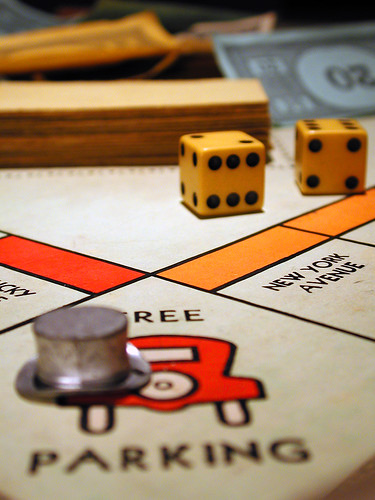 We're all familiar with the basic economic principle that if you underprice something, you cause long lines for--and shortages--of that thing, and that if you want that thing to be produced and consumed as efficiently as possible, you should let the free market set its price. Yet somehow, we all seem to have our blinders on when it comes to applying this principle to parking spaces, as Matt Yglesias explains:
When I took economics, we had a little squib in there about price controls. But it was about something nobody would actually think to do these days . . . mandatory cheap bread or something. It was a historical example. At any rate, it’s overwhelming conventional wisdom in the United States that price controls are bad. If I suggested that the city implement price controls on Diet Coke, people would say that it would lead to shortages. And if I proposed dealing with the ensuring shortages by saying that anyone who wants to build a new building needs to also provide millions of dollars worth of Diet Coke to people in the neighborhood, people would look at me as if I were insane. Creating the Diet Coke shortages is not a favor to anyone—neither fans nor haters of Diet Coke benefit—and the regulatory mandate is an absurd subsidy to Diet Coke drinkers with no conceivable policy justification. It’s bizarre. But people have a strong bias toward the status quo, so they tend to assume that status quo policy just must be non-bizarre, no matter how at odds it is with everything else.
It kind of reminds me of dollar beer night at the racetrack. At first you're all excited--beer for only $1!--but when you get there, and you see the gigantic lines, and realize you'll have to wait for like half an hour just to get a stupid Budweiser, you end up wishing that it was more like $3 or $4 beer night. Well, the same applies to parking here in San Francisco: it is basically 0$ parking night every night. And so you get the long lines...
(Photo by Mark Strozier)
Subscribe to:
Posts (Atom)
You know, these free market principles make a lot more sense if you assume everyone has the same amount of money, and hence the dollars they allocate to something represent exactly their 'desire' for that object. So the person who wants it the most gets it, with the least fuss.
Fine, you can say that the people with more money have more entitlement to stuff, that is the idea of capitalism anyway. But when it comes to basic needs, yes, like parking, it's meant to be something everyone can get. So free market can totally screw it. The richest people get it, even if they don't want it that much (a bit of a stretch), and maybe even abuse it.
It's more of an obvious problem with, for example, gas. If there's a limited amount of it, and prices soar, then rich folks can use it to excess, and poor people can get seriously screwed. So price caps as a form of socialism seem necessary, even though it makes the distribution much less efficient.
I don't think what you're saying makes a whole lot of sense. You seem to have slipped into the mindset that goods and services are just magically already there in set amounts, and that what happens on the consuming end has no effect on what happens on the producing end.
But consumption drives production. If gas becomes very scarce, it is in everyone's interest for prices to reflect this (for them to "soar"), not because the rich are "entitled" to anything, but because high profit margins in the gas business will encourage people, in the aggregate, to divert more resources into producing more gas, and so there will be more gas for everyone, and prices will go back down--for everyone. Or, alternatively, if the gas supply cannot be increased any further (if we have reached "peak gas"), then the high cost of driving a gas-powered automobile will start to make non-gas-reliant modes of transportation more competitive, and people will find it profitable to start diverting resources into developing those new industries and technologies.
So I think in this case you are guilty of "shooting the messenger"--you're blaming the price for the problem, when really the price is just indicating the real problem, which is that the tradeoffs of producing this good--gas--are becoming too costly in comparison to other things we could be spending our time and energy on. By introducing price controls you're just "living in denial"--delaying progress by keeping everyone in the same spending pattern on the same products, even as the quality and access to those products steadily declines.
Of course, this free market pricing mechanism can't be applied to everything--sometimes there are extenuating circumstances. For example, with healthcare, we might decide that it's morally unacceptable to deny a poor person medical coverage in an emergency, and then find ourselves on a slippery slope, so that by the time we're giving away ER care for free, it actually is more efficient to give that person access to less costly preventive care that would prevent the costly trip to the ER in the first place. And so--boom--you're on your way to some form of socialized medicine. That's just fine.
But there are no such slippery-slope-inducing moral imperatives regarding parking spaces! Only a child of Los Angeles could believe something so patently absurd as the idea that "free parking" is a "basic need". It reminds me of the Woody Allen quote about LA: "I don't want to move to a city where the only cultural advantage is being able to make a right turn on a red light".