Sunday, November 22, 2009

MST3K takes a stand for robot gay marriage

Did you know that Tom Servo and Crow once nearly got married?


UPDATE: It turns out Mike is a Republican? Says Wikipedia:

Mike Nelson rarely discloses his personal beliefs in public.[8] During a 2004 interview with the fansite MST3K Review, Nelson described himself as a Protestant and a conservative: "I read the National Review cover to cover. Check in at Townhall.com every day. Check the Washington Times daily. Listen to Dennis Prager and Michael Medved on a regular basis. Read Mark Steyn with regularity. Read the Weekly Standard. So, yes, I do vote Republican."[9] He went on to refer to the Minneapolis Star Tribune as "the Star and Sickle, or the Red Star Tribune."[9] Nelson also stated that he believed that the devil "was behind American Beauty. And Pulp Fiction was one of his better works, too."[9]


That sounds kind of ugh-y, but actually going to the source cited revealed this much more modest statement:

I’d call my politics center/right, and since politics intersects one’s whole philosophy of life, it’s hard to pin down a when. Whatever the case, I try very hard to keep politics out of my work and not to be too public with my thoughts because it’s just not my area of expertise. I write funny stuff. [I’m] not so good with politics. Maybe someday I’ll write on it, but as of now, the world is safe.

Sounds to me like a guy who understands that he and his fan base are not ideologically aligned.

Thursday, November 19, 2009

Tuesday, November 17, 2009

Sunday, November 15, 2009

Testing Artest


When the Ariza-Artest trade first went down, my general opinion was that it wasn't nearly so bad as people made it out to be--that, sure, it would've been nice to keep Ariza but Artest is certainly comparable.

But the more time goes by, the more worried I get that this was, in fact, a pretty bad move. Artest hasn't really impressed me so far: he seems kind of slow and lumbering on defense, and hasn't seemed to hit any kind of rhythm offensively. Meanwhile, Ariza is just getting better, as everyone predicted he would.

So the Rockets-Lakers matchup tonight should be an interesting test, as I'm sure both players will be playing hard to show up their former teams.

Fantasy aside: Josh Howard is injured "indefinitely"--which completely fucks me over. Thanks, fantasy basketball, for making me care about Josh Howard's ankle.

An interesting point

From Matt Yglesias:
I think it’s pretty clear that international terrorism has some dimensions that go well-beyond ordinary law enforcement, but if you have to put the whole thing in either the “crime” box or the “war” box, there’s a pretty strong case for erring on the side of crime.

In political terms, the right likes the war idea because it involves taking terrorism more “seriously.” But in doing so, you partake of way too much of the terrorists’ narrative about themselves. It’s their conceit, after all, that blowing up a bomb in a train station and killing a few hundred random commuters is an act of war. And war is a socially sanctioned form of activity, generally held to be a legally and morally acceptable framework in which to kill people. What we want to say, however, is that this sporadic commuter-killing isn’t a kind of war, it’s an act of murder. To be sure, not an ordinary murder—a mass murder—but nonetheless murder.

Wednesday, November 11, 2009

Oh, Yoko's alright

Tuesday, November 10, 2009

A mind poisoned by fantasy

I knew going into it that participating in an NBA fantasy league was going to have an impact on how I follow the sport--but I didn't realize the effects would be so instantaneous. I'm already secretly hoping that Lebron James gets swine flu and has to sit out the rest of the week...

Some day, one big wall?

This sort of thing is always interesting. Apparently Rupert Murdoch has plans to 1) erect a pay wall around all online Fox Corp content, and 2) block Google from indexing Fox sites. Not sure what there is to gain from (2)--maybe because he doesn't want Google caching the content of the sites?

In any case, it'll be interesting to see if the Great Fox Wall business model pans out. Conventional wisdom on the web says it is doomed to fail--that it will simply be undercut by comparable sites that offer their content for free. I tend to agree with this conventional wisdom.

On the other hand, though, it seems that at some point, newspapers and other content providers are going to have to start making money on the web in order to survive. A pay wall might work for some cases of specialized content--for example, the Wall Street Journal (which is behind a pay wall, and has been doing quite well). But I don't think it would work for general news and entertainment content--unless, maybe, you made the wall big enough?

The world can definitely learn to live without Fox, but could it learn to live without, say, Fox plus the major movie studios, major newspapapers, and big TV networks? If there were a critical mass of sought-after content behind one big universal pay wall, I could see a subscription model working--you buy one key that opens many doors. The companies behind the pay wall could then share the subscription revenue using some equitable sharing formula (based on, say, traffic numbers).

Hmm..

Monday, November 9, 2009

Kobe on the block


I haven't been watching the games, but I thought this was an interesting observation over at Forum Blue and Gold:

• This season, 36% of Kobe’s shot attempts have come out of the post. Last season that was 14%.

• I don’t expect the percentage to stay that high for Kobe when Gasol and Bynum return and need post touches — Phil Jackson said as much postgame the other night — but if team’s don’t adjust the Lakers should keep giving it to Kobe on the block.

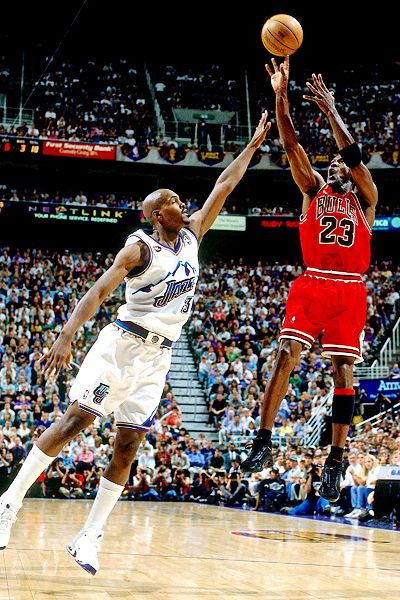
In general, I've often wondered why Kobe hasn't gone to more of a late-period-Jordan post game. I feel like with his repertoire of fade-aways, spin moves, and drop steps--plus the ability to draw favorable whistles--he'd be far more efficient in the post than when he resorts to his patented impossible-to-hit-contested-20-ft-jumpers-that-he-somehow-makes-sometimes shtick. Moreover, I think once Kobe gets within 10-15 ft of the basket, his FG% goes way up--although that's just a gut impression, unsupported by data.

Thursday, November 5, 2009

A rationale for hate crime laws

I left a fairly lengthy comment on a thread that I didn't realize till afterwards was probably dead. Oh well; here's the post, and here's my comment:

How about this:

When an attack on someone is motivated by racial hatred, the crime is compounded, not because the attack itself is somehow made worse due to the attacker’s hatefulness, but because the attack signals–as a matter of fact–a credible death threat against a group of people (gays, in this case). In other words, killing someone because they are gay–besides being an obvious act of murder–is also equivalent to sending a threatening note to every gay person in the community that reads: “I’m going to kill you.” And issuing death threats is, of course, against the law.

The important thing here is that the death threat component to the crime is purely an empirical finding: it is only due to the specific history of violent crime in this country that some classes are credibly “threatened” by hate crimes while other classes are not. So, for example, because there is no history of philosophers being singled out for attack, an attack motivated by hatred for philosophers does not constitute a credible death threat against the community of philosophers. But for a different class, say black people, the threat would be all too credible.

Interestingly, I think using this rationale you could also justify similar “hate crime laws” for situations not involving a broad class such as gays or blacks. For example, say the Hatfield and McCoy families have a long history of attacking each other. If John Hatfield attacks Bill McCoy out of a general hatred for McCoys, then I think you could make an empirical case that all members of the McCoy family were credibly threatened, and that therefore this death threat component should be added to John Hatfield’s crime.

So in the end, the rationale for laws against hate crimes reduces to the rationale for laws against issuing death threats. The final equation is “hate crime = violent crime + death threat”.

What do you think?

(PS: Another interesting twist to this is that I think the requirement that the death threat component be “credible” could have a mitigating effect in some cases. For example, in a town in which KKK attacks are common, a hate crime against a black person would constitute a very credible threat against the wider black population–after all, this is a group of likeminded people whose stated aim is to terrorize blacks and other minorities. However, if the attacker was just sort of this lone actor in a place where racially motivated crimes were extremely rare, the crime wouldn’t pose much of a substantive threat to others–it would mostly be discounted by the targeted minority as a freak occurrence. In this case, I don’t think a hate crime charge would be warranted–because the assailent in this case lacked the capacity to threaten anyone by his crime.)

Maine, gay marriage, Mr. Rogers, etc.

Katai has a good 'un.

Wednesday, November 4, 2009

Let the Artest era begin

"You know if somebody hits me, I'm going to react. I got hit with about three elbows. It's just not fair. I don't want to fight, I don't feel like doing it. If you throw an elbow into Ron Artest's chest, do you know who you're hitting?" -Ron Artest

Sigh. Here we go...

Monday, November 2, 2009

Breyer v. Scalia

Today I saw an interesting bit on C-SPAN, where Justices Stephen Breyer and Antonin Scalia sparred on the merits of their respective approaches to interpreting the law. Scalia, a so-called originalist, believes that in deciding the law you should rely almost exclusively on what the text says and what the original intent of the law was when it was written, and is extremely wary of any sort of approach that implies that what laws mean--particularly those set forth in the Constitution--evolves over time. Breyer, on the other hand, believes that this is an impractical approach because the conditions in which those laws were created and in which the rationale for the laws emerged do not exist in modern society, and that a modern society could not function under a Constitution that was so anachronistically interpreted.

I was sympathetic to both sides, but one thing that didn't seem to be addressed was the fact that the reason, it seems to me, that they find themselves in this box in the first place is because the Constitution is so damn hard to amend. Passing Constitutional amendments is rare, and passing ones that are in any way controversial whatsoever is impossible (indeed, the Bill of Rights basically came with the Constitution; and the 13th, 14th, and 15th amendments only went through because there were no Democrats to vote against them--they had seceded). This means that, though the society itself may evolve considerably, the Constitution that governs it will remain frozen in place, allowing a very small minority to stop any kind of progress from happening at all. Of course, I'm not saying that there shouldn't be some supermajority requirements in order to amend certain basic rights--there should be (that's what makes them rights). It's just that the supermajority shouldn't be quite this difficult to achieve. The Framers, in other words, badly miscalibrated the mechanism for amending the Constitution.

And so Scalia's position, which I think is the more intuitive one, becomes unworkable--it would lead to a society in total disharmony with the supreme law of the land (imagine, for example, that Plessy v. Ferguson was never overturned). A more expansive interpretation of the Constitution, though, allows you to effectively change the Constitution extra-legislatively, relieving the tension between a modern, morally evolving society and a rigid Constitution. In fact, you could even say something like: the expansiveness of interpretation that is required to effectively govern with a Constitution is proportional to the difficulty of amending it.

So in the end, judicial interpretation, it seems to me, is tied to the basically empirical political realities presented by a Constitution that does not function very well. And whereas folks like Scalia see their task as mechanistically following their interpretive principles regardless of this fact--fiat justitia ruat caelum--other folks, like Breyer, see their task as doing the best they can to pragmatically apply an ancient document to a modern and dynamic society.

The federal budget as a reflection of America's character

The amount of defense spending in the federal budget is truly mind-boggling, and, I think, pretty sickening too. This year alone we will be spending $680 billion on defense--not including the wars in Iraq or Afghanistan. Meanwhile we are busy haggling over a health reform bill that will cost a mere $90 billion per year ($900 billion over a 10 year time frame).

I wonder if some day we will have a political culture that is capable of saying "no" to military spending.