Showing posts with label media. Show all posts
Showing posts with label media. Show all posts
Wednesday, February 17, 2010
All the conventional wisdom that's fit to print
Remarkably, there is an entire article in the NYT about "party gridlock in Washington" that doesn't even contain the word "filibuster", let alone any explanation of its historically unprecedented abuse. It's "analysis" like this that prevents me from feeling all that bad when I hear that newspapers are going under.

Tuesday, November 10, 2009
Some day, one big wall?
This sort of thing is always interesting. Apparently Rupert Murdoch has plans to 1) erect a pay wall around all online Fox Corp content, and 2) block Google from indexing Fox sites. Not sure what there is to gain from (2)--maybe because he doesn't want Google caching the content of the sites?
In any case, it'll be interesting to see if the Great Fox Wall business model pans out. Conventional wisdom on the web says it is doomed to fail--that it will simply be undercut by comparable sites that offer their content for free. I tend to agree with this conventional wisdom.
On the other hand, though, it seems that at some point, newspapers and other content providers are going to have to start making money on the web in order to survive. A pay wall might work for some cases of specialized content--for example, the Wall Street Journal (which is behind a pay wall, and has been doing quite well). But I don't think it would work for general news and entertainment content--unless, maybe, you made the wall big enough?
The world can definitely learn to live without Fox, but could it learn to live without, say, Fox plus the major movie studios, major newspapapers, and big TV networks? If there were a critical mass of sought-after content behind one big universal pay wall, I could see a subscription model working--you buy one key that opens many doors. The companies behind the pay wall could then share the subscription revenue using some equitable sharing formula (based on, say, traffic numbers).
Hmm..
Tuesday, May 5, 2009
Black and white and red all over...er, you know, from the bloodbath
Ezra Klein nicely summarizes why the newspapers are dying:
It seems to me that each time you have a technological advancement in how information is distributed, a couple of familiar things happen: the amount of content increases dramatically; publishing becomes more democratic; the overall quality of content decreases dramatically; people fret about losing the benefits of the old technology; existing information outlets that rely on the older technology die off or consolidate. I guess it took a recession to really expose this process with regards to the internet supplanting newspapers.
...[R]eaders of the Boston Globe can now read the Washington Post or the Guardian right there on the internets. Newspapers from different regions didn't compete with each other 30 years ago. They do today. They didn't compete with Craigslist 30 years ago. They do today. Large regional newspapers once had near-monopolies over both news and advertising in a region. They've lost both. That's why they're failing. Not bad management.
It seems to me that each time you have a technological advancement in how information is distributed, a couple of familiar things happen: the amount of content increases dramatically; publishing becomes more democratic; the overall quality of content decreases dramatically; people fret about losing the benefits of the old technology; existing information outlets that rely on the older technology die off or consolidate. I guess it took a recession to really expose this process with regards to the internet supplanting newspapers.
Monday, March 16, 2009
Stewart, Colbert
Coates has a quote from formerly bow-tied right-wing pundit Tucker Carlson on the subject of John Stewart:
Funny thing is, I kind of agree with him, except the part about John Stewart being a pompous jerk (that sentiment can probably be attributed to Tucker's sour grapes). But Stewart does seem oddly untouchable. I think there's a feeling amongst the media and even politicians that there's just no way to win in a tangle with the Daily Show. Stewart can eviscerate you with embarrassing video clips night after night, and anytime you try to attack him he retreats to his "I'm just an ordinary citizen" or "I'm just a comedian" position of low status, so that suddenly you find yourself in a public feud with the court jester. If there's something cynical about Stewart and the Daily Show, it's that he's mastered this low-status/high-visibility combination to devastating effect, all the while pretending to be a humble, ordinary guy just trying to make sense of it all.
Oh, and on a slightly different note: I've never really felt that John Stewart is himself, when it comes right down to it, particularly funny. He's okay. But I think John Stewart's genius isn't as a performer, but as an administrator and institutional leader. If he were a WWII general, he'd be Eisenhower--maybe not the most gifted tactician on the field, but certainly gifted at the political task of commanding the respect of everyone below him and making sure that everyone is doing their part to keep the great juggernaut moving forward (I always liked Eisenhower's quote that the most important weapons in the war were the Jeep and the C-47 cargo plane--war at his level was just one big logistics problem, wasn't it?). In interviews with him about the show I get the impression that after the day's frantic process of writing the bits and putting together all the clips and doing rehearsal, doing the actual show is almost an afterthought. And indeed, when you look at his performances, there's not a lot there: he's kind of the straight man to his own material, expressing outrage at outrageous things and smiling at funny things and generally behaving in a way that is aligned with the audience. It's literally an effortless performance. He's not making us laugh--rather, the material is making us laugh, and John's just kind of emceeing the whole thing.
Colbert, on the other hand, I see as Patton: pure tactical genius. Where Stewart is just kind of amusing in a get-along-go-along sort of way, Colbert is really fucking funny and just absolutely razor sharp at all times--born for battle, so to speak. Where Stewart gently leads his audience, Colbert completely owns his. He's a beast. And his performances--all done completely in character--are amongst the most effortful you see anywhere.
So anyway--yes, I think Tucker is right that no one has the balls to go after Stewart, but I think there's a good reason for that. I wouldn't want to go up against Eisenhower and Patton, either.
No, I think Jon Stewart is dishonest. And by the way, I also think he's a sacred cow. There's nobody who has the huevos to attacks Jon Stewart because he's too popular. The press sucks up to him like I've never seen -- it's like Oprah. Jon Stewart, all the kids watch Jon Stewart. He's brilliant. I would like to see somebody have the stones to come out and say, Jon Stewart's kind of a pompous jerk, actually.
Funny thing is, I kind of agree with him, except the part about John Stewart being a pompous jerk (that sentiment can probably be attributed to Tucker's sour grapes). But Stewart does seem oddly untouchable. I think there's a feeling amongst the media and even politicians that there's just no way to win in a tangle with the Daily Show. Stewart can eviscerate you with embarrassing video clips night after night, and anytime you try to attack him he retreats to his "I'm just an ordinary citizen" or "I'm just a comedian" position of low status, so that suddenly you find yourself in a public feud with the court jester. If there's something cynical about Stewart and the Daily Show, it's that he's mastered this low-status/high-visibility combination to devastating effect, all the while pretending to be a humble, ordinary guy just trying to make sense of it all.
Oh, and on a slightly different note: I've never really felt that John Stewart is himself, when it comes right down to it, particularly funny. He's okay. But I think John Stewart's genius isn't as a performer, but as an administrator and institutional leader. If he were a WWII general, he'd be Eisenhower--maybe not the most gifted tactician on the field, but certainly gifted at the political task of commanding the respect of everyone below him and making sure that everyone is doing their part to keep the great juggernaut moving forward (I always liked Eisenhower's quote that the most important weapons in the war were the Jeep and the C-47 cargo plane--war at his level was just one big logistics problem, wasn't it?). In interviews with him about the show I get the impression that after the day's frantic process of writing the bits and putting together all the clips and doing rehearsal, doing the actual show is almost an afterthought. And indeed, when you look at his performances, there's not a lot there: he's kind of the straight man to his own material, expressing outrage at outrageous things and smiling at funny things and generally behaving in a way that is aligned with the audience. It's literally an effortless performance. He's not making us laugh--rather, the material is making us laugh, and John's just kind of emceeing the whole thing.
Colbert, on the other hand, I see as Patton: pure tactical genius. Where Stewart is just kind of amusing in a get-along-go-along sort of way, Colbert is really fucking funny and just absolutely razor sharp at all times--born for battle, so to speak. Where Stewart gently leads his audience, Colbert completely owns his. He's a beast. And his performances--all done completely in character--are amongst the most effortful you see anywhere.
So anyway--yes, I think Tucker is right that no one has the balls to go after Stewart, but I think there's a good reason for that. I wouldn't want to go up against Eisenhower and Patton, either.
Thursday, February 26, 2009
To borrow a phrase from Andrew Sullivan...
...Poseur Alert:
Incidentally, there needs to be a ban on a) articles mourning the decline of print media, b) references to how print media smells, and c) smug-ass bragging about what a special appreciation one has for print media.
Stout is a collector in the best sense of the word. Though he joked that he began acquiring books when he realized he’d never have a 401k, it is probably more accurate to say that Stout is in complete thrall of the smell of ink, the feel of paper, the intellectual and physical heft of the literary object, the near-indiscernible sound of the turning of pages.Intellectual heft?
Incidentally, there needs to be a ban on a) articles mourning the decline of print media, b) references to how print media smells, and c) smug-ass bragging about what a special appreciation one has for print media.
Monday, February 16, 2009
George Will smackdown
Sunday, November 23, 2008
Flighty writing
Sometimes writing can get what I call "flighty"--the writer throws caution to the wind and sort of lets loose with as much figurative language as he/she needs to naively say a thing, even while knowing that what is said might not stand up to analytical cross-examination later (what this means to me--"not standing up to analytical cross-examination"--is basically that it would receive a bad grade if submitted as a Philosophy paper). Sometimes it works, and sometimes it doesn't. A couple of excerpts on Sullivan today I think are good examples. The first, about Facebook:
My reaction to this was: what the hell is this guy talking about? I honestly have no clue. Now, compare that to the second example of flighty writing:
Rob Horning bashes Facebook:
In exchange for making our social lives more convenient, Facebook seizes the right to transform our sociality into commercially useful information, turn our relationships into market research and use that data to anticipate and shape our future selves with the ads it calculates that we should be presented with. It manages our friendships and then processes the data interrelationships to guide the process of how we subsequently develop our identities through its site.
Since it is mediating our friendships, and in effect making the effort for us, it is also directing what the fruits of that effort will be, supplying the framework through which friendships develop and making itself the very medium of friendship. At that point Facebook succeeds into making friendship a consumption product, and itself as the service provider. The other friends we have through it, on the other side the screen, are the product it marshalls for us. And our consumption of Facebook, rather than the actual experience of friendship with all the effort that would otherwise require, now shapes our personalities—in accordance with the commercial goals it has set our for ourselves. In that way, it isolates us more by promising to mediating our connections with the rest of the world. It deprives us of the optin [sic] to make more effort, and make our social efforts more meaningful. Is this too pessimistic?
My reaction to this was: what the hell is this guy talking about? I honestly have no clue. Now, compare that to the second example of flighty writing:
Mark Danner opines:My reaction to this was: well, that's very interesting! I especially like the idea of "the Gods of Great Events" coming down from on high to intervene in human affairs. I think that's right.
...scandal represents that media-age dream, the perpetual story. Scandal can be rehashed, debated, photographed, from initial leak, to perp walk, to hearing, to trial, to appeal. Scandal offers an endless stream of what the business is after all supposed to be about: news. As in: what is new. Scandal brings the heart-pumping, breath-gulping surge of stop-the-presses excitement, letting us know that into our fallen world the Gods of Great Events have finally come down from on high to intervene. Scandal represents movement, the audible cracking of the ice. And yet it is all an illusion, for beneath the rapidly moving train of gaudily hyped "breaking news," beneath all the grave and breathless stand-ups before the inevitable pillars of public buildings, beneath the swirling, gyrating phantasmagoria of scandal lies a kind of dystopian stasis. Everything changes and nothing does.
Sunday, October 12, 2008
Reporting the vector
I think a deficiency of campaign reporting is that it tends to report not the point, but the vector--which is to say, the story is not how well a candidate is doing in an absolute sense, but whether that candidate's electoral fortunes are rising or falling. It is the direction and speed of movement that is emphasized rather than the actual location in space. Nowhere is this more apparent than in coverage of debates, where the punditry judges the candidates' performances against the meaningless baseline of how well the punditry expected them to do going into it. Thus, if a candidate--like Sarah Palin--is deeply in the negative, but does better than expected and rises a little bit, then the candidate is rewarded with very positive coverage, and the viewer comes away with the belief that the conventional wisdom is that the candidate indeed "won".
This, I think, contributes to the pendular nature of campaign reporting, where you will get a week or two of coverage that seems to favor one candidate, followed by a subtle shift in positive coverage to the other candidate for a time. At work is a positive feedback loop, similar to the one that drives the booms and busts of a speculative market: positive motion gets reported as positive news, and positive news in turn drives positive motion, and so on, creating a sort of media bubble. But the higher that bubble wafts, the more routine and expected--and not-newsworthy--it becomes that the candidate will do well, thus causing the engine that drives the bubble upward to run out of steam. In the meantime--and because of the zero-sum nature of campaign coverage in a two-party system--expectations for the other candidate will be so low that any modest improvement results in a large vector of movement, which will result in significant positive news, in turn causing more positive motion, etc., until this other candidate becomes the one propelled by a bubble effect.
This process, though, only seems to occur in the absence of hard information that would otherwise be driving each candidate's fortunes. As bloggers like Ezra Klein and Matt Yglesias often observe, what decides elections is not this or that gaffe or campaign ad, but rather external events, like financial collapses or terrorist attacks. But this, again, is similar to what we see in markets: a speculative market occurs when there is uncertainty: people start using the behavior of others as a proxy for real information, piggy-backing on their presumably sound analysis, and the result is a herding effect. But when some real information emerges, the market reacts to it and prices quickly snap to reality. In this campaign, there has been an abundance of "real information" generated by the unfolding economic crisis, and so voters are responding to this rather than piggy-backing on the analysis of campaign reporting. As a result, the fortunes of the candidates has been marked not by the boom-and-bust cadences of campaign reportage, but by the performance of the stock market (which for many is the de facto barometer of economic health), which this chart from Ezra Klein strikingly illustrates:
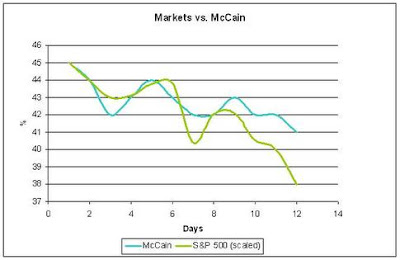
It is worth mentioning as an aside that all of this explains why the McCain campaign is desperately--and futilely--trying to change the subject away from the failing financial system. So long as the election is determined by outside events, the McCain campaign is powerless to help its candidate win.
This, I think, contributes to the pendular nature of campaign reporting, where you will get a week or two of coverage that seems to favor one candidate, followed by a subtle shift in positive coverage to the other candidate for a time. At work is a positive feedback loop, similar to the one that drives the booms and busts of a speculative market: positive motion gets reported as positive news, and positive news in turn drives positive motion, and so on, creating a sort of media bubble. But the higher that bubble wafts, the more routine and expected--and not-newsworthy--it becomes that the candidate will do well, thus causing the engine that drives the bubble upward to run out of steam. In the meantime--and because of the zero-sum nature of campaign coverage in a two-party system--expectations for the other candidate will be so low that any modest improvement results in a large vector of movement, which will result in significant positive news, in turn causing more positive motion, etc., until this other candidate becomes the one propelled by a bubble effect.
This process, though, only seems to occur in the absence of hard information that would otherwise be driving each candidate's fortunes. As bloggers like Ezra Klein and Matt Yglesias often observe, what decides elections is not this or that gaffe or campaign ad, but rather external events, like financial collapses or terrorist attacks. But this, again, is similar to what we see in markets: a speculative market occurs when there is uncertainty: people start using the behavior of others as a proxy for real information, piggy-backing on their presumably sound analysis, and the result is a herding effect. But when some real information emerges, the market reacts to it and prices quickly snap to reality. In this campaign, there has been an abundance of "real information" generated by the unfolding economic crisis, and so voters are responding to this rather than piggy-backing on the analysis of campaign reporting. As a result, the fortunes of the candidates has been marked not by the boom-and-bust cadences of campaign reportage, but by the performance of the stock market (which for many is the de facto barometer of economic health), which this chart from Ezra Klein strikingly illustrates:

It is worth mentioning as an aside that all of this explains why the McCain campaign is desperately--and futilely--trying to change the subject away from the failing financial system. So long as the election is determined by outside events, the McCain campaign is powerless to help its candidate win.
Wednesday, September 10, 2008
Nothing new under the bloggy sun
I was going to write a post called "Parity" in which I noted that according to the RCP meta-poll, 538, and Intrade, the race was about even--but then I saw that Paul Krugman has beaten me to it with a post called "Even Odds". Then I was going to write another post about how the McCain campaign is lying its pants off when it claims that Obama called Palin "a pig with lipstick", but half the internet has got that one covered.
For what it's worth, I think things are about to start turning around for Obama and the Democrats, and that this latest outrageously false claim from the McCain campaign is one outrageously false claim too far. Following Ezra Klein's insightful post the other day, the media renders the continuous onslaught of news data comprehensible to consumers by framing it within running narratives. I would add that--perhaps out of an obligation to "balance", or maybe just because of a bias towards closer and more interesting races--there is a somewhat pendular motion to press coverage, such that a week or two of positive coverage for a candidate tends to be balanced by a period of negative coverage.
I think the press is getting antsy with its rosy McCain-surging-from-convention-and-Palin-pick narrative, which is one that has emphasized Palin's star turn over the steady drumbeat of false claims eminating from the McCain campaign. However, in order for the shift to occur, there has to be something for the media to affix its narrative to. This pig/lipstick nonsense could be it. In the first place, it's a deception that is readily verifiable in print and on video, so mainstream outlets can comfortably show it without fear of seeming impartial: they can just run a clip of McCain people accusing Obama of making the insult, and then juxtapose it with footage of what Obama said in context, with no need for a reporter to connect any dots. Second, it plays into what has become a pattern of questionable or outright false statements from the McCain campaign, giving the story a direction to run in: does the McCain campaign have a truth problem?
Of course, these things don't happen entirely on their own. Obama is going to have to drive the narrative in speeches, through surrogates, and in campaign ads. He is going to have to actively call out McCain and Palin for campaigning on personal attacks, misrepresentations, and outright lies, and for their silence on issues like health care and the economy.
Biden is already sounding the notes (via Fallows):
And looking around the internet, some people have submitted some pretty good-sounding examples of "what Obama should say". From a Sullivan reader:
"Yesterday I talked to a group of voters about how the McCain campaign is trying to call their continuation of just about every single Bush-Cheney policy of the last eight years "change." In doing so, I used a common, hundred-year-old phrase that we all understand: You can put lipstick on a pig, but it's still a pig. Now the McCain campaign demands that I apologize for saying this. Everyone, it seems, wants to hear my answer. Here it is: NO.
No, I will not apologize for telling the American people the truth: That McCain and Palin represent a stunning, and disastrous, continuation of Bush and Cheney's policies. Policies of sacrificing the middle class to give huge tax cuts to millionaires and big corporations. Policies that prevent Americans from getting the health care they need. Policies that would privatize Social Security and take away a woman's right to choose.
[...]
There's a word I've heard from the McCain campaign recently: "deference." No one is going to ask Sarah Palin a question, they say, unless they show her "deference." Joe Biden points out that they oppose all stem cell research, and they are offended he even mentioned it. I point out that their claim of bringing change is ridiculous, and they demand an apology. Apparently we are not showing them enough deference.
Let me explain something to Senator McCain and Governor Palin, as deferentially as I can: This is a democracy -- not a monarchy. You don't get to demand "deference" from the American people as if they were your royal subjects. You -- and I -- and everyone who seeks elected office must defer to the American people, and answer their questions, and fight for them even when it's politically inconvenient. That is what I promise to do. Thank You."
And from Nate Silver at 538:
My opponent's chief strategest just said, "this campaign isn't about the issues." Well, I've got news for you, America. The Republican Party is desperate. They are going to do anything to try and hold onto their power, because they know the damage they've done to our country, and they don't know how to fix it. They know that people are out of work, and they don't know how to help them. They know that people are dying because they don't have health insurance, and they don't know to save them. They know that families are struggling to put food on the table, and they know don't know how to provide for them.
So they're going to try and distract you, America, because that's the only thing they know how to do. They're going to try and scare you. They're going to try and tell you stories, instead of offering solutions. And yes, folks -- these are the same people that have been lying to you for the last eight years -- and they're going to lie to you again.
We'll see how it goes in the next couple of days. McCain has been in the driver's seat for the last week or so, but he's sold his soul to do it. If Obama can regain the momentum, he will be in a strong position heading into the final two months.
Tuesday, July 29, 2008
Price up, demand down

Total driving on highways in the US was down 3.7% for the month of May compared with May 2007, with gas prices up 25%. The experts say that demand for gas in the short term is relatively inelastic because it is affected by long-term decisions such as what kind of car to buy and where to move, and so we won't see demand really fall off for a while yet.
PS: On a side note, I would like to take this news item as a case study of the suckiness of traditional newspaper writing in the age of the internet. First read this Reuters piece, then read this blog entry by CBS guy Kevin Drum. The first, you will notice, is terrible. Why it's terrible:
- Even though it's short, it's bloated with all these vapid quotes from the Secretary of Transportation.
- The first sentence tries to jam too much information in and ends up leaving out a critical piece of information: driving is down 3.7% compared to what? Compared to the previous month? Compared to the same month last year? I had to look elsewhere for the information.
- The author insists on expressing increases and decreases in the meaningless absolute terms of millions of total miles driven. Nobody has an intuitive grasp of these figures--so why not stick with percentages?
- There are no links to the source material.
- There are no charts or graphs.
Wednesday, April 30, 2008
Re: Gas Tax Holiday
Via Yglesias, it looks like at least one reporter is actually calling bullshit on the "gas tax holiday":
Subscribe to:
Posts (Atom)