Showing posts with label conservatives. Show all posts

Friday, August 14, 2009

Obama vs. the Right


Krugman's new column makes the case that Obama's attempt to be post-partisan and bring Democrats and Republicans together was naive and mistaken:

“I am in this race because I don’t want to see us spend the next year re-fighting the Washington battles of the 1990s. I don’t want to pit Blue America against Red America; I want to lead a United States of America.” So declared Barack Obama in November 2007, making the case that Democrats should nominate him, rather than one of his rivals, because he could free the nation from the bitter partisanship of the past.

...

Sure enough, President Obama is now facing the same kind of opposition that President Bill Clinton had to deal with: an enraged right that denies the legitimacy of his presidency, that eagerly seizes on every wild rumor manufactured by the right-wing media complex.

...

So far, at least, the Obama administration’s response to the outpouring of hate on the right has had a deer-in-the-headlights quality. It’s as if officials still can’t wrap their minds around the fact that things like this can happen to people who aren’t named Clinton, as if they keep expecting the nonsense to just go away.

...

What’s still missing, however, is a sense of passion and outrage — passion for the goal of ensuring that every American gets the health care he or she needs, outrage at the lies and fear-mongering that are being used to block that goal.

So can Mr. Obama, who can be so eloquent when delivering a message of uplift, rise to the challenge of unreasoning, unappeasable opposition? Only time will tell.


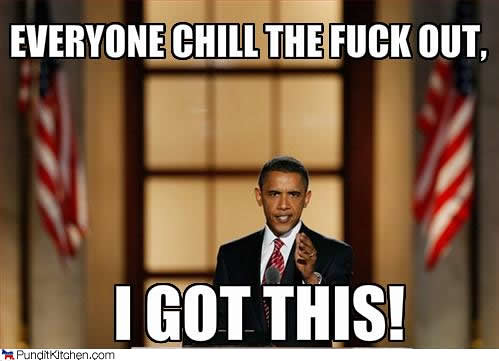
I think this article is good at showing why Barack Obama is President of the United States and Paul Krugman is not. The thing is, let's suppose that Obama "took off the gloves"--that he changed his tone to be more "outraged" and "passionate". What would this actually accomplish? Would it make Democratic Senators more motivated to pass legislation? Would it stop Glen Beck from doing his crazy Howard Beale act? Would it make ignorant, hysterical old white folks in town hall meetings any less ignorant or hysterical? I mean, game this out a little bit: what would be accomplished by adopting a 90s-era bunker mentality? Not much, so far as I can tell.

Meanwhile, there is an advantage to remaining calm, reasonable, amiable to negotiations--it's just that the advantage isn't really apparent until later. Remember, this isn't 1993: it is not as if conservatism is on the rise and the White House is merely trying to stand athwart things and yell "stop". Quite the opposite: Obama was voted in on an actual majority, not Clinton's 1992 plurality. The Bush years have discredited conservatism. What we're seeing now is the rump of the Republican party being particularly vocal. But Obama is still popular. The Democrats have huge majorities in Congress, and are showing no signs of weakness for the midterms--they might even gain seats. And the Republicans are alienating themselves from non-Southern-white America.

Moreover, everyone knows that health care reform--in some form--will pass. It may not be very good, from a progressive perspective--there may be no public option, it may be toothless in a bunch of different ways--but it will surely be a significant improvement over the current system, including provisions such as making it illegal for insurance companies to deny coverage for preexisting conditions. This will matter to a lot of people--and they will remember how the Democrats worked to improve their lives, and how the Republicans did nothing but scream and obstruct--and how, even in the 8 years before Obama, Bush didn't do a thing to reform health care. And they will conclude that Democrats are the "adults in the room"--and will vote to keep them in power.

So, to conclude: just because Obama is failing to end bitter partisanship doesn't mean he should stop trying to end bitter partisanship. The Republicans refuse Obama's olive branch at their own electoral peril.

EDIT: Apparently, Bill Clinton concurs.

Sunday, November 23, 2008

"We live in a dangerous world"

I'm calling bullshit on the constant refrain from conservatives that "we live in a dangerous world". They are quite fond of repeating this at every opportunity, and they never fail to press liberals on the question: "Surely you agree that we live in a dangerous world?" As if this statement somehow encapsulates some core governing philosophy.

The truth is, it is an emotionally charged statement with no actual substance. When you say "the world is a dangerous place", you are not saying anything anyone would disagree with, and you are not saying anything that favors one set of policies over another. The purpose is merely to set a tense emotional tone, an atmosphere of alarm and urgency that resonates with an ideology that favors aggression.

Now, does this mean that it is somehow warmongering to press someone on how great a threat something is when it seems that they don't appreciate the danger posed by it? No, not at all. If you are debating someone, and it seems that this person is naive about the threat posed, by, say, Bin Laden, then by all means ask: "but surely you think Bin Laden poses a serious threat?" The problem with the general statement "we live in a dangerous world" is just that--it's too general. It is an empirical claim stated with all the certainty and general application of a law of physics: as if it's some kind of immutable fact that at all times we must be on a war-footing in every situation.

Sunday, May 18, 2008

William Kristol's distortion

In his latest op-ed, William Kristol portrays the California Supreme Court's gay marriage decision as a case of an over-active judiciary overturning the will of the people:
On Thursday, the California Supreme Court did precisely what much of the American public doesn’t want judges doing: it made social policy from the bench. With a 4-to-3 majority, the judges chose not to defer to a ballot initiative approved by 61 percent of California voters eight years ago, which defined marriage as between a man and a woman.
What Kristol fails to mention is that, since that ballot initiative, the California legislature has enacted civil unions for gay couples, which include all of the legal benefits and responsibilities of marriage. The issue before the court was whether officially calling these arrangements "domestic partnerhsips" instead of "marriages" violated a provision against discrimination in the state Constitution of California. As it says plainly in the opinion:
Accordingly, the legal issue we must resolve is not whether it would be constitutionally permissible under the California Constitution for the state to limit marriage only to opposite-sex couples while denying same-sex couples any opportunity to enter into an official relationship with all or virtually all of the same substantive attributes, but rather whether our state Constitution prohibits the state from establishing a statutory scheme in which both opposite-sex and same-sex couples are granted the right to enter into an officially recognized family relationship that affords all of the significant legal rights and obligations traditionally associated under state law with the institution of marriage, but under which the union of an opposite-sex couple is officially designated a “marriage” whereas the union of a same-sex couple is officially designated a “domestic partnership.” The question we must address is whether, under these circumstances, the failure to designate the official relationship of same-sex couples as marriage violates the California Constitution.
From what Kristol says, you get the impression that the decision substantively altered California's policy on gay marriage. In reality, though, the decision's impact was on semantics, not substance. So Kristol and other conservatives will continue to hold this up as an example of extreme judicial activism, when in fact there was very little of this so-called activism going on.