Monday, November 30, 2009

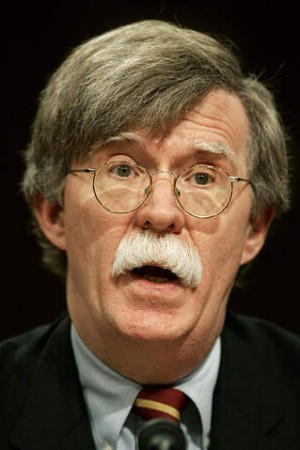
John Bolton: coward


Greenwald utterly destroys the erstwhile UN Ambassador:
Yesterday, Bolton -- on "Washington Times Radio" -- revealed that he is so petrified of Terrorists that he would not feel safe in New York City during the trial of Khalid Sheikh Mohammed and would not even allow his family there (audio here):

Host Melanie Morgan: Given the nature and danger of bringing these terrorists to American soil, where do you think is the most safe place to be when they get here and this trial begins? Where would you put your family?

John Bolton: Well, not New York City, I'm afraid to say. This is part of the callousness and the really, lack of professionalism and judgment to put them on trial anywhere in the United States in civilian courts.

The cowardice on display here is difficult to overstate -- and to behold without being ill. I lived in Manhattan on 9/11 and for many years thereafter. For weeks -- even months and years after that attack -- it was widely assumed that New York would be a likely target for another attack, but I never heard a single New Yorker -- not one -- talk about fleeing the city or hiding their family in some faraway place.
I don't think that Bolton really believes his family to be in danger from a single unarmed, detained terrorist--I think he's just being incredibly cynical. But still, if your cynicism is going to lead you to say something completely ridiculous, you should be nailed for it.

The future of sausage is upon us


Via Paul Krugman, it seems as though lab-grown meat is one step closer to becoming a reality:

SCIENTISTS have grown meat in the laboratory for the first time. Experts in Holland used cells from a live pig to replicate growth in a petri dish.

...

So far the scientists have not tasted it, but they believe the breakthrough could lead to sausages and other processed products being made from laboratory meat in as little as five years’ time.

I'm a huge proponent of lab-grown meat. Most people's initial reaction is one of disgust, but when you think about it meat grown in a petri dish can't possibly be more revolting than present day factory farm conditions. Moreover, you get the ethical bonus that there is no cruel treatment of animals (in fact, on this last point, I've often wondered why we don't try to genetically modify livestock to have essentially no brains, so as to alleviate animal suffering...this may seem horrifying at first, but how could it be more horrifying than torturing sentient creatures?).

But probably the biggest bonus is ecological: livestock, especially cattle, have a huge impact on the environment and on the climate change situation. Many people assume that when you talk about the carbon footprint of cows, you're mostly talking about cow farts, but that's only a part of the problem. First of all, most of the methane that cows are emitting come from burps, not farts. Second, though, a lot of the impact from cattle comes from the fact that feeding people cattle is a very inefficient way to use arable land, because you are using a whole bunch of arable land to grow crops to feed to cows instead of people. Or, if you're not giving feed to the cattle, you're burning down huge swaths of rainforest to create land that they can graze on--and, of course, the elimination of trees causes there to be more carbon in the atmosphere.

Anyway, it seems to me that a big win in the fight against climate change might be this ability to produce meat in an ecologically sustainable way--especially considering that beef is catching on in the developing world (in places like China).

(PS: I think envisioning things like sausage and gelatin and--I don't know, broth--rather than, say, a drumstick make the whole lab-meat idea far more palatable.)

Friday, November 27, 2009

Hey--remember Garfield Minus Garfield?

Charles O'Shea, Anecdotal Analyst

This is funny:
There seem to be more discounts on TVs this year, and shoppers are snapping them up, said Charles O’Shea, a New York- based retail analyst with Moody’s Investors Service. In the four hours he spent checking retailers in northern New Jersey, he saw several shoppers standing at bus stops holding flat-panel sets.

“It looks like everybody has caught the promotional bug pretty heavily,” O’Shea said.

Because nothing is more important in making a business decision than knowing what sorts of things Charles O'Shea saw people holding at a bus stop in northern New Jersey.

Humboldt squid


Megan McArdle is a libertarian who is basically sane, so she is not a global warming denier or anything. However, comments like this strike me as missing the point:

What's at stake is the degree of warming associated with our carbon dioxide emissions. In particular, to what extent the earth's many complex and not necessarily well understood feedback systems may mitigate (or exacerbate) temperature increases. I've long been skeptical of the more catastrophic scenarios, because all this carbon used to be in the atmosphere, which probably defines a ceiling on how bad it will get--a ceiling well below "WE'RE ALL GOING TO DIEEEEEEEE!!!"

I think she's narrowing in too much on the temperature aspect here. While it's true that earth has "many complex and not necessarily well understood feedback systems" that determine what the average global temperature will be, what is really relevant here is that the biological environment is made up of even more complex and even less understood systems, and we simply can't predict what all of the consequences will be for these systems if and when the global temperature shoots up. To invoke some Rumsfeldese, there are known unknowns and then there are unknown unknowns. It is the unknown unknowns that really make global warming such a serious threat--the stuff that no one could have predicted.

Personally, when I envision ecological disruption from climate change, it's something along the lines of the Humboldt Squid takeover of the North Pacific. The story here is that since 1960 the numbers of this kind of squid has exploded, altering the ecosystem so that fisheries for "anchovies, sardines, hake and rockfish"--all species that the squid feed on--are threatened. They theorize that nitrogen-rich farming runoff is causing a favorable environment for the squid, but the region in which they dominate continues to expand, and nobody knows why:

In the KQED-TV story, Gilly says that the OML [oxygen minimum layer] may be growing -- getting thicker and coming closer to the surface. And where the OML grows, the squid follow.

Nobody knows why the OML is growing, though. Does it have something to do with climate change? Is it related to agriculture? It would be handy to know.


This is the kind of thing we should be envisioning, I think, when we talk about the dangers of global warming--stuff like, oh shit, now squid are taking over the ocean. Of course, in this particular case the success of the squid isn't really too disruptive (besides endangering some fisheries, the article doesn't seem to be too worried about any of it), but the point is that this is the type of system that's being affected, and these are the types of consequences we can expect to encounter as global temperatures rise.

The NBA on NBC opening sequence for a new generation


If NBC ever gets rights to the NBA again, this is how the sequence has to go:

First, we get Tesh back into the recording studio to record a "preamble" to the original theme--something very dignified with a lot of horns that evokes great Presidents of history and hallowed...er, traditions. You know what I mean: the horns come in--do do dooooooooooooo--and then a big drum--bum bum bum.

So anyway, this preamble is playing and the camera is zooming forward through video cutouts of Great Moments of NBA History, as well as Great Players That Defined Their Era. So you're going to have--what is it, Jerry West hitting some half court shot?--in black in white, and then Wilt's 100 point game, and all this stuff. But the thing is: this sequence is structured like the Wall Chart of History, so that the size of the video cutouts are proportional to their importance at that time. I don't know enough about NBA history to know how the first chunk of this sequence will be, but I do know that once you get to the 80s you start seeing Magic's baby hook, that one Bird steal, and big cutouts of Kareem hitting a skyhook and one of Magic posting up Bird or something. And then of course you have a nod to the Pistons teams.

Then, of course, you get to the 90s and Jordan just dominates the screen, and you have all sorts of classic Jordan highlights going, including one of him maybe hugging the championship trophy (and there can be some smaller screen flitting by that feature Barkley, Stockton/Malone, whatever).

And then beyond this you get the Duncan/Shaq era, and so these two dominate, and you show cutouts of various Horry shots and--er, whatever great Spurs moments there might have been. And then the way is cleared for the present Lebron/Kobe era (with I suppose some kind of recognition for KG, though, really, he's just got the one ring), with the two of them mostly taking up the whole screen.

And mind you--the preamble tune has been playing this whole time (along with audio snippets from the various video cutouts), and, oh, I don't know maybe ten or twelve seconds have passed. But when we ease into the Lebron/Kobe era, the music resolves into the beginning of the original NBA on NBC sequence (in which the logo is etched into that steel thingy with lasers--doo doo doo do do do do doooo), and then--there is some kind of explosion or flash, and we hit the ground running, with the revamped version of Roundball Rock going and an appropriate montage of present day players starts flitting around the screen, plus other basketball visual bric-a-brac. You can fill this bit in yourself.

But the big question here is: what play do you use to finish the sequence off, before the announcer intones, "The NBA on NBC"? In the 90s, it was Jordan hitting the game-winner against the Cavs, but in today's NBA you'd have trouble because you'd have to choose between Lebron and Kobe. I suppose you'd have to go Kobe, since he's older and he's got the rings (and the larger catalog of great moments--I mean, Lebron has a ridiculous highlight reel, but the only meaningful things I think he's done are the Game 5 takeover against Detroit and the game winner against Orlando. But even then, he has no rings, so nothing he's done can be that important). I'm not sure what Kobe's signature moment would be--I suppose one of his buzzer beaters, but if it wasn't a clutch playoff shot I'd go with one of his more ridiculous moves, like for example that nifty pump-fake-spin-jumper he had in the 61-point game against the Knicks, or that one siiiiiiiiick, high-arch fade-away he hit over Lebron last year.

If I was rich I'd give NBC money to buy rights to the NBA. Or maybe just buy the theme song from them.

(PS: I forgot that a requirement for the last play of the sequence has to be a good Marv Albert call--so I retract those two suggestions.)
Thursday, November 26, 2009

Happy Thanksgiving!


It was weird watching this again, because I'd forgotten that a quote from it had worked its way into my family's lexicon. Basically, my mom and my sister will say, "It'll be fun Kevin!" in this goofy way whenever they're trying to get me to do something. What they're mimicking is Adam Sandler saying to Kevin Nealon, "C'mon Kevin! It'll be fun." I doubt if either my sister or mom remembers what they're quoting from when they say that.

(In a similar vein, you will find a lot of people who say in a particular voice and cadence, "I like it--Ilikeitalot"--having long forgotten the source material for this, which is the 1994 movie Dumb and Dumber.)

Wednesday, November 25, 2009

An oddly relevant Dinosaur Comics

They even get the name right.

Some responsible lawmaking at long last: a war tax


It seems as though Congressman Dave Obey's proposal to levy a tax to help pay for the Afghanistan war is serious. Via Yglesias:
The details of the proposal:

Dubbed the “Share the Sacrifice Act,” the six-page bill exempts anyone who has served in Iraq or Afghanistan since the 2001 terrorist attacks as well as families who have lost an immediate relative in the fighting. But middle-class households earning between $30,000 and $150,000 would be asked to pay 1% on top of their tax liability today — a more sweeping approach than many Democrats have been willing to embrace.

I love this idea. It's always bothered me that while we engaged in an elective war in Iraq, Congress was cutting taxes and Bush was keeping cameras away from soldiers' caskets. The American public was shielded from the costs of the war, precluding any reasonable weighing of costs and benefits from taking place. A tax like this would at the very least make the financial costs of the war salient for everybody.

I'd really like to see a Republican--or a Blue Dog Democrat--argue against this one. Especially after all this supposed concern they've been expressing about the deficit.

"I traced my dad... and discovered he is Charles Manson"

Egads.

Via my friend Laura.

Tuesday, November 24, 2009

It's-a me, Radiohead

I thought this was damn impressive:


It gets more intricate and clever as it goes on, so consider watching at least up through the transition to the "rain down" part.

Purity test

Via @zeekatai, it seems the GOP is considering putting together a "purity test"--which is a litmus test a candidate must pass in order to be endorsed by the Republican party. Apparently, a candidate would have to disagree with no more than three two of the following:

Here is the resolution’s list:

(1) We support smaller government, smaller national debt, lower deficits and lower taxes by opposing bills like Obama’s “stimulus” bill;

(2) We support market-based health care reform and oppose Obama-style government run health care;

(3) We support market-based energy reforms by opposing cap and trade legislation;

(4) We support workers’ right to secret ballot by opposing card check;

(5) We support legal immigration and assimilation into American society by opposing amnesty for illegal immigrants;

(6) We support victory in Iraq and Afghanistan by supporting military-recommended troop surges;

(7) We support containment of Iran and North Korea, particularly effective action to eliminate their nuclear weapons threat;

(8) We support retention of the Defense of Marriage Act;

(9) We support protecting the lives of vulnerable persons by opposing health care rationing and denial of health care and government funding of abortion; and

(10) We support the right to keep and bear arms by opposing government restrictions on gun ownership.


I don't put much stock in this sort of thing--it's the kind of irrelevant noise you get from political parties who are trying to appear faithful to their base (kind of like all that meaningless haggling over wording in the parties' respective platforms when the conventions happen).

That said, it's interesting to me that the document is pretty unserious and shows a total unwillingness to set priorities or make tradeoffs. For example, it seeks "smaller government", "lower taxes", and "lower deficits" in (1), and yet in (6) and (7) commits to significant war related expenditures, and in (9) appears to commit unlimited funds towards health care (if you do not "ration" health care or deny it to anyone--um, that means you're going to be spending exorbitant amounts of money on health care).

Moreover, points (2) and (9) stand in contradiction to each other. Market-based health care reform doesn't entail no rationing of health care; it just means that health care is rationed by the price mechanism in a market, rather than in some other way. Moreover, if you have a market-based health care system that (by definition) does not cover poor people (because they are priced out of the market), then how can you also claim to oppose "denial of health care"? A market-based health care system entails a denial of health care--to the poor!

Also: (3) is contradictory as well, because cap-and-trade is a market-based energy reform! It's essentially a way of pricing the market externality that is greenhouse gas emissions. It is no different in principle from a carbon tax.

Arg.

Monday, November 23, 2009

Web 2.0's Moore's law: every two years, the smarminess of the latest communication platform doubles

I used to think that Twitter was pretty damn smarmy and pleased with itself--until I used Google Wave. Ho-ly Christ. Bold prediction: Google Wave will fail to take hold in any significant way, because it is way too over-designed and way too concerned with finding solutions to problems that don't necessarily exist.

Here's the thing: Twitter was smart in that it kept things extraordinarily simple for so long. They let actual user behavior lead feature creation, rather than the other way around. For example, users would come up with hashtags on their own, and then Twitter would develop features and widgets around that. With Google Wave, though, it seems just the opposite: there's this preening tone to the whole endeaver that just seems to say, "We Google geniuses are so genius that we know what you want before you do. We're envious of you that you are just starting out on your journey, and have not yet had your mind blown by the sheer elegance and revolutionary user experience that awaits you."

(PS: Key indication of an application's smarminess? "Cute" error messages. Fail whale???!?!?! Why, these aren't some boring old programmers--what a sense of humor! Everything will be "shiny"??!?!?! Hey--that's from Firefly! These guys have some serious cred!)

Sunday, November 22, 2009

A sinking feeling

You know, it occurs to me that everyone who is alive in this era will be remembered in history as the horrible, short-sighted people who irrevocably destroyed the biosphere for all posterity so that they could drive around in cars and eat hamburgers.

We're the ones who burned the Library of Alexandria...

It's experts all the way down

A good bit from Target Practice--I can't really quote it, so just go read the whole thing.