In case you haven't already, it's definitely worth it to check out the Iran coverage over on Sullivan. Of course, all the videos, Tweets, etc. are very fragmentary and amount to unconfirmed reports, but you can still get a feel for the atmosphere over there. There's so much energy in those crowds, and confidence.
Now I'm just really curious as to what's going to happen. I don't know much about Iranian politics or anything. I don't know what the likely scenarios are as far as an end game for all this. But one thing that seems certain is that the protests won't just fade away. Something's gotta give. I guess at some point the generals will pick a winner...
Anyway, watch this haunting video. What you're hearing is the sound of thousands of people shouting slogans from their windows and rooftops:
How the hell does the Iranian government get out of this? They're in so deep..
Showing posts with label iran. Show all posts
Showing posts with label iran. Show all posts
Monday, December 28, 2009

Monday, October 5, 2009
Oh, and Mahmoud Ahmadinejad is Jewish btw
It's true. Ackerman lays out the ramifications:
YHWH, moonlighting as a subpar Borscht Belt comedian, has given Mahmoud Ahmadinejad Jewish origins, according to the Daily Telegraph's inauguration of a geopolitical psychodrama. We have now determined that identity politics has a dank and silted basement. From here on out, Ahmadinejad can say whatever he likes about the Holocaust or Israel and it'll just be performative and tasteless, not an international outrage. Israel, in the most mindfucky course of events in its history, might be obliged to grand him citizenship. (Knowing Benjamin Netanyahu, he might bulldoze some Palestinian farmer's olive garden to build Ahmadinejad an apartment complex or something.)Ahmadinejad's detractors are now objectively antisemitic. His comment-thread defenders are caught in quite a thorny Hebraic trap of their own -- so diabolical that one wonders if the Jews planned this all along...
If I were Andrew Sullivan, I'd say "Oy" here.
Monday, June 22, 2009
Why Twitter is so unreliable
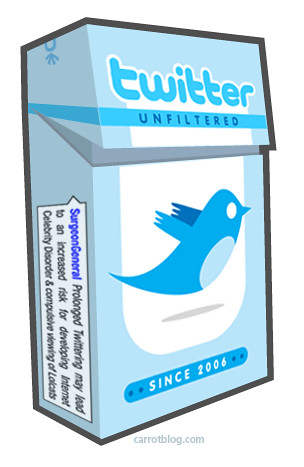
Much ink has been spilled over the unreliably of the torrent of Tweets coming out of Iran, but I just want to point out that, specifically, what keeps Twitter from being a good source of information is that sources cannot be independently confirmed. Which is to say, normally, if multiple, separate sources tell you the same story, you can be pretty sure that what they're saying is true--their stories are mutually corroborating.
Of course, this doesn't work if the sources had an opportunity to collude before you could question them, for the obvious reason that they could have agreed on a lie.
Because Twitter allows everyone to see what everyone else is saying, it allows all sources the opportunity to "collude"--there are many voices, but none of them have the power to corroborate what any of the other voices are saying.
So the irony here is that the very ease of information sharing is what is preventing us from getting reliable information. I wonder if there's some clever way you could get around this? One thing that comes to mind is that videos and photos can corroborate each other via their metadata: if two different videos depict the same event, and they both purport to have been taken at the same time and place, then that is good evidence that the metadata is accurate, simply because it is unlikely that a person has the wherewithal to alter the metadata on his video to be similar to one that is already posted on the internet somewhere--it would be a difficult thing to "collude" on.
The drawback here, though, is that videos and photos are not tagged with metadata in a standard way (I don't think), so we aren't able to do this analysis (it's not like the date and location of the video/photo is contained in the file header (again: I don't think)). But I think you could really get somewhere if the metadata were in place.
(Photo by carrotcreative)
Sunday, June 21, 2009
Cohen's adventures in Iran
Unlike most pundits, the NYT's Roger Cohen is actually in Iran, getting into adventures. Well worth a read.
Tuesday, June 16, 2009
If Iraqis could Tweet, would we be so cavalier about bombing them? We might, if they Tweeted all the time, for no good reason.
Although I disagree with some of the phrasing that he uses--clearly, even those who favor bombing Iran do not do so because they "want to slaughter" innocents, as he seems to imply at one point--I think Glenn Greenwald makes a very, very good observation:
Hopefully, one of the principal benefits of the turmoil in Iran is that it humanizes whoever the latest Enemy is. Advocating a so-called "attack on Iran" or "bombing Iran" in fact means slaughtering huge numbers of the very same people who are on the streets of Tehran inspiring so many -- obliterating their homes and workplaces, destroying their communities, shattering the infrastructure of their society and their lives. The same is true every time we start mulling the prospect of attacking and bombing another country as though it's some abstract decision in a video game.
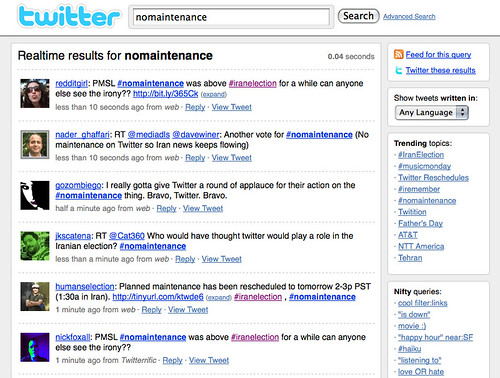
Humanizing is right. Although it's a bit of a cliche at this point to refer people to the #iranelection tag on Twitter, I think it actually shows pretty well how these social networking sites enable Americans to become exposed to--and emotionally invested in--whole groups of people who would otherwise remain foreign and abstract.
It makes me wonder, a bit, how things would have been different if Iraqis had been able to communicate this effectively in the run-up to the war in 2003. Suppose that when their homes and neighborhoods were bombed, they emitted a steady stream of horrifying pictures and videos? Suppose that they directly entreated us to stop raining death down upon them from above with Facebook groups and hashtags? Even as I write that it seems kind of dumb, but, still: isn't there something very powerful about one person saying to another, in whatever medium: please don't kill me and my family?
The post title is a paraphrase of a great Jack Handy line, that questions whether we would be so quick to cut down trees, if they could scream. Unfortuneately, I have a feeling that the same principle applies to people. Before the internets, it would have been nearly impossible to have any kind of meaningful, personal, and affecting interaction with someone on the other side of the world--and, as a consequence, the snuffing out of tens, even hundreds of thousands of lives would enter into our brains as bare factual information. Psychologically, we wouldn't "hear the screams".
So maybe this is the "Kantian turn" in the ongoing discussion about what, if anything, the role of sites like Twitter are playing in the Iranian civil unrest. The change isn't taking place within Iran; it's taking place within our brains.
(Photo by natachaqs)
Saturday, June 13, 2009
What the hell?
Monday, June 23, 2008
Total Commitment
This post from Sullivan, in which neocon Bill Kristol airs the idea that the Bush administration may launch a strike at Iran if it looks like Obama is going to win the election, reminds me of General Ripper's rationale for launching an unauthorized nuclear attack against the Soviets in Dr. Strangelove:
...a decision is being made by the President and the Joint Chiefs in the War Room at the Pentagon. And when they realize there is no possibility of recalling the Wing, there will be only one course of action open. Total commitment. (Hat tip: filmsite.org)
I doubt even the Bush administration would do something like this. Right now they have so little credibility that, short of an actual attack of some kind on the US, there is nothing they can say or do that can convince people that Iran needs to be bombed--and for Bush to take such an action without popular support would be a political disaster of the highest order. So I think this one will likely be thrown onto that heap of hare-brained historical what-ifs, along with MacArthur's invasion of China and Goldwater's nuking of Vietnam.
But on the other hand, you never know with this wily bunch. Maybe they've reached a point where they can no longer sit back and allow the radical Muslims to sap and impurify their precious bodily fluids....
...a decision is being made by the President and the Joint Chiefs in the War Room at the Pentagon. And when they realize there is no possibility of recalling the Wing, there will be only one course of action open. Total commitment. (Hat tip: filmsite.org)
I doubt even the Bush administration would do something like this. Right now they have so little credibility that, short of an actual attack of some kind on the US, there is nothing they can say or do that can convince people that Iran needs to be bombed--and for Bush to take such an action without popular support would be a political disaster of the highest order. So I think this one will likely be thrown onto that heap of hare-brained historical what-ifs, along with MacArthur's invasion of China and Goldwater's nuking of Vietnam.
But on the other hand, you never know with this wily bunch. Maybe they've reached a point where they can no longer sit back and allow the radical Muslims to sap and impurify their precious bodily fluids....
Thursday, May 8, 2008
Tact
There's been a bit of a dust-up recently over some comments that Hillary Clinton has made about Iran:
In the first place, the question itself was a fairly outlandish hypothetical--there is absolutely no one who seriously believes that Iran would launch a direct attack against Israel. In fact, the reason this is the case is precisely because Iran and everyone else already knows that the United States would retaliate in such a situation (in addition to the retaliation that would be carried out by Israel itself). Therefore, Clinton's first reaction should have been to give a careful preface to her answer to make it clear that this was a purely hypothetical question with no immediate relevance to the current situation with Iran.
Next, rather than use colorfully bellicose language like "totally obliterate", she should have couched her answer in the most boring technocratic terms possible. I mean, you don't want to sound like you relish the idea of having to retaliate. Non-emotional, bureaucratic, mechanistic--this is how you want to express a policy of deterrence, because it gets the substantive point across without making anyone nervous or sending any confusing rhetorical messages. Moreover, she could have even avoided singling out Iran altogether, instead choosing to give her answer in terms of what the US generally does to protect close allies, Israel being one of them.
Obama, I think, is perceptive in seeing the potential trouble that remarks like Clinton's are likely to cause down the road:
In the end I think it comes down to a sort of fearfulness on the part of Democrats that has been ingrained in them by Republicans on national security issues, especially since the Republicans rose to dominance in the 90s: they don't want to look weak, and so they protect themselves from this perception by mimicking the Republicans, in style if not in actual policy. The result has been the dangerous lack of a counterweight to the sort of macho, with-us-or-against-us Bush foreign policy--an imbalance that expressed itself most painfully in the Democrats' non-existent opposition to the Iraq War resolution in 2003.
One thing I like about Obama is that he doesn't seem to have this fear. I greatly look forward to him taking on McCain on foreign policy in the general election.
"I want the Iranians to know that if I'm the president, we will attack Iran (if it attacks Israel)," Clinton said in an interview on ABC's "Good Morning America."The thing is, though what she is saying is correct--any policy of deterrence entails the sort of massive retaliation that she is talking about--the way that she says it makes her sound unnecessarily aggressive."In the next 10 years, during which they might foolishly consider launching an attack on Israel, we would be able to totally obliterate them," she said.
"That's a terrible thing to say but those people who run Iran need to understand that because that perhaps will deter them from doing something that would be reckless, foolish and tragic," Clinton said.
In the first place, the question itself was a fairly outlandish hypothetical--there is absolutely no one who seriously believes that Iran would launch a direct attack against Israel. In fact, the reason this is the case is precisely because Iran and everyone else already knows that the United States would retaliate in such a situation (in addition to the retaliation that would be carried out by Israel itself). Therefore, Clinton's first reaction should have been to give a careful preface to her answer to make it clear that this was a purely hypothetical question with no immediate relevance to the current situation with Iran.
Next, rather than use colorfully bellicose language like "totally obliterate", she should have couched her answer in the most boring technocratic terms possible. I mean, you don't want to sound like you relish the idea of having to retaliate. Non-emotional, bureaucratic, mechanistic--this is how you want to express a policy of deterrence, because it gets the substantive point across without making anyone nervous or sending any confusing rhetorical messages. Moreover, she could have even avoided singling out Iran altogether, instead choosing to give her answer in terms of what the US generally does to protect close allies, Israel being one of them.
Obama, I think, is perceptive in seeing the potential trouble that remarks like Clinton's are likely to cause down the road:
"When Iran is able to go to the United Nations complaining about the statements made and get some sympathy, that's a sign that we are taking the wrong approach," Obama said.Moreover, he seems to know how to give the more careful answer that I think is better to give:
"We have had a foreign policy of bluster and saber-rattling and tough talk, and in the meantime have made a series of strategic decisions that have actually strengthened Iran."It is not as if the sort of cowboy-diplomacy sloppiness of Clinton's remarks can be attributed to hers being off-the-cuff comments--she had already said earlier that Iran would undergo "massive retaliation" for an attack on Israel, and so she should have had her wording on this issue down pat.Israel is "the most important ally" the United States has in the Middle East, and that Washington would respond "forcefully and appropriately" to any attack, Obama said Sunday.
"But it is important that we use language that sends a signal to the world community that we're shifting from the sort of cowboy diplomacy, or lack of diplomacy, that we've seen out of George Bush," he said. "And this kind of language is not helpful."
In the end I think it comes down to a sort of fearfulness on the part of Democrats that has been ingrained in them by Republicans on national security issues, especially since the Republicans rose to dominance in the 90s: they don't want to look weak, and so they protect themselves from this perception by mimicking the Republicans, in style if not in actual policy. The result has been the dangerous lack of a counterweight to the sort of macho, with-us-or-against-us Bush foreign policy--an imbalance that expressed itself most painfully in the Democrats' non-existent opposition to the Iraq War resolution in 2003.
One thing I like about Obama is that he doesn't seem to have this fear. I greatly look forward to him taking on McCain on foreign policy in the general election.
Subscribe to:
Posts (Atom)