Monday, June 10, 2013
Obama on NSA spying: "Was that wrong? Should I not have done that?"
An amusing thing about this NSA story is Barack Obama's response that he "welcomes" a debate about government surveillance. He has also said, "[w]e're going to have to make some choices as a society."
But of course, precisely the problem with the NSA program is that there could be no public debate because the whole thing was steeped in secrecy. The only reason we're having the debate now is because the whole program was leaked by a whistleblower--a whistleblower that Obama will almost certainly prosecute to the fullest extent of the law.
The whole thing reminds me of when George got busted for having sex with the cleaning lady at work.

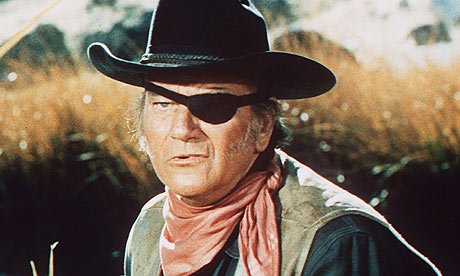
True grit
What is problematic about this for society is that since elite academic institutions feed our public institutions, there gets to become a culture of groupthink that can lead to disastrous institutional failures. If you have a newsroom culture that systematically defers to authority, then the government can get away with waging a baseless war. If you have an office culture in a financial firm in which dissent is punished or ignored, then the firm will go bankrupt investing in a housing bubble.
What is required to run the world is not just intelligence, but grit--the courage and the will to place one's own principles and dignity above money and status and the rebuke of authority figures. But a person who spends a lifetime dutifully completing school assignments and taking exam prep courses is not likely to have the history of failure, rejection, and hardship that builds character.
So I was not too surprised to see that the leaker of the NSA spying programs, Edward Snowden, is not a graduate of an elite university but has had something of an uneven history:
...he never completed his coursework at a community college in Maryland, only later obtaining his GED — an unusually light education for someone who would advance in the intelligence ranks.Even if you disagree with Snowden's actions on the merits, I think everyone can acknowledge that risking his entire life and giving up everything for something he believed in was an act of courage, an act that requires true grit.
Sunday, June 9, 2013
What kind of surveillance state do we want?
 |
| A bald eagle on a fucking KEY |
provocatively argues that “[t]he question is not whether we will have a surveillance state in the years to come, but what sort of state we will have.”
The professor distinguishes between authoritarian and democratic surveillance states:
What do authoritarian surveillance states do? They act as “information gluttons and information misers.” As gluttons, they take in as much information as possible....But authoritarian surveillance states also act as misers, preventing any information about themselves from being released. Their actions and the information they gather are kept secret from both the public and the rest of government.
...I think this is a pretty interesting approach to the problem. For example I've long thought about how the de facto decentralized surveillance enabled by the widespread distribution of video-capable phones has been overwhelmingly beneficial for our security--used against not only criminals, as in the Boston Marathon bombings, but also against our own government, as with the countless instances of police brutality that have been captured on video. Expanding in this direction seems to me a way of making a surveillance state compatible with democratic principles.
What would a democratic surveillance state look like? Balkin argues that these states would be “information gourmets and information philanthropists.” A democratic surveillance state would limit the data it collects to the bare minimum.... A democratic surveillance state would also place an emphasis on destroying the data that the government collects.
Critique of authoritarian surveillance
To me the sole advantage to be gained from the authoritarian model of the government keeping what it knows a secret is cases in which bad guys unwittingly divulge information because they don't know they are being spied upon. But to the extent that bad guys are suspicious of the government and careful not to communicate sensitive messages using technological means, that sole advantage is nullified. And meanwhile there are HUGE negatives with this approach, starting with the potential for abuse and blowback that occurs when the abuse is inevitably discovered--not to mention the moral issues of privacy and democratic accountability involved.
In the end, I don't think that waging a secret spy campaign is something that makes sense for America to do; it is simply not the kind of fight that suits the nation, its goals, and its ideals. An analogy might be made here between checkers and chess. In checkers, the goal is to destroy the opponent's pieces; in chess, it is to trap the opponent's king. With a "daylight" model--or democratic surveillance state--where the US makes the extent of its spying publicly known and accountable, the enemy would know exactly the capabilities of US spying and would therefore avoid certain kinds of communication. But while this would make them difficult to apprehend, it would also significantly inhibit their ability to wage terrorism. So though we may not be able to eliminate them from the board, we could still "trap" them into a limited space, capabilities-wise.
Rather than making the primary goal eliminating terrorists, we would be focusing on making terrorism hard to do. And we would get to keep the legitimacy of our government in the bargain.
Monday, April 15, 2013
Risking it all for a souvenir
 |
In both books, a strange behavior of the embattled soldier is described: he will undergo extraordinary risks to his personal safety for the seemingly trivial reason of nabbing a "souvenir" from the battlefield.
In Band of Brothers--which is a nonfictional account--soldier Donald Malarkey suddenly bounds out from behind his cover during an assault on a German position, because he thinks he can see a Luger on the body of a dead German soldier. He runs out to the body, finds that it is not a Luger after all, and scurries back to his position unharmed. The only reason he is not shot dead is because the Germans assumed he was a medic.
In All Quiet on the Western Front, soldiers risk their lives scavenging No Man's Land for silken parachutes to send home to their wives and girlfriends as sewing material:
The parachutes are turned to more practical uses....Kropp and I use them as handkerchiefs. The others send them home. If the women could see at what risk these bits of rag are often obtained, they would be horrified.Ruminating on this, Stephen Ambrose quotes Glen Gray, a war veteran (and, later, philosopher at Colorado College), who speculates that
[p]rimarily, souvenirs appeared to give the soldier some assurance of this future beyond the destructive environment of the present. They represented a promise that he might survive.I suppose that is one plausible theory. To me, though, it seems that at least part of the explanation must have something to do with the fact that soldiers in those circumstances have trained themselves to disregard risks to their own personal safety in general. Being in denial about the extreme physical danger of a battlefield makes it possible to charge headlong into machine gun fire to assault the enemy, but perhaps a side effect of this denial is that a soldier will also take extreme risks for lesser, even trivial goals.
In any case, though, this is a very surprising and interesting behavior exhibited by soldiers in battle.
Thursday, February 14, 2013
Let's end the music industry's monopoly powers

A very concrete example of this is the impact of the internet and personal computing on the music industry. Before these technologies, the recording and distribution of music was a costly process: it required special studio equipment, playing time on limited radio bandwidths, and the pressing of vinyl records (or later, cassettes, then CDs). And so a system needed to be devised such that the costs of making and distributing music could be recouped by the producers. This was accomplished by granting the authors a monopoly on the distribution of music: with monopolistic pricing power, the authors could recoup the costs of recording, marketing, and distribution.
This system worked well initially because technological constraints happened to enable enforcement of the monopoly power of the authors: it was infeasible to copy vinyl records, and so people were forced to buy them from record stores. Later with the emergence of cassete tapes copying was easier but the quality degraded with each copy. Later still, CD's enabled perfect copying fidelity, however a person was still limited to copying the CDs that friends happened to own. Violations of the author's--or content owner's--monopoly of course occurred, but not to the extent that the recording industry could not thrive.
But this changed with the emergence of the interent, which now enabled the virtually cost-free distribution of monopoly-protected music to anyone, anywhere. There was no longer a technological constraint that kept people going to the record store as their source of music. And as internet use became adapted by more and more of society, the record industry's revenues plummeted.
What had happened, though, was that the original economic rationale for the music industry had been obviated: before the internet and affordable, high quality recording equipment/software, recording and distributing music was very costly, and required scarce resources. But post internet, anyone with an okay computer and an internet connection could produce, and distribute for free, studio-quality music. The costs had been so dramatically lowered that it no longer made sense to perpetuate the legal regime (the granting of monopoly powers) that the music industry is predicated on.
Of course, by the time this technological revolution had occurred, the special interests and institutions collectively referred to as "the music industry" had been firmly entrenched. And so rather than dropping away and being replaced with a new, more fitting system, it fought aggressively to take extreme steps to perpetuate itself. It asked for extreme powers to infiltrate and compromise computing systems to prevent the duplication of music files. It asked that extreme penalties be enforced to deter duplication and distribution of music files. It publicly campaigns that unauthorized duplication and distribution of music files is an immoral act, tantamount to stealing physical objects from a store.
These policies, arguments, and actions should be rejected because technology has advanced to a state where the system they are meant to preserve is no longer relevant. Granting monopoly powers--and, therefore, monopoly pricing power--to large companies for the production of an incredibly low-cost product is unnecessary and anticapitalistic, and stifles both the production of creative arts and their consumption. The music industry, once spawned as a means of recouping the costs of music production and distribution, now serves no societal purpose. It is a rentier, parasitic entity.
One alternative to the current system would be simply to abolish the granting of monopoly or any other exclusive powers to the authors of content. The signature benefit of such a system would be its simplicity and the fact that it would not require any invasive laws to enforce: people would be free to create and exchange bits as they saw fit. However, there would also be significant drawbacks to such a system. For one, there could arise a problem of truth-in-authorship: even if no monopoly powers were at stake, artists would not want someone else falsely claiming authorship of a piece that they created. The artist would want artistic credit and public praise for his or her works. So some legal framework may be required to give a plagierized artist legal recourse to claim ownership of the work, even if just for non-monetary reasons. Moreover, there is the issue of compensating artists for their work, under the rationale that they deserve to be materially compensated for worthy works of art, so that they may continue to contribute such a valuable thing to society. Some schemes are compatible with a free model that could result in ample revenue for an artist: for example, an artist can have a Kickstarter-like scheme where the next work of art will not be produced/distributed until enough money is raised to recoup costs and provide a living.
However, such schemes are not a realistic source of revenue for most artists, especially ones who are not already established with their own following. Such a scheme can work for Radiohead or Louis CK; but an unknown or marginally popular musician is unlikely to be able to raise any money this way. A better system is required.
One such system could be this: society decides in advance, in terms of GDP say, how much material resources it wants to divert to the musical arts. This chunk of money represents the pie from which all artists will receive a slice. The size of the slice for each artist can be determined in a number of different ways. One way could be the allocation of government grants by an esteemed panel who decides who is worthy of compensation, and how much. Another, perhaps more democratic scheme could be the printing of virtual money that all citizens can then use to "buy" works of art, with this money then being translated to a percentage of the overall arts pie. Each citizen would be granted an equal amount of virtual money at the beginning of every year. Unused virtual arts money would be voided, increasing the "purchasing power" of the rest of the virtual money actually in circulation. In this way, the selection mechanism of a free market would be replicated, though the total "revenue" for the "arts industry" would have been a fixed amount previously agreed upon my democratic fiat.
Some economic shenanigans could arise from such a system: for example, a market would naturally arise in the buying and selling of virtual arts money. However, it is difficult to see what harm there would be in this. Moreover, steps could be taken to hinder such a market, such as not enforcing contracts involving the sale of virtual arts money, and making the arts money non-transferrable by disabling this ability in its technical implementation.
What do you think?
Monday, November 12, 2012
Years of obstructionism has destroyed the GOP in California
 |
| A common state politics nerd tattoo |
Columnist George Skelton in the LAT ticks off a list of Republican defeats:
Democratic Sen. Dianne Feinstein drew only token Republican opposition and won by 23 points.
Democrats, at last count, were gaining four congressional seats in California.
The stunner was the state Assembly, where Democrats apparently achieved a historic supermajority to match the party's similar feat in the Senate.
I think what you're seeing here--total Republican irrelevance in California--is the inevitable result of what has been poisoning California politics for decades, namely the conversion of the legislature to a supermajoritarian body on any law involving budgets and revenue. By requiring a 2/3 majority in the legislature in order to raise taxes, the state constitution has effectively granted the minority party the power to control the political agenda via obstruction. This has led to gridlock and insolvency over the years, and to what almost everyone agrees is a dysfunctional state government unable to make hard budgetary choices.
But it has also atrophied the Republican party, rewarding anti-tax extremists with real power and removing any incentive for striking deals and compromises. Ideologues thrive in this environment as they are able to portray themselves as heroic last lines of defense--and show results--but moderates are gradually purged from the party, their ability to make deals useless so long as the party is successful with obstructionism. Over the years the Calfornia GOP has evolved into an institution optimized for obstruction, very good at ideological purity and solidarity but completely clueless when it comes to bipartisan compromise and the art of cobbling together an ideological diverse constituency to support it.
Now--due to a combination of growing alarm at dysfunctional state government, rejiggering of district boundaries, and the continued demographic shift away from "establishment whites", Republicans find themselves completely ousted and on the wrong end of a Democractic supermajority that they can no longer obstruct, and that no longer needs to seek their bi-partisan acquiescence.
In a way this will be healthy for the Republicans, as now they will once again have the political incentive to make bargains and extract concessions from inevitable Democratic legislation. I predict a move towards more moderation and deal-making in the state legislature in the coming years--and far more functional government than we've seen over the last few decades.
I hope that in addition to solving California's eternal budget problems, both sides come to see the harm of supermajoritarian requirements in the legislature and return to the days where a budget--or a tax increase--can be passed with a simple majority, subject to the subsequent approval of the citizens come election time. That's how it's supposed to work.
Sunday, November 11, 2012
Review: The Beach

A few months ago I decided to take a break by watching The Beach, which someone had put on in the common area of the hostel I was staying at in Thailand. The choice was apropos: the movie is all about a young traveler Richard (Leonardo DiCaprio) who visits Thailand but spurns the commercialized experience and boorish, ugly-American behavior of the typical tourist.
Playing the familiar archetype of an idealistic young man discontented with the world and seeking the authentic, Richard rails against the "cancers" and "parasites" that spend their time in Thailand binge drinking out of large plastic cups and whooping and shouting obnoxiously. He does this in a self-important, monotone narrative that cinematic convention--from classic noir to Apocolypse Now to Terminator 2--has deemed the appropriate way of conveying a cynical protagonist's world-weary pronouncements about the human condition. Helpfully, in the world of The Beach, figurative ugliness and beauty are reinforced by the actual, physical kind: the good tourists, who are either basically decent or amiable eccentrics, are invariably good looking (Richard, his French friends, most of the inhabitants of the commune), whereas the bad tourists, who are seldom seen without a drink in hand, nonsensically shouting, are invariably plain or cartoonish (the surf dude interlopers, the various shots of revelers). At one point the beautiful DiCaprio looks with disgust at a fat, hairy tourist as a Thai masseuse forcefully massages his buttocks. An ugly American indeed! The audience is all but asked to shake its collective head at the shame of it.
Eventually Richard finds himself on a real adventure: mysterious map in hand he sets out to find a paradise, a rumored island with surpassingly beautiful beaches, ample supplies of marijuana, and--most important of all--no tourists. When he gets there he finds that in fact there is a community of like-minded travelers who have settled there and have, over the years, created a sort of hippy-commune for themselves, where they frolic and do hedonistic things during the day, along with a healthy dose of chores like hunting for fish, doing carpentry work around the commune, and light gardening. However, interestingly, Richard himself recognizes that this utopia, for all its alternative-lifestyle trappings, is in substance no different than the sort of mainstream tourism he despises. It was, in the end, "just a beach resort--for people who don't like beach resorts". And throughout his stay, he only refers to his life in the commune as one dedicated to "pleasure" and "fun"--there is no overriding pretense of anything more important going on, either religious/spiritual or ideologically (the place is not connected with environmentalism, for example). For Richard, we are led to believe that--while certainly an improvement over the obnoxious drunken hordes of Koh Phangan, and an interesting and unique enough experience in itself--it has not satisfied his search for the truly authentic and meaningful travel experience. Our protagonist, surprisingly shrewd, has retained his cynicism.
All of which makes what follows so baffling: for even though Richard has admitted the underlying frivolity of his supposed utopia, he goes ahead and jettisons all notions of morality and common decency in order to preserve it. It begins with his indifference to the painful cries of a member who is denied permission to leave the island to visit a dentist, and who has the tooth forcibly removed by the commune's carpenter; and accelerates quickly as he passively allows the murder of four innocent tourists, and soon after goes ahead and deliberately murders an injured man in cold blood by suffocating him. All of these actions, to one degree or another, are motivated by the desire to keep the secret of the commune from leaking--for the commune can only exist in isolation from the hideous tourist-industrial complex that has ravaged the rest of Thailand. His actions--cold blooded murder to preserve what he himself refers to as mere "fun"--render him a monstrous character who ought not to have a shred of the audience's sympathy; yet the movie continues to treat him as the same credible narrator who not long ago encouraged us to judgmentally leer at a tourist merely for receiving a massage in a tacky bathing suit.
This is where I have trouble with The Beach. At first it seems to treat the problem of tourism, of authenticity in travel, with a surprisingly subtle handling: we are hit over the head with the awfulness of the typical drunken partier only to have this complicated by the observation that even the antithesis of this--the alternative life-style hippy commune--is morally no better, both being exercises in vapid hedonism by Westerners who are incurious about and insulated from the authentic native culture they are purportedly there to explore. But Richard's reaction is not to reject the commune and continue his search for the authentic, perhaps by, I don't know, interacting with some locals--no, instead he abruptly leaves the commune and runs around like an idiot in the jungle for a while. What is he doing in there? It is difficult to say. Sometimes it feels like he has rejected all of society in a contented Robinson Crusoe sort of way; other times it feels as if he has reverted to some kind of Rambo-style Vietnam commando mode that the audience had not previously been informed about. Watch him slowly eat a bug! Watch him unblinkingly track his human prey! He even sets a rudimentary jungle booby-trap that seriously maims a druglord's henchman. It is, to me, a nonsensical mish-mash of various Vietnam/jungle tropes that don't connect with the first part of the story.
Eventually he wends his way back to the commune, where--after the aforementioned cold-blooded, first degree murder of a fellow member--he collects the original friends he arrived with and flees the imploding mini-world he had killed to defend, as the druglords run them out by force and their charismatic, murderous-psychopath leader is exposed as a murderous psychopath. Time passes, and we end on a winsome, sentimental note: back in civilization, presumably Bangkok, Richard is checking his email (with the improbable user name "Richard"--but we'll look past that), and has received a photo from his friend he had gone to the island with: it is a group photo of everyone in the commune, jumping and cheering in merriment. The movie insanely asks us to sigh along with Richard at those great times they once had, even though one of the pictured men was killed by a shark and another one was murdered by Richard himself. The movie shows no sign that it is aware of this startling juxtaposition; there is neither wink nor nod, at least that I can detect.
So for me The Beach begins promising but ends in frustration, seeming to fall into thematic incoherence just when it starts getting interesting. Interesting problems are posed, but not only is no remedy or resolution forthcoming, but the latter part of the movie doesn't even seem aware that the problems were posed in the first place. Lame.
Sunday, September 23, 2012
Science, theism, and different types of belief
 Thomas Nagel has a review in the New York Review of Books of Alvin Plantinga's latest, Where the Conflict Really Lies. Nagel says the book's overall claim is that, quoting Plantinga, "there is superficial conflict but deep concord between science and theistic religion, but superficial concord and deep conflict between science and naturalism."
 As Nagel explains, Plantinga justifies apparent contradictions between empirical, scientific claims and theological ones by distinguishing between different "basic types" of warrented belief--perception, memory, rational intuition, induction, and some others--each of which is sufficient by itself to give us what can rightly be called knowledge, without any evidentiary support from the other basic types. So for example, if I remember that I took a shower this morning, then I can safely say that I know (in the epistemological sense of the word) I took a shower, without any further appeal to any other authority than memory, a basic type. With this in place, Plantinga goes on to argue that theistic claims--e.g. that there is a God--is another basic type of warrented belief alongside all the others, and as such does not require any further appeal to perception or rational intuition in order to be warrented.
Now, I'm not sure if I'm understanding or summarizing that correctly, and I haven't read Platinga's book, BUT I like the general approach of trying to distinguish between types of belief, and the attempt to find compatability between scientific and theological beliefs by arguing that they are both primitive types, ultimately on equal epistemological footing.
However, to me it's interesting to note how very different the two types are in terms of the role they play for humans. The basic types of belief entailed by science and naturalism--perception, induction, maybe others--are in some sense a mere means to an end, for all we're really interested in when we perceive and make inductions and so forth is to get to a point where our actions make sense and have efficacy in the world around us. For example, if I'm in a room and I see a sofa against the west wall, what matters to me isn't whether the sofa is on the east or north wall or whatever--what matters is that the belief is true, whatever wall it might be, so that if I decide to go sit down I don't fall on the floor, and if I decide to move about the room I don't go stumbling over it. So these scientific beliefs are just messengers, and if we're uninterested in the message--for example, a precise description of the downtown area of Canton, OH--then the messenger, the set of beliefs about downtown Canton, are quickly dropped from our mind entirely, and we care little whether or not the beliefs were true or false. So our scope of interest in scientific beliefs is a function of what we're interested in, what our future plans and intentions are, what are goals are. Certainly, for example, the city developer in Canton will be very interested in the downtown schematics, because of his particular set of goals and interests.
Theological belief, however, is entirely different: we don't need them as a means to move around and enact our will on the world, but rather to fill some spritual void in ourselves that, for whatever reason, needs filling. Thus what matters for these beliefs isn't whether or not they are "true", but whether the subtance of the belief itself is spiritually fulfilling. Unlike the sofa, the actual physical position of which was arbitrary to us--and in which our only concern was simply that, whatever the coordinates of the sofa, they were the correct coordinates--in theological belief the substance of the belief itself is the crucial, important point--does God love me? Does he forgive me?--for simply the act of believing these beliefs is sufficient to get what we want from them, for the beliefs to serve their purpose as spiritual relief from existential dread. And similarly to scientific beliefs, the area of interest in theological questions is a function of our spiritual deficits, our dread, our need for meaningfulness in our lives. In the same way that we are uninterested in the description of downtown Canton because it has nothing to do with our future plans, intentions, and goals, we are also uninterested in, say, whether God prefers the Dodgers, because that question is of no spiritual significance to us. However we are very interested in things like being loved and being good and there being some significance to our lives, and those are at the very core of theistic belief systems.
Another way to put it is to ask: what makes this type of belief fail? For scientific beliefs, the point of failure occurs when our will gets frustrated when we've based our actions on those beliefs--for example, tripping over the couch. That's a result of a misperception of where the couch is, and what you need is a different perceptive belief, specifically, the one that is true and will therefore not lead you to trip on the couch.
For theistic beliefs, however, the point of failure is if you are in a state of misery, existential dread or boredom, or some other thing like that, having based your lifestyle and worldview on those beliefs. So for example if you are a Christian and find your life lacking meaningfulness, then that's like misfaith, or a bad theistic belief. Similarly if you are an atheist and are suffering from a profound sense of amorality in the world, then it seems that you would need to toss out those beliefs and find a different set that sets you to spritual rights.
I acknowledge that this sounds something like the argument you hear from atheists, which is that, "Look, if having religious beliefs makes you feel better, then by all means have those beliefs", reducing religious belief to something exactly like a placebo pill--something that essentially fools the person into feeling better but has no real efficacy in the world. However, I think this really misses the point, for it merely applies the standard of scientific beliefs to theistic beliefs and reasserts the central premise of materialistic naturalism, which is that the only things that exist are those that are described by science.
But I think that, really, the epistemological space opened up by scientific belief and the epistemological space opened up by theistic belief are separate spaces, and they hang together, sometimes harmoniously and sometimes with much dissonance, an organic part of our strange, fragmented animal selves--and it is unclear to me by what standard or criteria you can metaphysically rank one space above the other, and say the one is real and the other is not, as the materialistic naturalist argues. We're animals that need to eat and move around and plan ahead and sit on sofas, but we're also animals that need meaningfulness in our lives and sundry other spiritual salves, and to each of these needs there must be a way of deciding if the need is satisfied, and it is to this end that beliefs, at the most general level, are used. Maybe the best way to think about ourselves is as many different animals crammed into a single vessel, all existing in parallel, each one complete with its own metaphysics. We are large, we contain multitudes....
Saturday, November 26, 2011
Casablanca quotes in the style of The Wire

I have a good idea. Let's divide up Casablanca into sections, and then select a quote from each section that would be the quote shown in the beginning of an episode if Casablanca was made in episodes like The Wire. Got that? Let's go:
- Introduction
"We hear very little, and we understand even less." - an Englishman - The arrival of Major Strasser
"Everybody comes to Rick's." - Captain Renault - The letters of transit
"I found myself much more reasonable." - Ugarte - A 10,000 Franc wager
"Yvonne, I love you, but he pays me." - Sacha - The arrest of Ugarte
"Are my eyes really brown?" - Rick Blaine - The arrival of Victor Laszlo and Ilsa
"Play it, Sam." - Ilsa Lund - Rick gets drunk
"...if it's December 1941 in Casablanca, what time is it in New York?" - Rick Blaine - Flashback to Paris
"We said 'no questions.'" - Ilsa Lund - Laszlo comes in for questioning
"Even Nazis can't kill that fast." - Victor Laszlo - The black market
"...the Germans have outlawed miracles." - Ferrari - Rick does a beautiful thing
"Oh, he's just like any other man, only more so." - Rick Blaine - The Marseillaise
"Your winnings, sir." - the croupier - Ilsa plies Rick for the letters of transit
"...a story without an ending." - Rick Blaine - Rick and Laszlo have a chat
"Since no one is to blame, I demand no explanation." - Victor Laszlo - Rick sets up to leave Casablanca
"I shall remember to pay it...to myself." - Ferrari - Rick turns on Capt. Renault
"I suppose you know what you're doing, but I wonder if you realize what this means?" - Captain Renault - Rick reveals his intentions
"...soon, and for the rest of your life." - Rick Blaine - Conclusion
"Round up the usual suspects." - Captain Renault
Wednesday, November 9, 2011
Where is all the money going?
Here's a chart showing that America spends way more per capita on health insurance than any other country:

What I don't understand is: where is all this extra money going? Who is profiting from this? Big insurance companies or something? Then wouldn't these companies have gigantic revenues, like ExxonMobile or WalMart or something? I don't understand it very well.

What I don't understand is: where is all this extra money going? Who is profiting from this? Big insurance companies or something? Then wouldn't these companies have gigantic revenues, like ExxonMobile or WalMart or something? I don't understand it very well.
Friday, November 4, 2011
Three detainees at Guantanamo were clearly tortured to death
The amount of circumstantial evidence for this is almost comical.
Wednesday, October 12, 2011
You need 51 votes to pass a law in the Senate, not 60

But you wouldn't know it from the way this NYT article is presented:
Obama’s Jobs Bill Fails in Senate in First Legislative Test
By ROBERT PEAR
The vote of 50 to 49 to open debate on the measure was shy of the 60 needed to overcome procedural objections, forcing the White House to consider breaking up the package.
When is the Washington establishment going to realize that you can't govern with supermajority requirements in the legislature, and that this way of doing business in the Senate is a radical departure from the past?
The Senate needs to abolish the filibuster, or neither party will be able to make headway with the gigantic structural problems the country faces.
Saturday, October 8, 2011
Economics follows the logic of self-fulfilling prophecy, not morality
 It is common for humans to understand things in moral terms when confronted with a phenomenon they don't understand. For example, faced with the inscrutable vagaries of weather, ancient peoples would interpret poor weather as some sort of recrimination from the gods, and favorable weather as a divine blessing. It is in some ways a very narcissistic view of the world, because it posits human goings on as the ultimate cause of the phenomena.
However, once humans achieve an empirical understanding of the phenomenon, the old moral framework is abandoned in favor of a scientific one. Suddenly the drought is no longer seen as divine vengeance for our moral transgressions. Instead, it's seen as an indifferent naturalistic occurrence that can be predicted and maybe even stopped with the aid of tools, technology, and a coordinated plan of action.
I've noticed that with economics--and particularly the current recession--many people are reverting to a morals-based view of the economy because they lack a proper understanding of it. Hence, the recession and unemployment must be due to some moral failing of the American people: we lack a good work ethic, or we're being one-upped by the Chinese, or we're not educated enough, or we're not thrifty enough, etc. The general idea is that we are being punished for one moral failing or another, or a deficiency in our character, or for the sins of our ideology or way of life. Bad things are happening and it's not clear why; surely we must have angered the gods!
The problem with this way of thinking is that, not only is it not helpful, it is actually actively harmful, making the situation worse. For when we view economics in a moral framework, the remedy that presents itself is the one that makes us feel the cleansing, righteous pain of punishment. And so we undertake "austerity measures"--we begin to spend less, buy fewer things. But ironically when everyone does this in unison--as well as convince politicians that the government should be spending less money, as well--it makes the recession worse and everyone more poor than if they had never changed their spending behavior at all. But this in turn only causes people to become even more austere. It is a vicious cycle; a self-fulfilling prophecy.
Once this understanding of the economic situation is reached--once it is realized that there is a mechanism of self-fulfilling prophecy, a feedback loop, that is the driver of mass unemployment--a very different remedy than austerity presents itself. Indeed, we see that what is needed is a way to break the vicious circle by introducing a giant amount of demand (spending) into the economy. The only player big enough to inject this much demand is the government: it can encourage people to spend by targeting tax breaks to people who will spend the money (e.g., the unemployed), lowering real interest rates so more people will take out loans and/or repay their debts faster, and increasing government spending on infrastructure and state aid (money given to the states will be used to sustain government employee payrolls). What is causing the recession is the downward spiraling of demand; what is needed to end it is a giant, forced injection of demand into the economy.
Pivoting back to the moral understanding of the economy, this advice--to spend spend spend--seems bonkers. That we are experiencing tough times morally implies that we must have done something irresponsible to bring it upon ourselves; surely the irresponsible behavior must have been reckless spending; so how can the remedy to our troubles be even more reckless spending, to double-down on the unvirtuous behavior that got us here? The answer, of course, is that it is simply not the case that immoral behavior on our part has caused the recession, any more than immoral behavior on our part can cause a drought.
To be sure, there are some people who actually really are responsible for what is happening--specific people who did specific things, not all Americans in general. After all, the recession was caused by the financial crisis in 2008, and certainly there were people to blame for this: the investment elites who recklessly leveraged their positions, positions that ultimately rested on the false belief that housing prices would never fall, and complex financial instruments called CDOs were risk-free, AAA assets. And after the recession hit, it was Republicans and gun-shy Democrats who prevented the government from injecting enough stimulus into the economy (Obama's stimulus needed to be somewhere between $1.5 to $2 trillion; it ended up being a paltry $800 million); and even now, it is the Federal Reserve who pursues the lender-friendly (i.e., bank friendly) policy of keeping real interest rates high, which sustains the recession and high unemployment. So there ARE people to blame, but it is specific people for specific, technical things that they are or are not doing; the blame does NOT lie with the American people in general or society in general, and it doesn't have anything to do with moral character or anything like that.
And indeed, when you think about it for a moment, it becomes clear that the moral understanding of the recession doesn't really make any sense. In the 1990s things were going wonderfully; then there was the dot-com bust, and then in the Bush years things were growing again. Then in 2008 the financial crisis struck, and we've been in recession ever since. So in a 20 year period we went up, down, up, and back down again. Are we to believe that we, as a people, were driving this movement in economic fortunes with our personal moral behavior? Were we especially frugal and responsible in the 90s and then suddenly became lazy and incompetent at the end of the decade? Were we hard-working Protestants in the 00's and then suddenly decided we would slack off and charge too much on our credit cards in 2008? The answer is, of course, no. We have been the same people, with the same financial moral fiber, through all these ups and downs.
So this is something to consider as the Occupy Wall Street movement consolidates into whatever it is it's going to consolidate into, and as voters continue to pressure the government into austerity mode, and as the Federal Reserve continues to keep inflation low and (therefore) real interest rates--and unemployment--high. What is needed right now is demand, even though that requires further deficit spending. This isn't sinful behavior; in macroeconomics, there is no such thing.
Tuesday, September 20, 2011
The Super Mario Bros. 3 interpretation of continents
This video about the arbitrary way we divide the globe into continents has been making the rounds. While I don't think there's anything very interesting about this--just an issue of semantics, really--I do think that insofar as cultural considerations enter into it, one thing people of a younger generation have in mind is the video schema of different "worlds", where each one has some recognizably different aesthetic or gimmick. For example, there's always an ice world, a fire/volcano world, maybe a cloud world, etc. And there's usually around 7-10 different worlds.
The upshot of all this is that you HAVE to count Antarctica because that's DEFINITELY the ice world.
The upshot of all this is that you HAVE to count Antarctica because that's DEFINITELY the ice world.
Saturday, August 27, 2011
Subscribe to:
Posts (Atom)